
|
 |
“AI Will Figure It Out” Is Not a Content Strategy
Tech writers aren’t adding unnecessary structure — they’re preventing AI from turning ambiguity into operational chaos
|

| |||||||||||||||


There’s a phrase quietly spreading through documentation teams, architecture meetings, and hallway conversations like the smell of burnt popcorn in an office microwave: “The AI can probably figure it out.”
You’ll hear this immediately after someone proposes adding content typing, metadata, role labeling, taxonomy governance, semantic structure, or any other activity requiring humans to think carefully for more than seven consecutive minutes.
Need clearer task categorization?
“The AI can infer the intent.”
Need to distinguish process explanations from procedural instructions?
“The model understands context.”
Need explicit roles, conditions, warnings, or system states?
“Modern AI is really sophisticated now.”
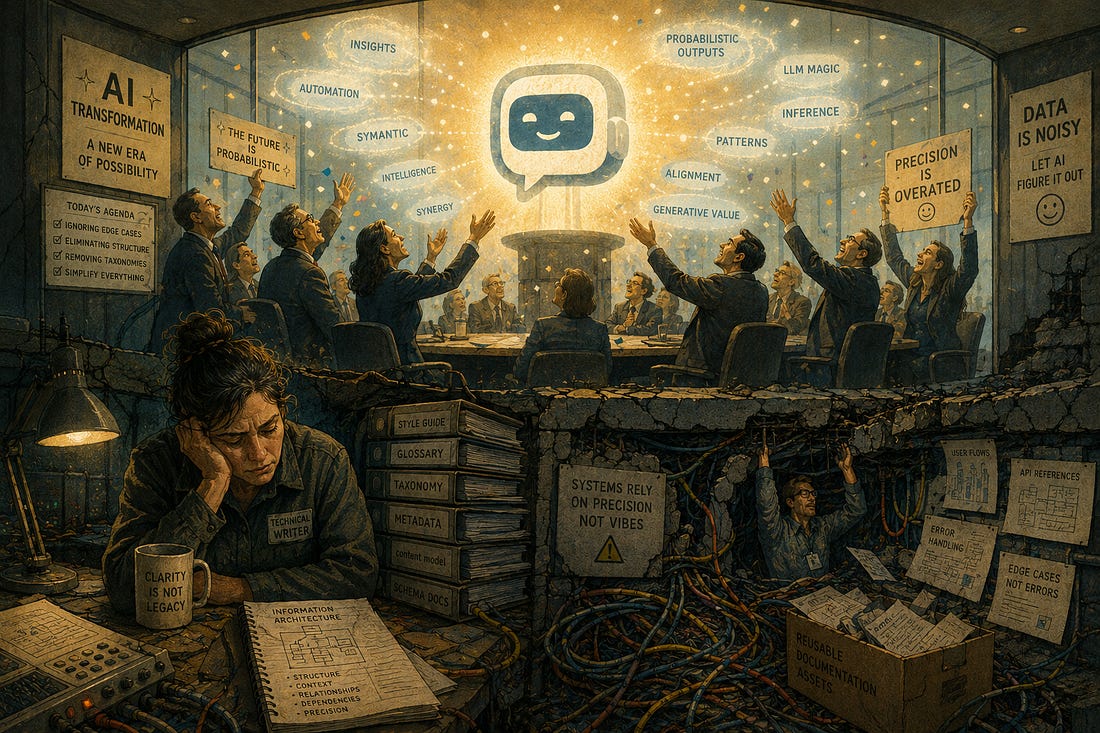 |
And there it is. The magical thinking phase of enterprise AI adoption.
Not the technical phase
Not the governance phase
Not the budgeting phase
The magical thinking phase. 🧞♂️
This is often where leaders attempt convince themselves that probability engines are somehow replacing the need for precision.
Meanwhile, tech writers are sitting in the corner like exhausted air traffic controllers wondering why everyone suddenly wants to remove the runway lights because airplanes have GPS now.
AI Does Not “Understand” Our Documentation
This is the first thing tech writers must recognize when these conversations arise.
AI systems like large language models do not understand documentation the way humans do. They don’t comprehend intention, accountability, risk, authority, or operational nuance. They predict likely relationships between patterns of words.
That distinction matters more than people realize.
When humans encounter vague instructions, they often compensate using experience, judgment, and contextual clues. We’re surprisingly good at this. We’ve had practice. Humanity has spent thousands of years decoding ambiguous instructions from bosses, governments, user manuals, and passive-aggressive family members.
AI systems compensate differently. They generate statistically plausible interpretations.
Sometimes those interpretations are correct, while other times they’re spectacularly wrong. And the more ambiguous the source material becomes, the more interpretive work the AI has to perform.
That’s not intelligence. That’s interpolation.
Ambiguity Becomes Operational Debt
For years, poorly structured documentation mostly punished humans. Our readers became frustrated. Support calls increased. New employees took longer to onboard. Procedures got skipped. Nobody enjoyed any of this, but the damage was somewhat contained.
AI changes the scale of the problem.
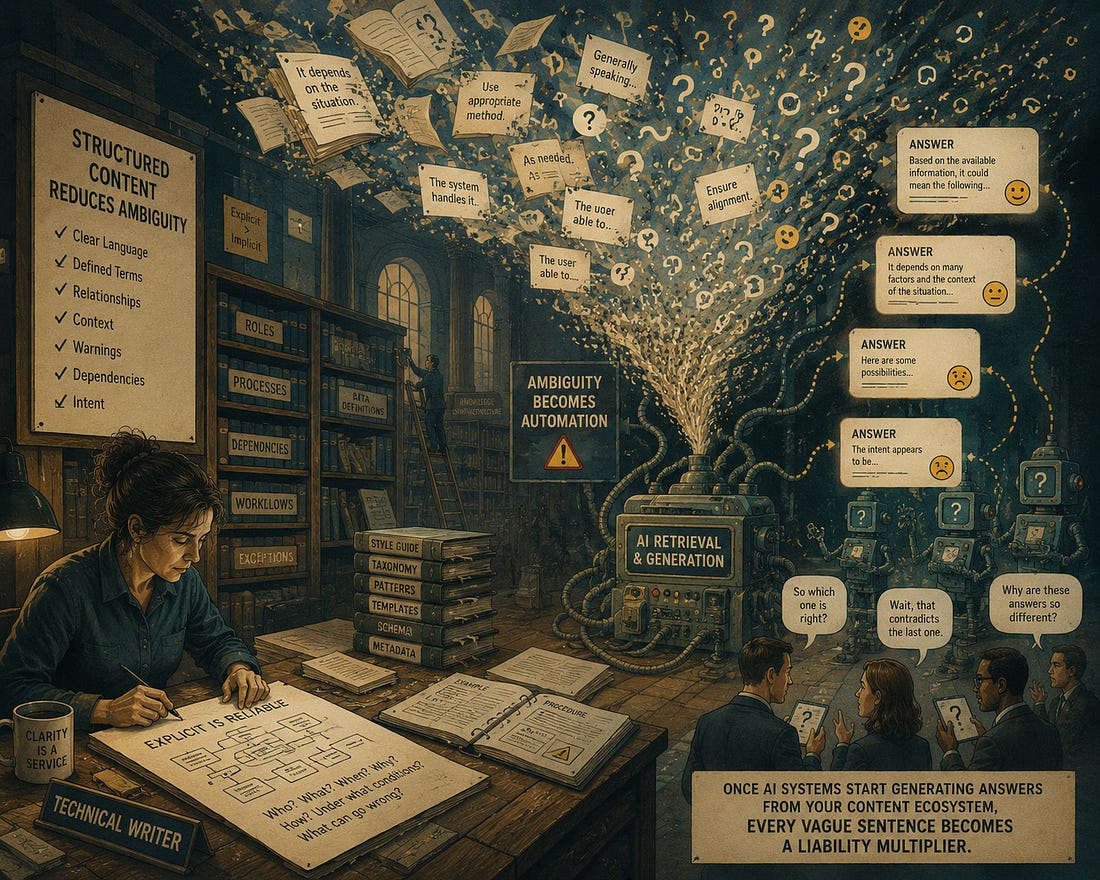
Now ambiguous content isn’t merely read by humans. It’s ingested, chunked, embedded, retrieved, summarized, synthesized, recombined, and operationalized by machines.
Which means every undocumented assumption suddenly matters.
If a procedure never explicitly states who performs an action, the AI has to guess
If preconditions are implied instead of stated, the AI has to infer applicability
If process explanations are mixed inside step-by-step instructions, the AI has to determine which text represents action versus explanation.
If six departments all created slightly different versions of the same procedure over eight years because governance was treated like optional cardio, the AI now retrieves conflicting truths simultaneously and attempts to merge them into one coherent answer.
What emerges is often less “artificial intelligence” and more “organizational fan fiction.”
 |
“But The AI Can Infer Meaning” Is Missing The Point
Of course AI can infer meaning. Humans can infer meaning too. That’s not the benchmark.
The real question is this: