Lumina Foundation is working to increase the share of adults in the U.S. labor force with college degrees or other credentials of value leading to economic prosperity.
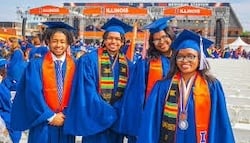
Journey Short graduated from a South Side Chicago high school in 2022 with a 2.34 GPA. At the time, college felt more like a distant hope than a realistic option—especially since it would place a financial burden on her single mother. Then Short discovered Hope Chicago, the nation’s largest two-generation scholarship program.
Short is one of about 400 Hope Scholars and Parent Scholars across Illinois who will complete college degrees or workforce credential programs by the end of the summer, all graduating completely debt-free. Launched in 2022, Hope Chicago gave Short and her mother the chance to attend college, easing financial pressure on the family as they sought to pursue their degrees at the same time.
In his first interview since being named the sole finalist for the University of Florida’s presidency, Stuart Bell recently defended his past diversity initiatives at the University of Alabama as an effort to boost in-state enrollment and described colleges’ explicit goals of recruiting more minority students as a form of “segregation.”
Conservative activists, prominent Republican lawmakers, and Education Secretary Linda McMahon have called for Bell’s candidacy to be rejected because of his diversity efforts as president of the University of Alabama, which they say led to pervasive discrimination against white students and faculty.
Former foster youth—a term that includes anyone who has spent time in the child welfare system, typically due to abuse or neglect—have some of the worst college graduation rates of any demographic group. An estimated eight to 11 percent of former foster youth go on to earn any college degree, compared to 49 percent of adults overall, according to one analysis. They also typically have lower rates of employment and lower earnings than their peers with similar levels of education.
Programs like Sacramento State's Guardian Scholars are working to rewrite those odds.
Leaders of the California State University system want it to become the nation's first artificial intelligence-powered institution of its kind. It entered into a $17 million no-bid contract with OpenAI last year to provide students, faculty and staff with a new resource: ChatGPT Edu—a version of the popular generative AI chatbot intended for use by educational institutions. The system recently renewed that contract for another $13 million a year for the next three years.
For many, however, the decision is unpopular, and the project represents what happens when an administration commits to a technology that its campus community isn't convinced will improve education.
Earlier this month, the U.S. Department of Education and U.S. Department of Labor announced the “historic expansion” of combined state Workforce Innovation and Opportunity Act and Carl D. Perkins Career and Technical Education Act of 2006 plans. Per the Administration’s announcement, 21 states have submitted state WIOA plans combined with Perkins. This is a big increase from 2024, when just eight did so. This jump, according to the ED and the DOL, means that more states will benefit from joint planning, which, in their words, “creates greater efficiency and helps align education and workforce priorities.”
At a time when many graduates are worried that artificial intelligence could short-circuit their careers, Advanced Micro Devices CEO Lisa Su offers a bigger-picture perspective about the role and responsibilities humans will still play despite technological advancements.
As an MIT graduate who earned her bachelor's, master's, and doctorate degrees from the university, Su emphasized in a recent MIT commencement speech that the world does not need more people who simply know how to use AI. Rather, it needs people who know what to use it for in order to solve some of the world’s greatest challenges.




.jpg?width=500&upscale=true&name=istockphoto-2244095178-612x612%20(1).jpg)