|
JUNE 2, 2026 |
|
What percentage of middle-market firms say fraud is typically detected after a payment is already settled or treated as “done”? |
|
A) 17% B) 37% C) 57% D) 77% |
|
|
Was this email forwarded to you? Sign up
here. | | | |
|
AGENTIC AI |
|
|
|
Fintech Meow launched a banking integration specifically for AI agents, per The Street. The platform lets autonomous agents perform tasks that traditionally require human involvement: forming a company, obtaining an employer identification number, opening a business bank account, completing know your customer (KYC) checks, issuing payment cards, sending payments and wires, paying contractors, and generating invoices. |
|
Meow is currently geared toward businesses—not retail customers—and integrates with AI assistants such as ChatGPT and Claude through a conversational interface. |
|
|
|
| | | |
|
FINTECH |
|
|
|
While their revenues still trail banks’ by far, the strongest fintechs are growing fast, becoming profitable, and moving into banks’ most lucrative pools—including payments, wealth management, capital markets, and lending. |
|
Among the combined revenues of the largest 1,000 banks and top 1,000 fintechs by valuation, fintechs’ share rose from 10% in 2021 to 17% in 2025—far outpacing banks’ growth. This is evidence of fintechs maturing from niche challengers into scaled financial institutions, per McKinsey. |
|
|
|
| | | |
|
FINANCIAL SERVICES |
|
|
|
A PYMNTS Intelligence report emphasized that subprime consumers (credit score between 300 and 619) are a large, stable, and underserved market representing 17% of US consumers, or about 44 million adults. And banks are losing share of this group, because these consumers are increasingly turning to alternative providers when traditional credit products fail to meet their cash-flow realities. |
|
PYMNTS data shows the subprime population has remained remarkably consistent for 47 consecutive months, making it an enduring customer base rather than a cyclical credit problem. Yet traditional issuers often view this group as an underwriting risk instead of a relationship opportunity. |
|
|
|
| | | |
|
REPORT |
|
|
|
Blockchain is moving from test phase to real-world finance, transforming how money moves and who controls it. Financial institutions (FIs) must keep pace as faster payments, modernized identity verification, and new investment access redraw the competitive map. |
|
Key question: What are the key blockchain innovations reshaping financial services? |
|
Key stat: A unified platform for supporting both traditional and tokenized money payments is important to 79% of US banks and credit unions, per a February 2026 Arizent Research and American Banker survey, underscoring the industrywide belief that tokenization is an inevitable shift. |
|
(EMARKETER subscription required to read the full report) |
|
|
|
| | | |
|
CHART OF THE WEEK |
|
|
|
|
|
|
|
|
|
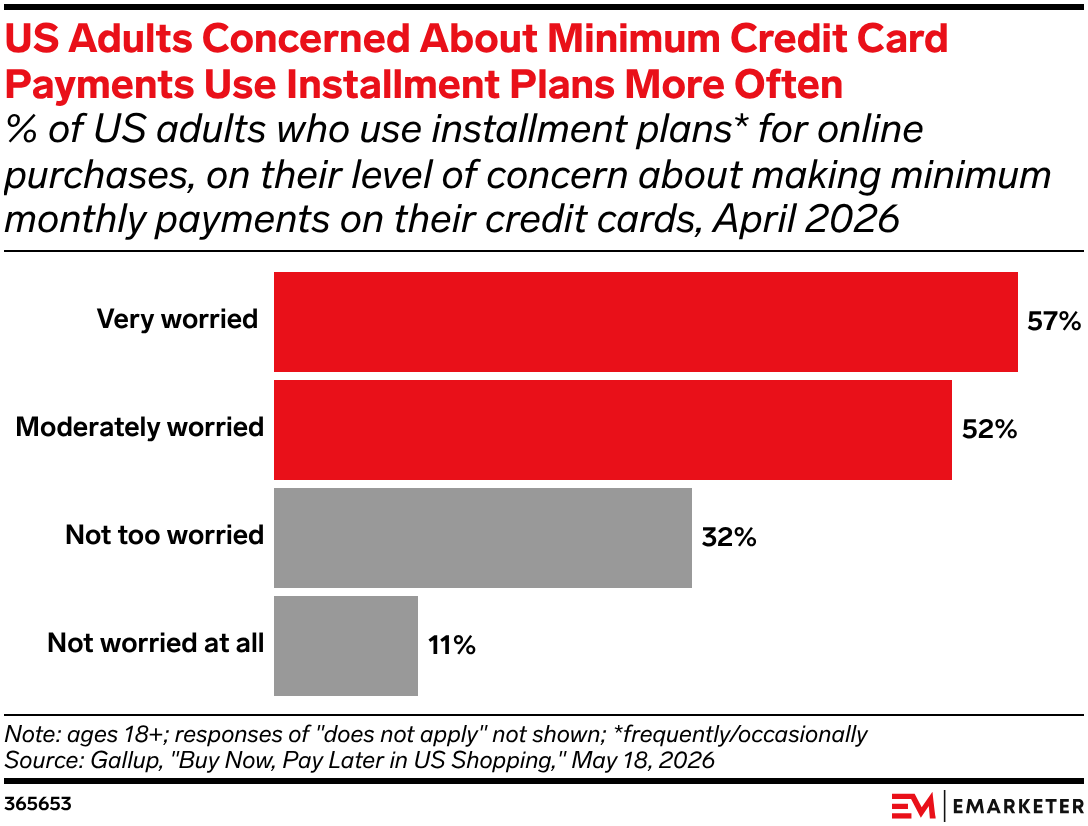
Key stat: Over half (57%) of US adults who use installment plans for online purchases are “very worried” about making minimum monthly payments on their credit cards, according to an April 2026 Gallup survey. | | | |
|