
|
 |
The Recipe Paradox: Why Food Is Still Missing from the Structured Content Conversation
Everyone in tech loves using recipes to explain structured content — except the people actually drowning in recipe content at scale
|

| |||||||||||||||


Guest post by: Sandie Markle
In nearly every industry that builds digital content systems, you can count on one thing: at some point, someone will bring up recipes.
Healthcare teams use recipes as an example to model modular patient education content. SaaS companies reference recipes when explaining documentation reuse. Government websites apply recipe frameworks to citizen-facing information. Even chatbot schema documents use recipes to explain how structured content works. Apparently, everyone loves using recipes as structured content examples, except the industries actually managing recipe ecosystems at scale.
The irony is, the one industry that relies on recipes the most, food and cooking media, is largely absent from structured content conversations.
While food creators and recipe platforms are producing some of the highest-volume, metadata-rich content on the web, they often lack the underlying structure that makes content scalable, adaptable, and intelligent. And it’s costing them discoverability, automation, and revenue in a ramped-up AI-mediated search ecosystem.
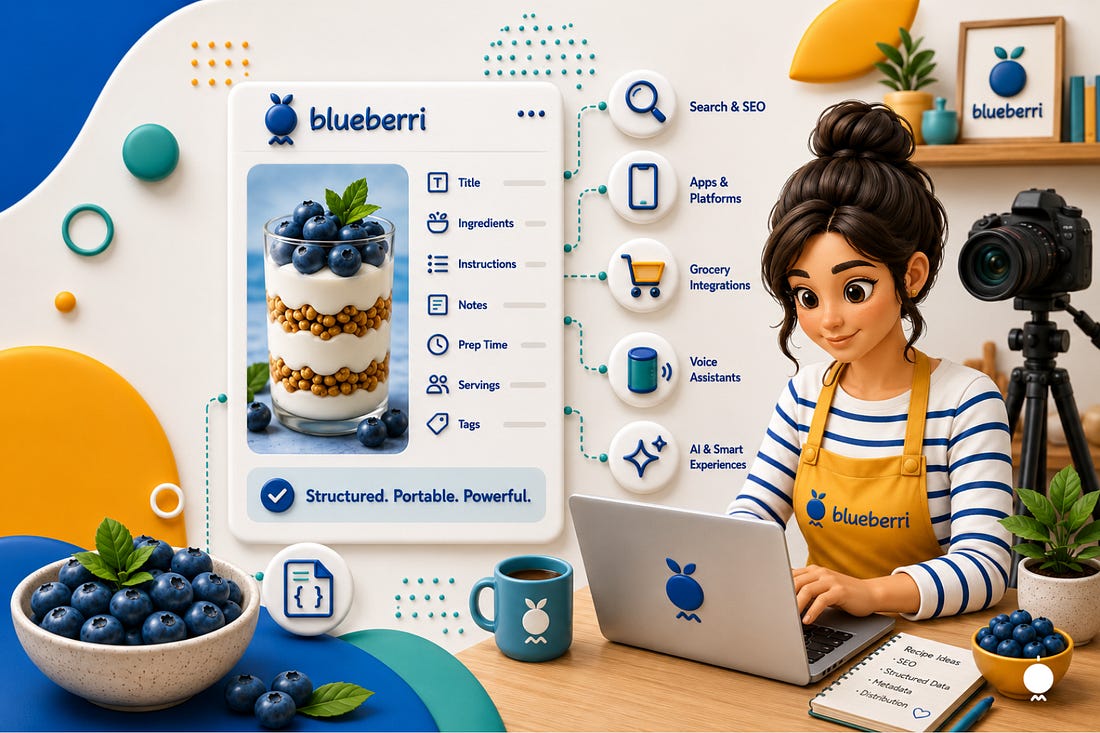
As the founder of Blueberri, I work with recipe publishers, food bloggers, and food tech companies. My background is in content strategy and content engineering, and I was surprised to learn just how disconnected food media is from the broader industry conversations happening around content engineering, taxonomy, and reuse.
 |
The Scale (And Strain) Of Recipe Content
Most recipe creators today are managing dozens (sometimes hundreds) of recipes across websites, social media, apps, partnerships, and AI tools. Every new format, a TikTok video, a smart display, and a grocery integration requires additional work. A recipe written once somehow ends up needing six additional versions, three exports, two rewrites, and a social caption written five minutes before publishing. And for many, it means retyping, copy-pasting, or uploading their content all over again.
That’s because most recipes are written for human readers, but not machines. They lack consistent fields, metadata, and hierarchy. Even when recipe plugins or CMS templates are used, the content itself is often semi-structured at best.
The result? Content that performs well visually but struggles operationally once it needs to move across systems. This is one reason structured recipe content matters far beyond SEO. That’s a missed opportunity for:
(Even more) Search engine visibility
Platform distribution (Pinterest, Instacart, TikTok, etc.)
Smart assistant compatibility
Licensing and monetization
In fact, the biggest content problems food teams face are the exact problems structured content was designed to solve.
And yet, I’ve found many food platforms are still missing the chance to invest in the kinds of systems that other industries take for granted. Structured content isn’t just a way to clean up content or just an organizational advantage. It’s the infrastructure behind scalable digital publishing. It’s the infrastructure that enables growth, reuse, and automation. Without it, food creators and platforms are left constantly reinventing the wheel, even as their content becomes more in-demand across platforms.
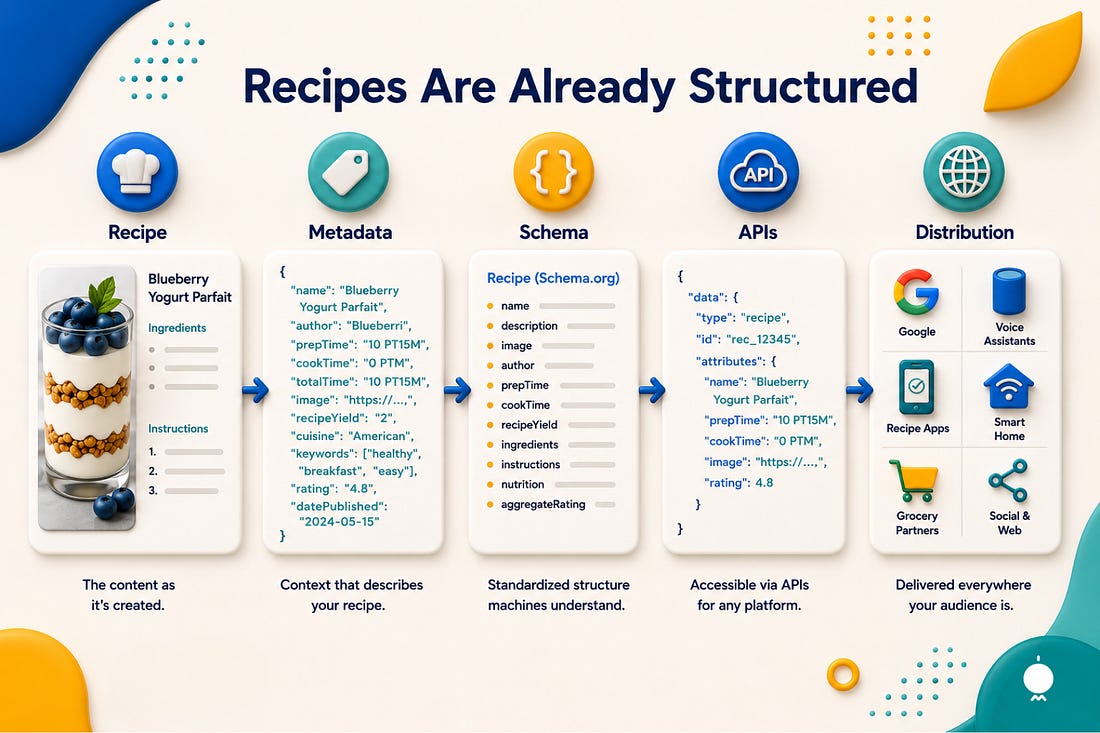
Most Recipes Are Already Structured (Just Not On Purpose)
The irony is, recipes are inherently structured. Food creators have been modeling structured content for years. Most just didn’t realize they were doing information architecture while testing banana bread.
They follow a predictable format: title, ingredients, instructions, notes. They map beautifully to content fields. They’re ideal for modeling relationships (e.g., base recipe → video → variation) and applying taxonomy (e.g., cuisine, dietary tags, meal type).
The problem is that the structure is often informal, inconsistent, or invisible to the systems trying to interpret it. It’s buried in visual design or disconnected metadata.
If food content were treated with the same level of system thinking as technical documentation, content operations, or knowledge bases, we’d see a massive shift in how recipes move through digital ecosystems. And we’d open the door to smarter, more adaptive food platforms.
 |