| | Zelenskyy proposes face-to-face talks with Putin, Anthropic calls for a slowdown in AI development, ͏ ͏ ͏ ͏ ͏ ͏ |
| |  | Flagship |  |
| |
|
The World Today |  - Zelenskyy’s Putin letter
- Xi to visit North Korea
- Learning lessons in war
- Anthropic wants AI pause
- NSA’s Claude hacking
- Australia’s emissions down
- Dems target Trump deals
- US sanctions Cuban leader
- Kenya’s Ebola quarantines
- China uni applications down
 A classic novel by ‘the funniest English writer since PG Wodehouse.’ |
|
Zelenskyy proposes Putin talks |
 Thomas Peter/Reuters Thomas Peter/Reuters
Ukrainian President Volodymyr Zelenskyy proposed face-to-face talks with Russian leader Vladimir Putin in a combative letter that comes as Kyiv strikes ever deeper into enemy territory and Moscow’s offensive stalls. Zelenskyy said the starting point for any negotiations would be “the front line today,” rejecting a prior proposal that would have forced Ukraine to give up swaths of territory. European leaders are reportedly pursuing direct talks of their own with Moscow, though Putin rebuffed them. The diplomatic blitz comes as the Kremlin’s battlefield losses mount — thousands of Russians are dying every month — and the country’s elite appear to increasingly be turning against the war. |
|
 KCNA via Reuters. KCNA via Reuters.
Chinese leader Xi Jinping will visit North Korea next week, aiming to court the pariah state’s dictator Kim Jong-un, who has been strengthening ties with Moscow while tightening his own grip on power. In the seven years since Xi’s last trip, Pyongyang has sent troops and weapons to Russia for the Ukraine war, sought to further expand its nuclear weapons program, and officially abandoned the prospect of reunification with the south; at home, meanwhile, Kim has consolidated power further and elevated his daughter as his potential successor. Still, Pyongyang needs Beijing as its protector on the world stage, a Chinese scholar wrote in Foreign Policy, while China sees North Korea as a “bargaining chip” in a region replete with rivals. |
|
Lessons from Ukraine for Iran |
 A pro-regime rally in Tehran. Majid Asgaripour/WANA via Reuters. A pro-regime rally in Tehran. Majid Asgaripour/WANA via Reuters.Hezbollah’s and Iran’s staying power in conflicts with more powerful conventional forces points to the failure of major militaries to learn key lessons from the Ukraine war, a top defense analyst warned. The Lebanese militant group rejected a ceasefire between Israel and Lebanon — Israel has kept up much of its military campaign anyway — while Tehran has raised doubts over a potential peace deal with Washington. Their persistence despite being heavily outgunned cements a truth that emerged from the Ukraine war, the former Australian general Mick Ryan argued: “Even supposedly much weaker [belligerents] have agency.” Knowing what lessons to apply from one war to another is difficult, Ryan acknowledged, but leaders must change their culture. |
|
Anthropic calls for AI slowdown |
 Anthropic CEO Dario Amodei. Denis Balibouse/Reuters. Anthropic CEO Dario Amodei. Denis Balibouse/Reuters.
Anthropic called for a slowdown in global AI development, saying that its models were increasingly capable of autonomously designing and developing their own successors. Claude now writes 80% of Anthropic’s code, the firm said, and proposes research directions and solves open-ended problems. AI safety thinkers have long warned of “recursive self-improvement” leading to an exponential increase in AI capabilities, and Anthropic said that such an explosion could be close. Ensuring powerful AI systems are safe could take time, the company’s cofounder wrote, and “it would be good for the world to have the option to slow or temporarily pause frontier AI development” to give that time. |
|
Mythos being used in cyberhacking |
 Larry Downing/File Photo/Reuters Larry Downing/File Photo/Reuters
The US National Security Agency is reportedly using Anthropic’s cutting-edge Mythos AI model for hacking. Mythos has not been publicly released because of its powerful abilities to detect and exploit software vulnerabilities, and instead is being offered to select institutions to help them build defenses. The NSA is apparently using it for offensive purposes even as the US government fights a legal battle against Anthropic. AI agents are increasingly ubiquitous on the web — Cloudflare said that most traffic is now AI-led, a year ahead of earlier projections, with a decent minority of them malicious bots; Iran is a hotspot for such activity. And while such bots lack Mythos’ cutting-edge capabilities, top open-source models are less than a year behind the frontier systems. |
|
Australia emissions decline, again |
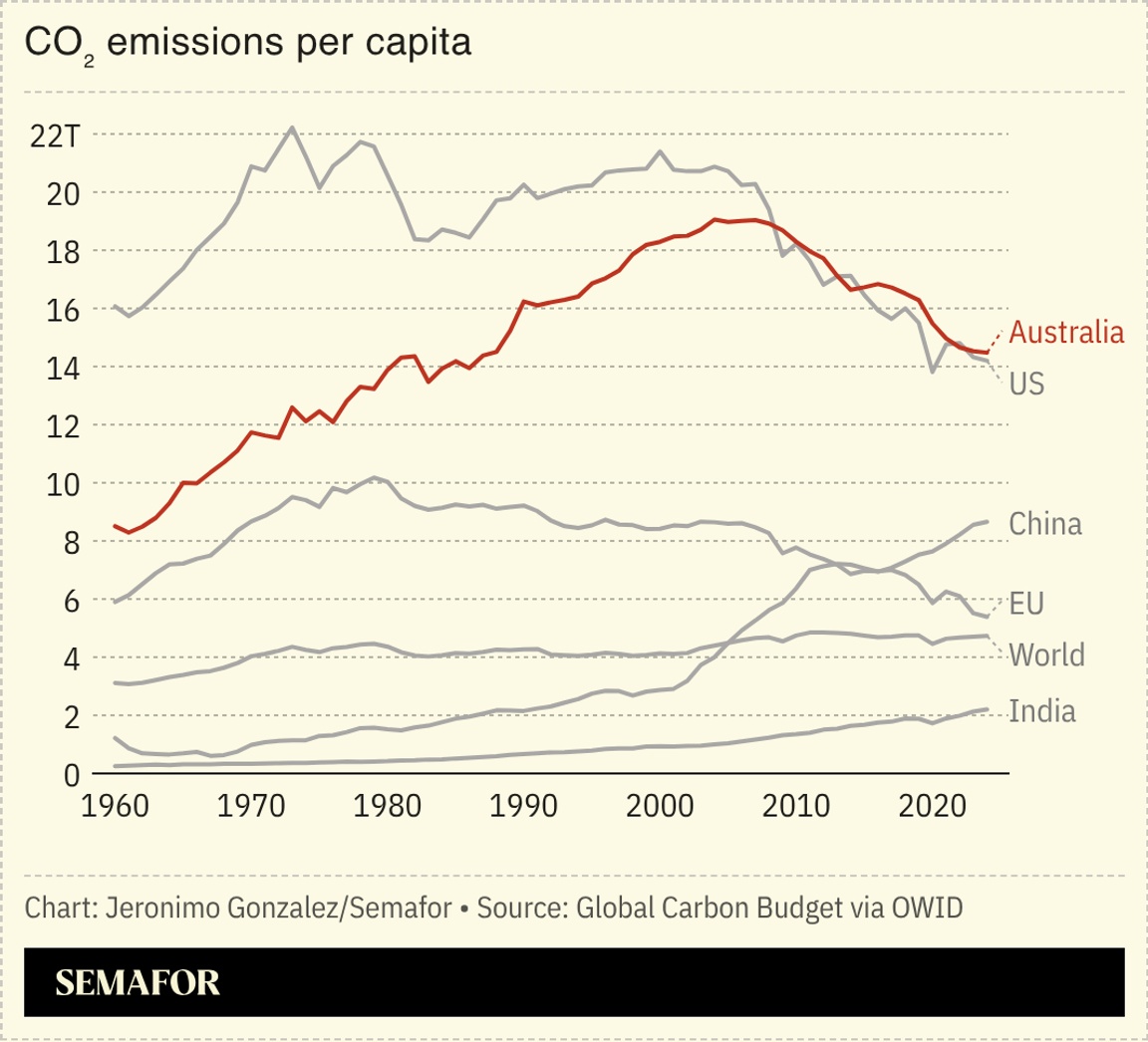 Australia’s greenhouse gas emissions dropped for the second year in a row, underscoring the resilience of the renewable revolution worldwide despite waning political support. Government figures showed that emissions in every sector barring industrial processes fell, even before a huge surge in EV sales since the start of this year. Similar stories can be seen elsewhere: Despite removing subsidies and trying to block renewables projects, “[US President Donald] Trump will likely preside over the biggest clean-energy buildout in US history,” Semafor’s energy editor wrote, because AI data centers are driving a surge in demand. A power company boss said it is “one of the best periods to invest in renewables in the US” in recent decades. |
|
Democrats ready Trump probes |
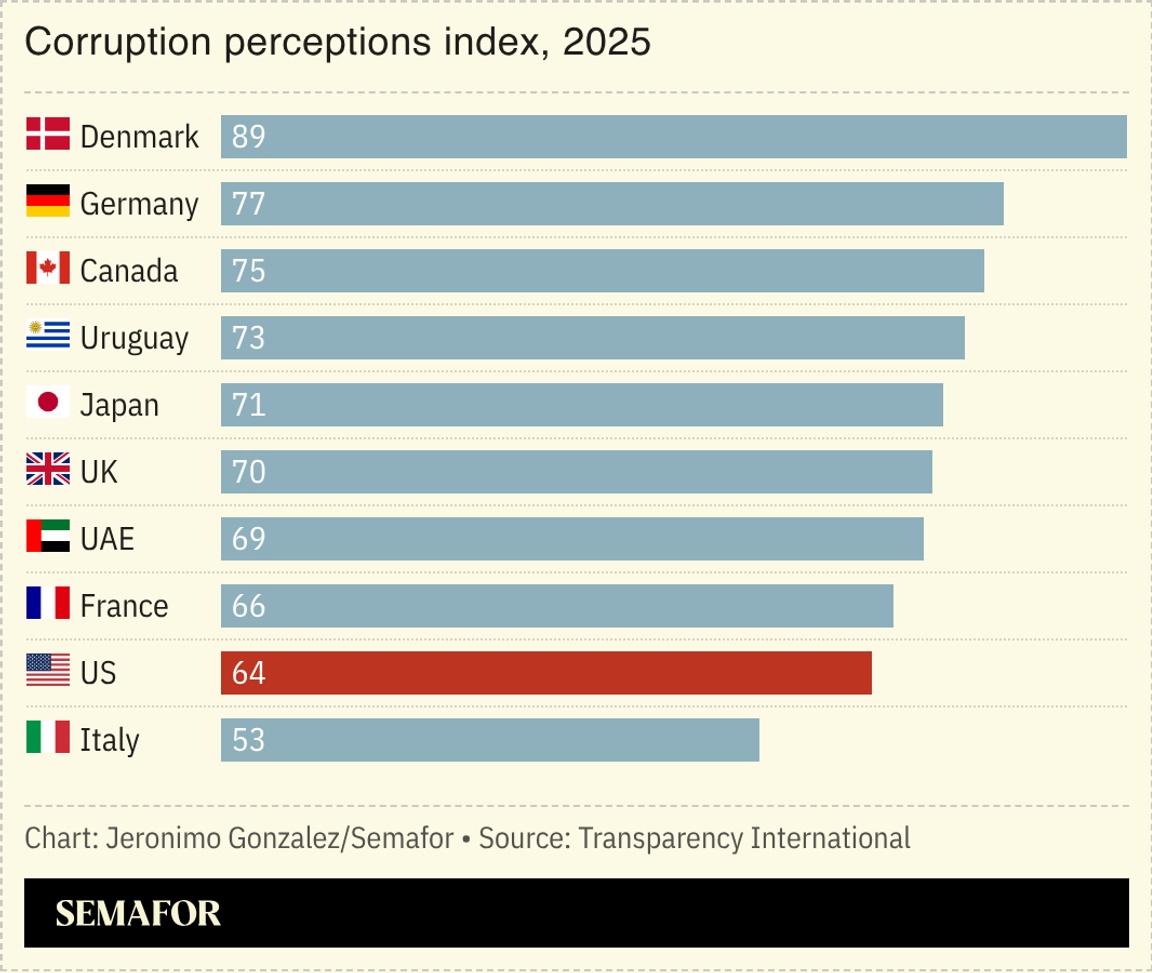 US Democrats plan to start investigating businesses which have profited from deals with President Donald Trump, in an effort to scrutinize the administration via the back door. The party is expected to win a House of Representatives majority in November’s midterms, and will use that power to inspect dealmaking by the Trump family and allies, Semafor’s Nicholas Wu reported. The president’s unpopularity is eroding his power: 68% of Americans polled want the Iran war over “as quickly as possible,” and Republican lawmakers have rebelled over Trump’s plan for a White House ballroom and joined a symbolic call to end the war. Trump’s “aura of invincibility” may be fading, the Financial Times’ Washington bureau chief wrote. |
|
 Lucia Bell-Epstein for The New York Times/Reuters Lucia Bell-Epstein for The New York Times/ReutersThey have landed interviews with Taylor Swift, A$AP Rocky, Olivia Rodrigo, and Bad Bunny by offering what most celebrity media won’t: no question approval, no topic restrictions, and years of credibility. On this week’s episode of Mixed Signals, the hosts of The New York Times’ Popcast show join Max and Ben to talk about the evolution of their two-decade-old podcast, killing the written review, and whether literacy is over. Listen to the latest Mixed Signals now. |
|
US sanctions against Cuba leaders |
 Miguel Díaz-Canel. Norlys Perez/Reuters. Miguel Díaz-Canel. Norlys Perez/Reuters.
The US imposed sanctions on Cuban President Miguel Díaz-Canel and other senior officials, marking a significant escalation in its campaign against Havana. US President Donald Trump has vowed to oust Cuba’s communist rulers, so far using economic coercion, including an oil embargo to paralyze the island’s economy. Separate sanctions have forced Visa and Mastercard to halt operations in the country, while Spanish hotel chain Meliá, one of the biggest operators there, said it would close 15 hotels, further kneecapping Cuba’s tourism sector. Washington has also upped the threat of a military intervention: US Secretary of State Marco Rubio, the son of Cuban immigrants, recently said the odds of peaceful agreement were “not high.” |
|
Ruto backs US Ebola quarantine facility |
 Gradel Muyisa Mumbere/File Photo/Reuters Gradel Muyisa Mumbere/File Photo/ReutersKenyan President William Ruto said that US plans to build a facility in his country to quarantine Americans exposed to Ebola was the “right thing” to do, risking further protests and setting up a legal clash. Washington has continued building the facility despite a Kenyan court order blocking it |
|
|


