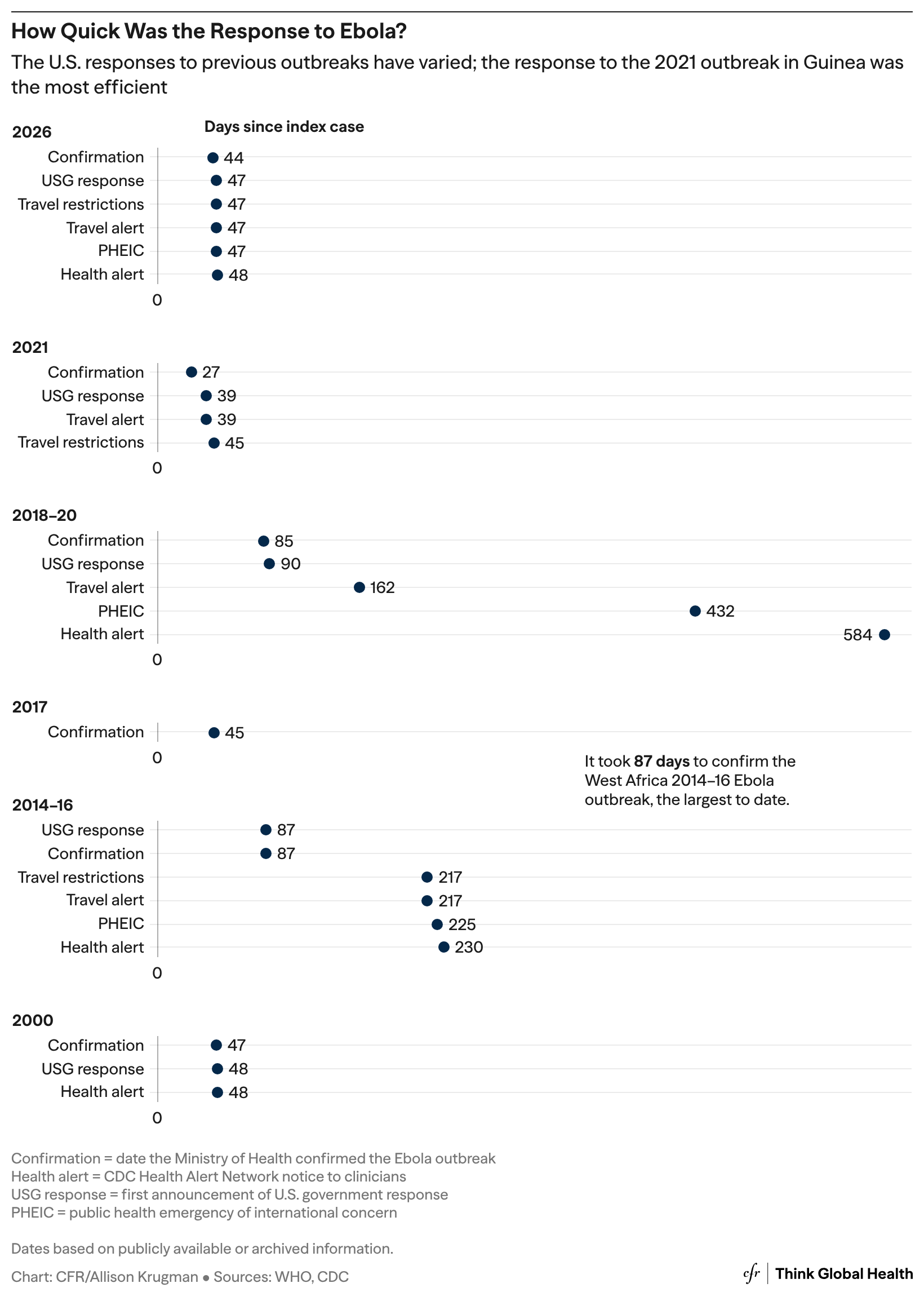
On May 25, as the World Health Assembly wrapped up, World Health Organization (WHO) Director General Tedros Adhanom Ghebreyesus warned that the latest Ebola epidemic is outpacing current response efforts. The outbreak’s size has prompted speculation as to how long the Bundibugyo virus—the Ebola species causing the incident—had been spreading. Although some critics have blamed U.S. cuts to foreign assistance for limiting surveillance capacity, others have faulted the WHO for being too slow to share the notification.
To lead this week’s edition, CFR Senior Fellow for Global Health Stephanie Psaki, Global Health Program Coordinator Anya Hirschfeld, and TGH Data Visuals Editor Allison Krugman examine the current outbreak’s timeline and compare how responses were handled during five other Ebola incidents that occurred between 2000 and 2021.
Closing the U.S. Agency for International Development (USAID) led to the removal of a public online archive documenting the program’s achievements. Its absence has made it impossible to assess what is needed to maintain progress toward global health goals. To save that data, Ramona Godbole, USAID’s former acting director of global health policy, planning, and programs—alongside former data analysts Kate Daley and Agnieszka Lubon—offer a new interactive tool that recovers USAID global health data from the Wayback Machine, an internet archiving site.
To wrap up, journalist Sam Nichols explains how the U.S. National Drug Control Strategy’s waning support for harm reduction strategies in favor of faith-based recovery is not informed by scientific evidence.
Until next week!—Nsikan Akpan, Managing Editor, and Caroline Kantis, Associate Editor