
|
Getting Lost in the Luminous Dark
Three books on Christian mysticism, Old Testament history, and a persistent heresy.
| |||||||||||||||


 |
This edition is sponsored by The Geneva College Center for Faith & Life
When I studied theology at Duke, I marveled at how many questions and controversies the church grapples with today are the same issues the historic church dealt with. The way the past still speaks to us now is clear in this set of reviews by pastor theologian Andrew Wilson. In his latest book, James K. A. Smith turns to Teresa of Avila and John of the Cross for wisdom to meet the current cultural moment. Ian Vaillancourt illuminates new aspects of the Old Testament history books to make these often-dense works accessible for modern readers. And Wilson even revisits Tertullian’s historic rebuttal to Marcion—and finds his ideas still resonate today.
Happy Reading,
Taylor Berglund
Senior Features Editor, Christianity Today
A portion of this newsletter appeared as a column at Christianity Today. Join CT for full access to all our journalism.
This email may contain affiliate links that help support CT at no additional cost to you.

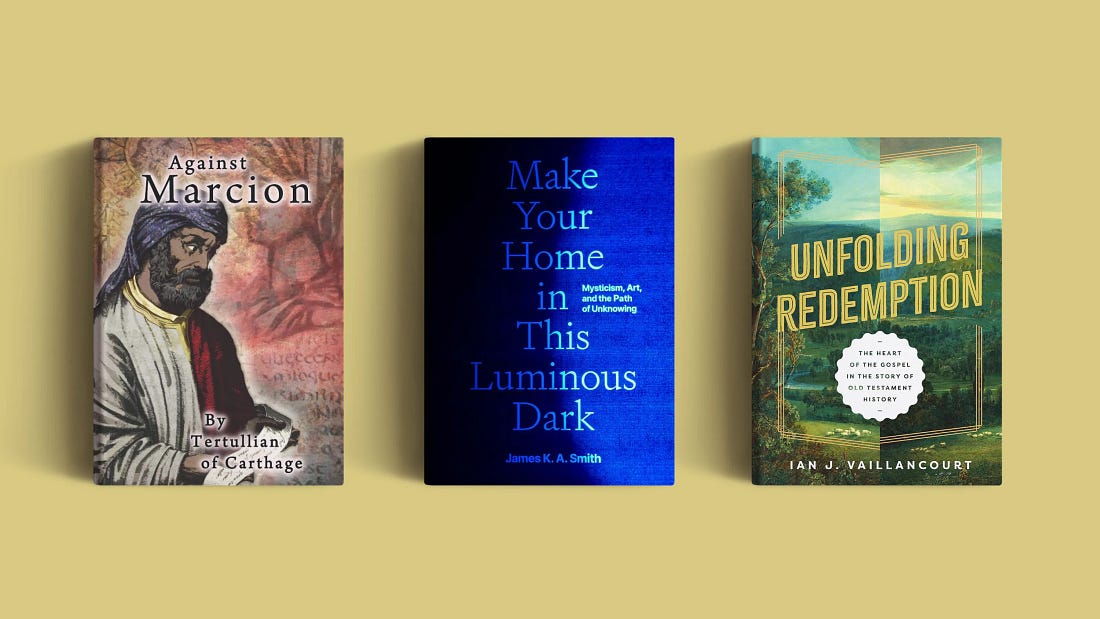 |
Three Books on Theology
James K. A. Smith, Make Your Home in This Luminous Dark: Mysticism, Art and the Path of Unknowing (Yale University Press, 2026)
I will always be grateful for Jamie Smith. His trilogy of books on cultural liturgies, particularly Desiring the Kingdom, made a huge difference to the way I think about worship, discipleship, and culture. I read and enjoyed his Letters to a Young Calvinist when I was still a young Calvinist. I read Who’s Afraid of Postmodernism? and Who’s Afraid of Relativism? when I was still somewhat afraid of both, and they helped me enormously. I went through On the Road with Saint Augustine in my devotional times and still have You Are What You Love in my bedroom. Admittedly, I found How to Inhabit Time more puzzling—it felt as if I was no longer Smith’s intended audience—but I read it anyway, like a Beatles fan persevering through Let It Be.
With all that said, Make Your Home in This Luminous Dark was a struggle. The aim of the book is a good one: an invitation to mysticism, which Smith summarizes as “how to be when you don’t know.” Its flow—from anachoresis (solitude) to hesychia (silence), then docta ignorantia (unknowing), and finally mysterion (wonder)—is illuminating. But reading each chapter is like hacking through dense jungle. We move from the medieval mystics to lengthy descriptions of modern art via Marcel Proust and James Joyce, and from the philosophy of Edmund Husserl, Emmanuel Levinas, and Jean-Luc Marion to elaborate accounts of contemporary movies where very little happens—all the while encountering plenty of sentences like “I began to understand how I could live as both question and answer” and “Do I even know anything anymore?” Maybe this is what we should expect from a book with the word unknowing in the subtitle. Maybe it is “evidence of my own thickheadedness or lack of empathy,” as Smith says of his own experience reading a short story in The New Yorker. But at times it verges on the impenetrable.
Mysticism has clearly helped Smith “imagine a future for my faith after a season of anger and embarrassment at the dogmatism of both my youth and my co-religionists.” Mysticism may or may not be for everyone. But this particular call to it was not for me.