| | In today’s edition: There’s still life in Abu Dhabi’s startup scene, Saudi Arabia aims to boost logi͏ ͏ ͏ ͏ ͏ ͏ |
| |  | Gulf |  |
| |
|
 - Fighting ratchets up again
- Gulf earnings peak in Q1
- Saudi revives Hejaz railway
- Omani industrial investments
- Oil and LNG trickle out
 A new way to avoid Riyadh traffic jams. |
|
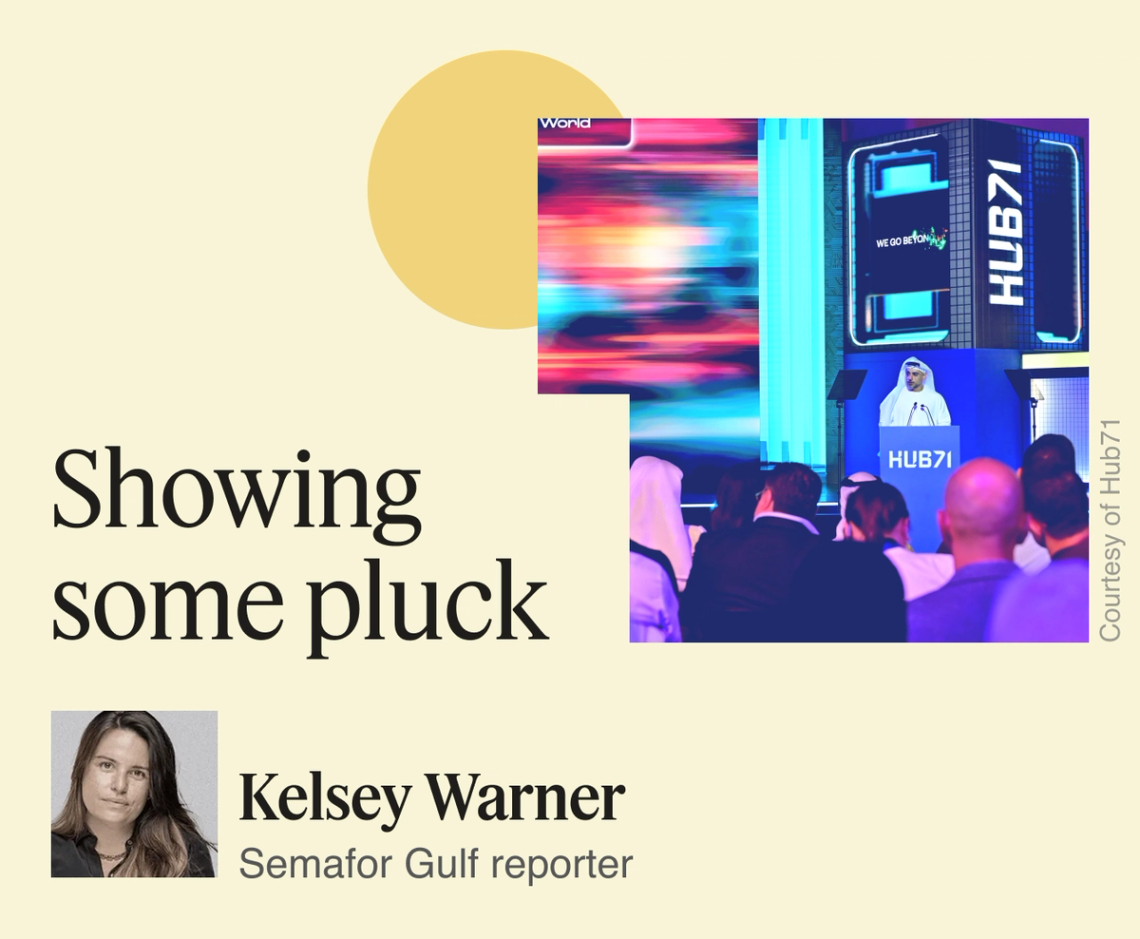 Organizers feared a subdued annual gathering for Abu Dhabi’s seven-year-old entrepreneurial center Hub71; the vibe at the event this week was anything but. There were hundreds of attendees — entrepreneurs, investors, academics, and corporates — noshing on handouts of poke bowls and mango popsicles, with one founder wearing a T-shirt indicating he was fundraising and also “accepting free shawarma.” Hub71, backed by sovereign wealth fund Mubadala Investment Company, recruited 27 startups to its most recent year-long program, offering cash and investor introductions to founders in exchange for the option of future equity. All of them are from outside the UAE, and not one has dropped out despite the economic fallout from the Iran war. While one entrepreneur lamented how quiet Abu Dhabi was during the early weeks of the conflict, things are starting to pick up. Another founder developing AI for the energy industry (who asked not to be identified) said he had been preparing to close a $5 million funding round from regional venture capital funds when the war broke out. “Investors basically ghosted,” he told me, but in the last couple of weeks those backers have begun answering the phone again. He now expects to close the round in September. Startups aiming to tackle some of the Gulf’s largest pain points and opportunities — financial inclusion, food security, and longer lifespans, to name a few — are a crucial part of the UAE’s diversification drive and its efforts to import less technology and build more at home. It’s a strategy that is drawing in international and regional investors: Hub71’s CEO Ahmad Ali Alwan told me Abu Dhabi has helped investors expand their horizons beyond San Francisco. Some 50 family offices from the Middle East have also partnered with Hub71, both for the potential investments and for innovations that might be useful to their portfolio. Gulf startups have expanded even as global venture funding has contracted. A full view of the war’s impact on investments and firms’ valuations has yet to emerge, but in Abu Dhabi, at least, the entrepreneurial scene is showing some pluck. |
|
Iran war expansion fears grow |
 Smoke rises following an Israeli strike in southern Lebanon. Stringer/Reuters. Smoke rises following an Israeli strike in southern Lebanon. Stringer/Reuters.Widening violence across the Middle East raised concerns that the Iran war was expanding. The Iranian military said it struck US bases in Bahrain, Jordan, and Kuwait, Israel bombed Tyre in southern Lebanon, and a cargo vessel off Yemen was attacked by a small boat, after Houthi rebels in the area threatened Red Sea shipping. The various strikes are complicating US President Donald Trump’s efforts to find a peace deal, since Iran has made an Israeli withdrawal from Lebanon a condition of any agreement, and Hezbollah has rejected Israel-Lebanon talks. The apparent Houthi attacks are also troubling because, with Strait of Hormuz traffic largely choked off, the Red Sea is another crucial chokepoint, responsible for 12% of global trade. Iran’s chief negotiator warned the US: “We prefer the language of diplomacy, but we speak other languages far more fluently. Break your commitments, and we’ll switch to what we speak best. You ride the horse you saddled!” |
|
Prewar, corporate profits were on a tear |
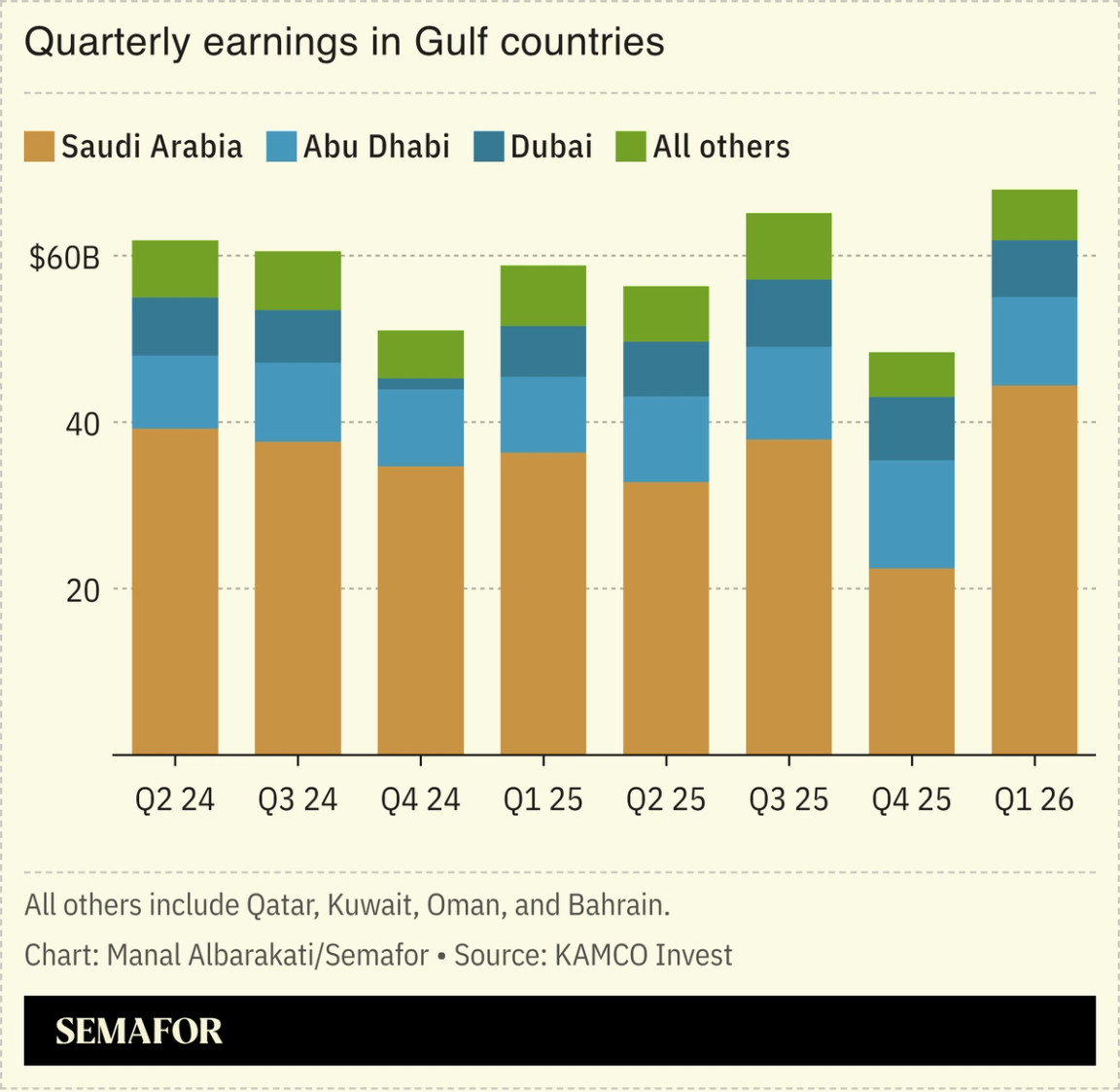 Early in 2026, it looked like Gulf businesses were in for a banner year. The region’s listed companies saw net profits rise 15.5% to a record $67.9 billion in the first quarter, according to a report by research firm KAMCO Invest. Saudi Aramco led the way by making $32 billion thanks to higher crude prices; the region’s banks added $16.9 billion on steady lending. Most of that quarter pre-dated the Iran war, which began on Feb. 28. Even so, its impact was quickly apparent in some areas. Profits at Abu Dhabi’s ADNOC Gas fell 15% as the war cut its sales volumes, and Industries Qatar saw a drop of nearly 26% as the conflict disrupted its petrochemicals operations and shipments. The real test will come in July, when results for the second quarter are released — a period in which the Strait of Hormuz was almost entirely closed. — Manal Albarakati |
|
Saudi, Türkiye to revive rail link |
 Al Qadam train station in Damascus. Omar Sanadiki/Reuters. Al Qadam train station in Damascus. Omar Sanadiki/Reuters.Saudi Arabia and Türkiye agreed to improve logistics links, including reviving and extending the long-dormant Hejaz Railway to connect the Gulf to Europe. The idea has been broached dozens of times over the past century, but has taken on new urgency after disruptions to Red Sea shipping and the Strait of Hormuz boosted interest in alternative routes for Gulf goods through Jordan, Iraq, Syria, and Türkiye. The long-term project will not provide near-term relief and requires extensive work in Syria, where much of the rail infrastructure was destroyed during the 2011-24 civil war. It also depends on the region remaining stable. The trade corridor was originally severed by bombings led by British Army officer T. E. Lawrence (Lawrence of Arabia) during the Arab Revolt against the Ottoman Empire during World War I. — Mohammed Sergie |
|
Oman pulls in more foreign investment |
 Special Economic Zone at Duqm Special Economic Zone at DuqmOman announced $9 billion worth of projects involving investors from Asia, Europe, and the Middle East — a sign of how the country is proving more able than some in the region to handle the disruption caused by the Iran war. They include a slate of 10 deals in the Duqm Special Economic Zone, with a total value of 2.9 billion riyals ($7.5 billion), including a green hydrogen project, and plants making chemicals, electric vehicle battery materials, and steel structures. The investors involved come from China, Germany, Egypt, India, and elsewhere, alongside the government and other local backers. Separately, Future Fund Oman — an arm of the Oman Investment Authority — announced 105 projects, including ones in the medical technologies, renewable energy, and tourism sectors. They are worth a combined 583 million riyals, with around a third coming from foreign investors. Muscat also continues to pursue financial services: Sultan Haitham this week appointed board members for the International Financial Centre of Oman, which is due to launch later this year. |
|
Some ships get through Hormuz |
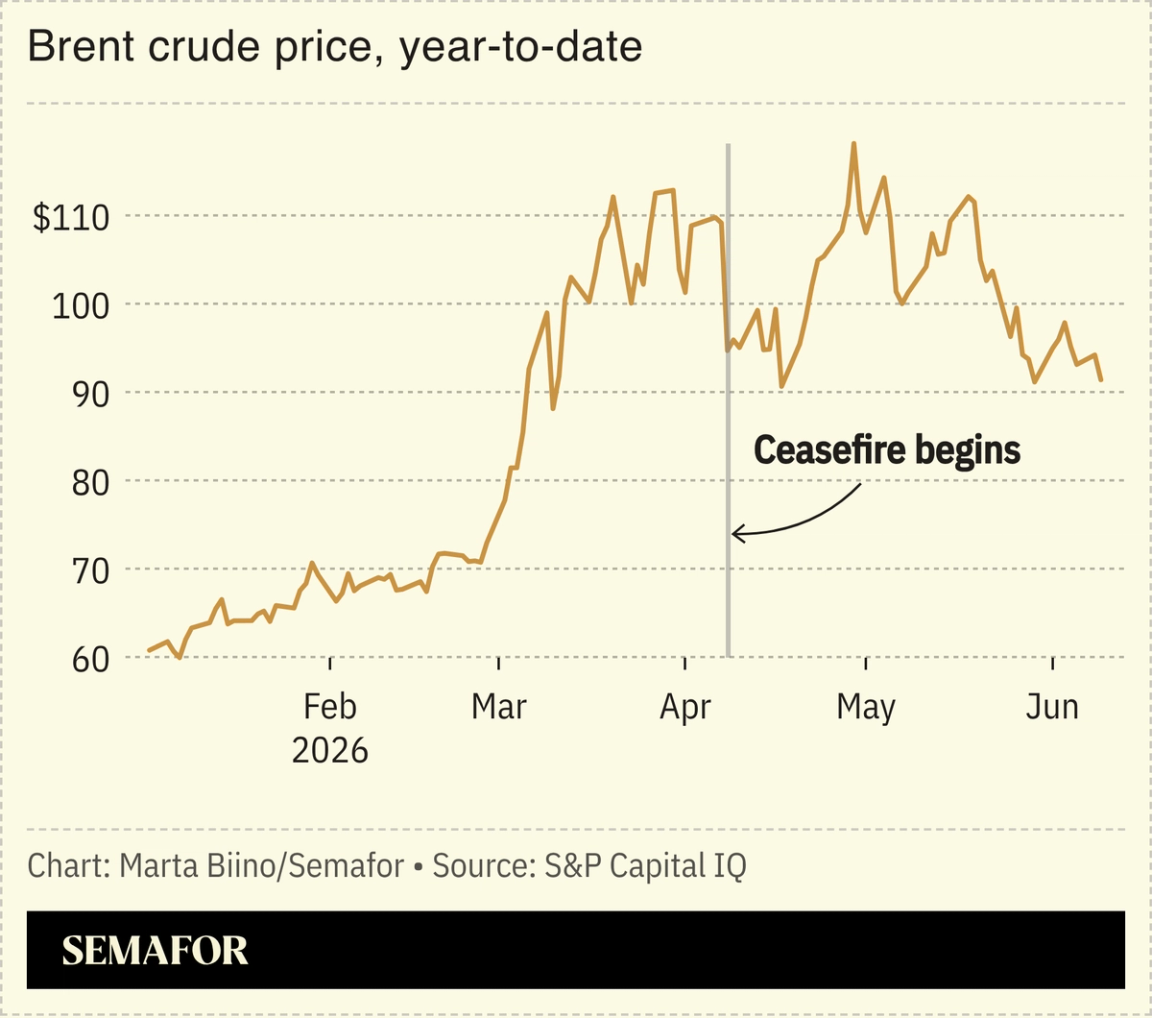 Oil prices rose on Wednesday after the US and Iran traded fire, having been trending down for weeks despite little sign of progress toward a full reopening of the Strait of Hormuz. Some oil and gas is filtering out of the Gulf though: ADNOC issued two tenders within the past week to sell crude through the strait, an indication that it is managing to get some tankers through, and a fifth Qatari LNG tanker successfully exited the Gulf as well. Iran’s own efforts to bypass the US blockade of its oil exports have been less successful; US forces disabled one unladen tanker attempting to reach an Iranian port on Monday, and Iran is reportedly deepening its discounts for Chinese refineries. In a forecast Tuesday, Barclays analysts said they expect Brent crude prices to stay around $100 per barrel for the remainder of the year, but fall to $88 on average next year. |
|
 Sovereign Wealth- Security is in Qatar Investment Authority’s sights. The fund backed ICEYE in a Series F round that raised €1 billion ($1.15 billion), valuing the Finnish satellite surveillance firm at €10 billion, with General Atlantic and Nokia among the other investors.
- Mubadala is considering a bid for Restaurant Brands Europe, the operator of Burger King, Popeyes, and Tim Hortons in Spain and Portugal. The Abu Dhabi sovereign fund is already into fast food with a stake in Brazil’s Zamp. — Enterprise AM
Weapons- The war has hardened the Gulf’s ambitions to wean itself from Western defense and produce more armaments domestically. The UAE is furthest ahead, with state-backed EDGE among the world’s top three makers of precision-guided munitions. — The Economist
Sports- Eight Arab countries, out of 48 teams, are competing for the 2026 men’s soccer World Cup. Most of them, other than Morocco, still have thousands of tickets available. An average of 3,900 tickets are still unbought for the three Saudi matches in the group phase. — Financial Times
- UAE hotels and bars are hoping the soccer World Cup will throw a lifeline to a hospitality sector reeling from the Iran war, with venues offering free overnight stays so fans can watch the tournament’s 2 am to 6 am kickoffs. But the absence of tourists, combined with the Gulf summer lull, and unsociable match times means a repeat of the Qatar 2022 frenzy is unlikely.
|
|
 Hamad I Mohammed/Reuters Hamad I Mohammed/ReutersSaudi authorities are looking for more innovative ways to address Riyadh’s often crippling traffic problems besides just building more roads (which they are also doing). One solution being tested this week is a practice that local bosses have opposed in the past: flexible working hours. Employees in some of the city’s main business hubs, including the King Abdullah Financial District and the Diplomatic Quarter, are being told they can come to work early to avoid the morning rush, and head home before the afternoon traffic builds up. Saudi firms have typically not offered their staff flexible hours or the option to work from home, other than during the COVID-19 pandemic or when offices were closed during the Iran war. But with many residents complaining that getting across the city is so time-consuming that they avoid going out in the evening, the government is finally trying to address the problem. |
|
|


