
|
 |
Oops, We Accidentally Undersold XML
The forgotten business value of XML, and why AI is making interoperability matter again
|

| |||||||||||||||


Looking back, I think we accidentally undersold Extensible Markup Language (XML). We spent years celebrating 🎉 its publishing capabilities while paying far less attention to the larger problem its creators were trying to solve: interoperability. The W3C XML Working Group wasn't simply building a better publishing format. They were building a framework for making information portable, reusable, and understandable across disparate systems.
For most of the last twenty-five years, XML was presented primarily as a publishing solution. We talked about single-source publishing, content reuse, multichannel delivery, conditional processing, and translation savings. Those benefits were real, and they helped many organizations justify investments in structured content, content management systems, and XML-based authoring environments.
Looking back, though, I think we focused on the most visible benefit rather than the most important one. XML certainly made publishing more efficient (which was needed then, and is definitely needed now), but publishing was never its greatest contribution.
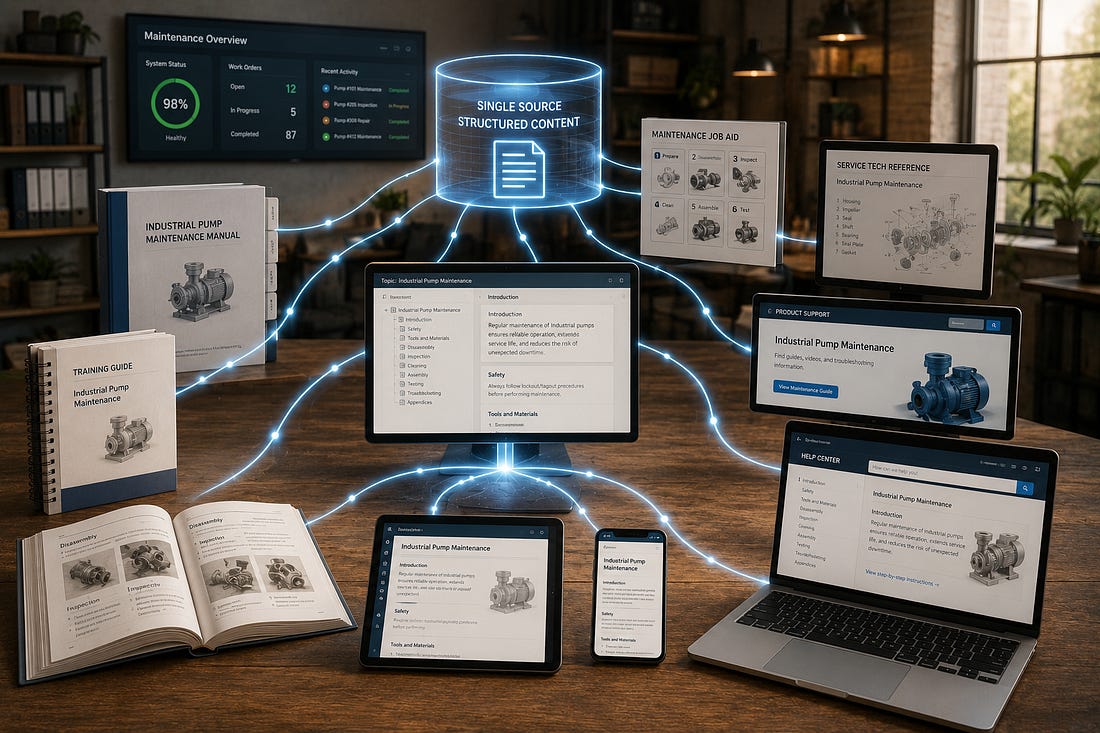
XML’s real value was interoperability. It gave us a way to represent our information so that it could move between systems, retain its meaning, and be repurposed in contexts that had nothing to do with the original publication.
The rise of generative AI has brought that original promise back into focus.
Related reading: The Role of XML in Interoperability
 |
What The Automotive Industry Figured Out First
Long before AI entered the conversation, manufacturers faced a problem that should sound familiar to anyone responsible for creating, managing, and delivering enterprise content.
Information existed everywhere, but it didn't travel well. That was true between organizations, where suppliers and manufacturers constantly exchanged documents, and it was often true within organizations as well. Information created by one department frequently had to be manually interpreted, reformatted, or reentered (typed by hand) before another department could put it to work. The result was delay, duplication, cost, and mistakes.
Purchase orders, invoices, shipping notices, inventory reports, and production schedules arrived through the postal service. Someone had to receive those documents, open the envelopes, sort the contents, route them to the right department, read them, and manually enter the information into another system.
Every step required work.
Handoffs from one party to another introduced delays. When information was rekeyed, accuracy depended on another human hand. Studies of manual transcription show error rates ranging from roughly 1% to more than 10%, depending on the workflow and data type, which means every extra handoff created another opportunity for mistakes. Each time someone rekeyed information, another opportunity for error appeared.
Technology gradually improved the speed of delivery, but it didn’t eliminate the underlying problem.
👉🏾 Paper became fax transmissions
👉🏾 Faxes became scanned images
👉🏾 Scanned images became PDFs
Our information moved faster than before, but much of it remained trapped inside formats that humans could interpret and machines could not.
The automotive industry eventually realized that the bottleneck wasn't the movement of their information but the lack of a shared way to represent it. Without a common structure, every transfer required specialized interpretation, creating cost, delay, and opportunities for error.
 |
Before the advent of XML, Electronic Data Interchange (EDI) addressed that challenge by giving manufacturers, suppliers, and trading partners a standardized way to represent business information. Business documents could move directly between systems because everyone agreed on how the in