
|
 |
This is a public post so please share it widely. If you enjoy this newsletter, I hope you’ll consider upgrading to a paid subscription.
For those who don’t want a Substack account, you can keep Off Message going with a donation. All support is appreciated, and donations of $75 or larger come with a comped annual subscription—all content unlocked and emailed to the address provided.
Casting A Ballot Is Not Flashing A Gang Sign
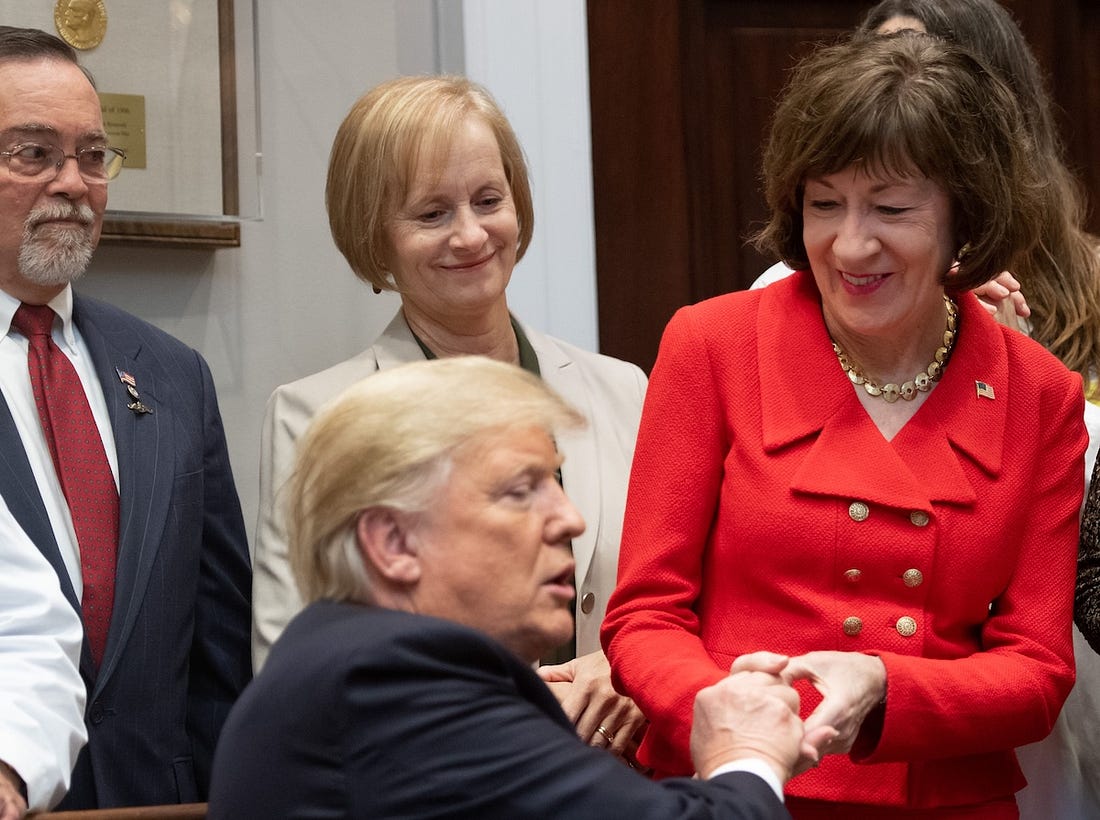
It's always, always, always about harm reduction; and few people have caused, or threaten to cause, more harm than Susan Collins.
|

| |||||||||||||||


 |
More-or-less regular people will sometimes attach themselves morally to powerful bad actors.
Some people become in thrall to politicians or cultural icons and then begin lying to others or deluding themselves about the ways those actors abuse power. They stop assessing leaders on the merits, or based on how they stack up to their predecessors, and instead build new identities around their support for particular hero figures. They forget that amassing power is opportunistic; that politicians work for us; that transparency and accountability are checks on corruption and abuse. They become unable to criticize their tribe and its members over discrete points of disagreement, because they experience that kind of independent thinking as a form of betrayal.
This essentially describes MAGA.
Other people accept jobs they don’t need to advance the interests of powerful individuals with bad values or poor character, and they stick around long after they’ve been pushed beyond their once-imagined redlines. There is honor even on the political side of public service (campaigns, p.r., etc.) just as there’s honor in representing criminal defendants. There’s less honor in choosing powerful but morally deficient clients for the pay day, while pretending they’re no different from anyone else in the market for professional services. And there’s no honor in being swept into immoral or criminal enterprises.
This essentially describes cretins like Kellyanne Conway, lawyers for the tobacco industry, Andrew Cuomo’s inner circle. People like that. Perhaps one day we’ll say it describes the crew that plucked Graham Platner from obscurity and hid facts about his character, knowing he might become the linchpin for control of the U.S. Senate.
But we’re not there yet. I’m not sure we’re even particularly close.
Reasonable minds may differ as to where we should draw these lines, or how proximate one must be to bad deeds before their service transforms into complicity. Some moral judgments are close calls. Others are more cut and dry. But the realms of power, particularly political power, are sprawling. The world would probably be a worse place if the people who stood up PEPFAR under George W. Bush had instead resigned to protest the Iraq War.
Grey area extends horizon to horizon; people get lost in it and don’t always recognize when they’ve crossed over into the black and white.
Platner, and the relatively small group of people who’ve made Platner possible, are well within the grey area. They might well be vindicated. They might well be disgraced. It may be that the stakes of Platner’s campaign turn out to be minuscule. But it’s reasonable to expect them and him to feel conflicted, like they’ve placed their credibility and the lives of strangers on the line.
Voting in an election, as a distinct act, is not like this at all. It’s not meant to be like this, at any rate. Voting, particularly in a two-party democracy, is about harm reduction. Even when candidates are inspiring and well-intentioned, voting is still about harm reduction, because politics is highly impure. Superpower politics are especially impure. Voting is utilitarian. It is not like flashing a gang sign. In a contest between a bad candidate and a worse one, voting for the bad candidate is like expressing the moral intuition that someone should amputate a gangrenous leg rather than allow the patient to die. To take a more familiar example, a ballot does not ask you whether to pull the lever that sends the trolley onto the new track; it asks you which of two people you want in the conductor’s seat when the dilemma arises.
You can’t know exactly what the future holds—maybe pulling the lever causes the trolley to derail—but for that reason you are not attached to subsequent failures morally, so long as all you did is vote on the basis of sound judgment.