| | In this edition, join us for our tech-focused event in San Francisco, and Anthropic launches a versi͏ ͏ ͏ ͏ ͏ ͏ |
| |  | Technology |  |
| |
|
 - The race to IPO
- Mythos opens up
- Data centers in space
- The surge in corporate AI
- Klarna CEO on agentic commerce
 Navigating AI in the physical world, and dancing Chinese robots are building a US fanbase. |
|
 Soon after we launched Semafor in the fall of 2022, OpenAI released ChatGPT and kicked off what’s become a historic period of innovation and investment. But we’re at a technological inflection point where AI itself is no longer the final product. It’s an ingredient. Software has leapt out of the confines of chips and data centers, reshaping the physical world in ways that would have seemed like science fiction not so long ago: driverless cars, high-speed internet beamed from space, video games controlled by our brains alone, and life-saving drugs designed on laptops. And we’re only at the beginning of this acceleration. Today, I’m bringing some of tech’s deepest thinkers together for First Principles, a tech event Semafor is hosting in San Francisco that focuses on the technologies that will actually change the world. I’ll ask Max Hodak, who co-founded Neuralink with Elon Musk and now runs Science Corporation, why people alive today might live to be 1,000 years old. I’ll ask Daphne Koller, a pioneer in AI and biotech, what the world should do to truly accelerate therapeutic medicine. And I’ll ask Google Quantum AI’s Charina Chou and PsiQuantum’s Pete Shadbolt to decode the quantum math underlying the world. AI is, in a sense, what ties all of these things together. The token economy and the industrial race to build computers of unimaginable power are fascinating topics. But those are not the things our grandchildren will talk about. This time will be remembered as the dawn of a new era of abundant, clean energy, healthier and longer lives, general-purpose robotics, and the exploration of our solar system. If you can’t join me in person, you can stream the event here, check out the interviews online, and ping me with any questions you have for the speakers. |
|
 Steve Nesius/File Photo/Reuters Steve Nesius/File Photo/ReutersAs OpenAI joins Anthropic and SpaceX in the IPO queue, the question for Wall Street: Is there enough money for all of them? IPOs are famously momentum-driven; companies go public when other companies go public. But the sheer amount of money these AI giants will need — SpaceX is expected to raise $75 billion on Friday — raises concerns they’ll crowd out fast followers. “This is a terrible year to go public,” the CEO of Databricks, which is valued at $134 billion and has flirted with an IPO since before ChatGPT’s release, told Bloomberg. Retail investors will be key. Fidelity dropped the velvet rope for SpaceX shares, allowing customers with as little as $2,000 in their brokerage accounts to buy into the IPO. The company’s bankers have received orders for twice as many shares as it intends to sell, according to Bloomberg, a lower ratio than other tech IPOs, but remarkable given the size of the offering. Still, $75 billion is enough money to be noticed if it’s pulled out of other market bets: Keep an eye on the Treasury tape when shares price Thursday night. — Rohan Goswami |
|
Anthropic’s Mythos faces backlash |
 Claude Fable 5 playing Pokémon FireRed. Courtesy of Anthropic. Claude Fable 5 playing Pokémon FireRed. Courtesy of Anthropic.Anthropic’s new Fable model, released Tuesday, has drawn backlash due to costs, security measures, and customer service. Fable shares the same base model as Mythos, which the company says is still too dangerous to release to the general public. The guardrails and other new policies are its way of ensuring the public can reap the benefits of its most powerful technology without giving bad actors a field day in cybercrime. But it’s pricey, and Anthropic now retains data from customer chats with Fable, including from enterprise customers. The company said it “extensively” tested the model with hackers who tried to bypass its safeguards, and none were successful. Instead, Anthropic’s less powerful models stepped in to answer those questions. Anthropic acknowledged that without safeguards, Fable 5’s capabilities could be misused in dangerous ways. “The difference [between Fable and Mythos] is not what the model can do, but what our safeguards will allow,” a spokesperson told Semafor. “Fable 5, without safeguards, would be exceptionally strong at finding and exploiting software vulnerabilities, which could meaningfully lower the cost of cyberattacks.” — Rachyl Jones |
|
The case for data centers in space |
 The International Space Station. NASA/Reuters. The International Space Station. NASA/Reuters.Building data centers in space could be cost-effective by the early 2030s, analysis suggested. Right now, launch costs drive up orbital compute to roughly four times the price of terrestrial, SemiAnalysis wrote. But the cost difference could fall to 30% within five years, and if demand zooms upward, chip supply increases, and public backlash against building data centers on the ground grows, space could become “the only alternative.” Elon Musk is betting on that outcome: He argues that energy shortages, grid connections, and permitting will create construction bottlenecks, while chip production will accelerate. Space could be the cheapest option even before the end of the decade. Another common argument is that it’s hard to switch chips and fix broken hardware up in space, but there’s a path to addressing that as well. New York startup Icarus Robotics is developing robots that can be controlled remotely to assist in space missions, and the bots are already slated to begin testing in the International Space Station next year. For that mission, they will unload bags with supplies like food and lab equipment, but the team can develop workflows for data center maintenance if the market demands it, CEO Ethan Barajas told Semafor last month. — Tom Chivers and Rachyl Jones |
|
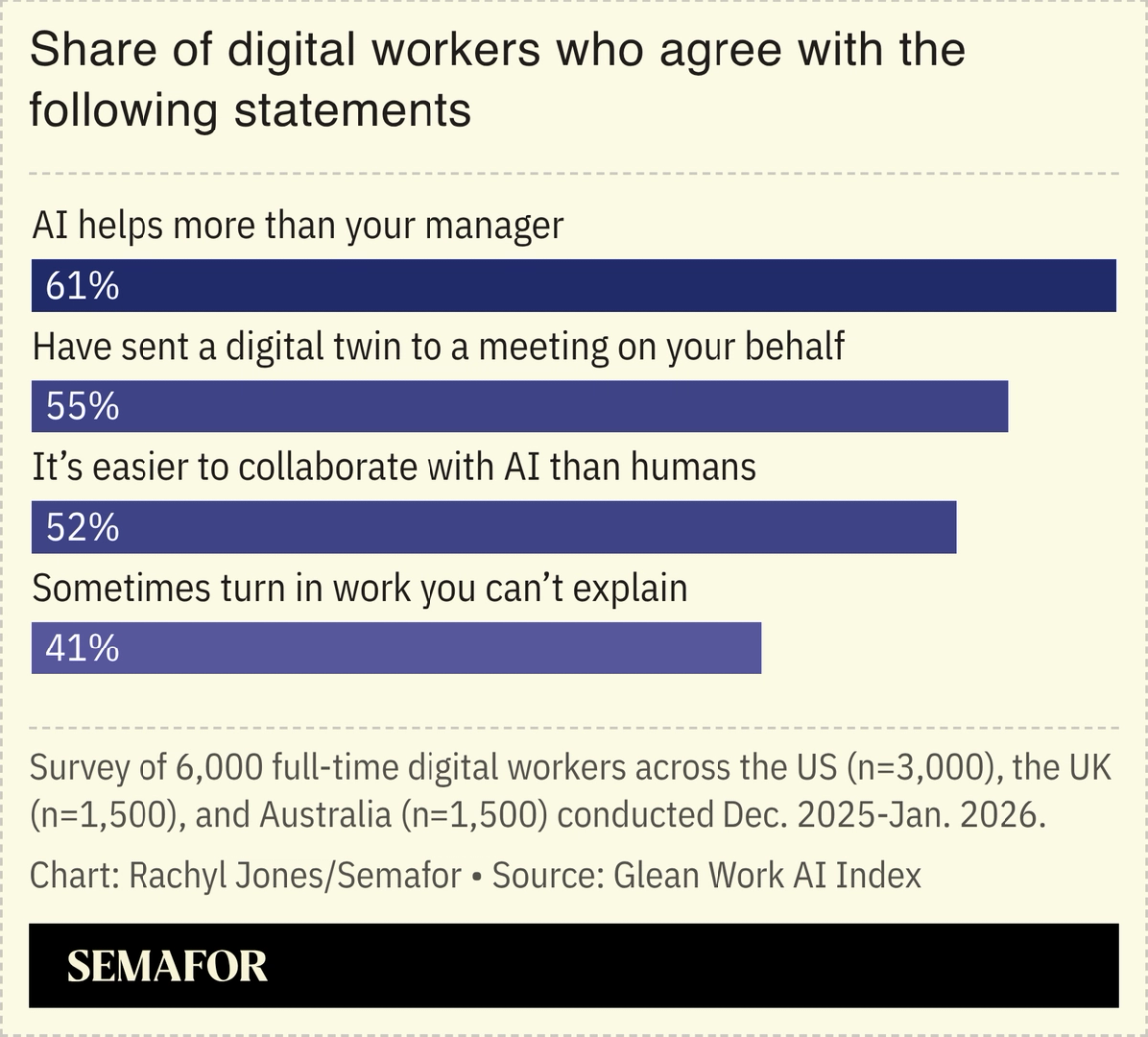 Roughly 20% to 30% of operating expenses will come from spending on agents versus humans in the next three to four years, according to a new report summarizing the views of C-suite leaders from consultancy Bain & Company. Businesses looking to get a leg up on competitors say they are under pressure to use the most advanced AI products, but costs are rising (new models like Anthropic’s Fable are double the cost of OpenAI’s most powerful model). Bain’s answer is a mix of models whose capabilities (and price) matches the task — a bet also made by Perplexity and several open source model makers. For their part, workers say AI saves 11 hours a week on average, according to a separate survey of 6,000 full-time digital workers in the US, UK, and Australia from AI startup Glean. While 87% of workers use AI at work, only 13% say AI has significantly improved their organization’s performance. And it turns out the employees getting the most out of AI are those who tend to break the rules: More than half of users who say AI has improved their work use unapproved tools — or authorized tools in unapproved ways — and more than a third hide from their manager how much AI helps them. |
|
Klarna CEO: Agents won’t kill brand loyalty |
 Semafor SemaforThe CEO of fintech Klarna said the rise of agentic shopping won’t destroy brand loyalty, an outcome feared by e-commerce players who worry that it will be harder to woo bots than the humans whose errands they are running. “If you have preference, it doesn’t matter that much how many buttons are in the checkout or what happens in the world with new things, because you have that brand affinity,” Sebastian Siemiatkowski said on the latest episode of Semafor’s Compound Interest show. Swarms of bots fill shopping lists in internet backrooms, armed with some instructions from consumers, posing a challenge to e-commerce companies. Agents are harder to advertise to or reward with better perks or service. They put an abstracting step between end customers and what they choose to buy — and how they choose to pay for it, bringing the “top of wallet” fight into the AI world. |
|
 The most powerful people in media are gathering in Cannes this month, and we’re on the ground to cover it all. Starting June 22, Semafor’s Ben Smith and Max Tani will hop between panels, parties, and yachts to bring you the essential guide to marketing and media’s most consequential event. Whether you’re jetting to Cannes or just want to stay in the loop, subscribe to our pop-up newsletter, Semafor Cannes. |
|
 Manami Yamada/Reuters Manami Yamada/ReutersDancing robots — which have become a fixture of tech culture in China — are starting to build a fanbase in the US. A group of dancing Unitree robots got a standing ovation on America’s Got Talent last week, and more recently, New Yorkers have been engaging with those same bots donning Knicks gear during the NBA finals. However popular the humanoids become with Americans, US lawmakers continue their bipartisan push against China. Lawmakers recently unveiled a bill to ban Chinese robots deemed a national security threat, including those made by Unitree — encapsulating the gulf between public perception of Chinese tech and attitudes in Washington. TikTok’s popularity with American users complicated US officials’ efforts to ban the short-form video app over national security concerns. As Chinese tech extends its global reach — more American companies are also using Chinese AI models — hawks in Washington face the challenge of trying to regulate Unitree and its peers before they become too popular to contain. — J.D. Capelouto |
|
| |  | | | You’re receiving this email because you signed up for briefings from Semafor. |
|


