| | In this edition: Inside Steyer’s expensive faceplant, Platner digs in, and the origins of a GOP figh͏ ͏ ͏ ͏ ͏ ͏ |
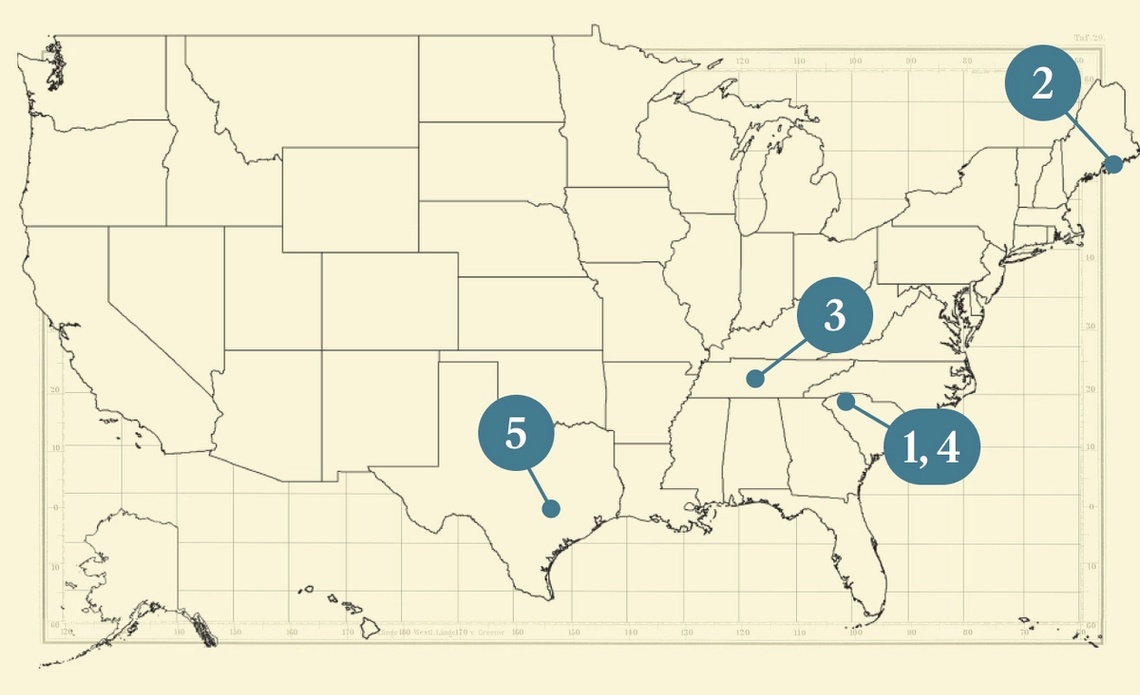
| |  COLUMBIA, TN COLUMBIA, TN |  WASHINGTON, DC WASHINGTON, DC |  BAR HARBOR, ME BAR HARBOR, ME |
 | Americana |  |
| |
|
 - Surprising primary Ls
- Platner’s comfort zone
- Over the rainbow
- Graham’s ad battle
- Paxton-Abbott gap
|
|
 As Tom Steyer became the least successful self-funding candidate in modern US political history this week, his initial years in Democratic politics felt like a fever dream. Steyer, who liked to say that he became a hedge fund billionaire “by accident,” joined Democratic politics at the start of its modern crisis. In 2014, the party despaired at the success of the Koch donor network — decades of right-wing philanthropy that paid off in the tea party movement. Where were the left’s billionaires who could fight back? Steyer was one of them, a hyper-energetic San Franciscan who wore tartan ties with a four-in-hand knot, committing to bundle a historic amount of money for Democrats who’d fight climate change. “Is it going to take $100 million?” he told The New York Times then. “I have no idea.” That election ended up being a Democratic disaster, with non-college educated support for the party collapsing, presaging the rise of Donald Trump. Steyer’s runs for president and governor didn’t work, either; $558 million bought him no delegates and a third-place finish in his home state, below a British political strategist who became a citizen five years ago. Why couldn’t Steyer pull this off? What did his 12 years as a “donor-doer” leave behind for his party? Quite a lot, mostly related to the ballot measures he funded before getting more tied to national politics. But as he grew more ambitious, Steyer embodied the Democratic Party’s problems. He operated in a campaign finance regime where the ultra-wealthy have ever more ways to influence elections, meaning the party needed people like him to compete. But his gubernatorial campaign rolled out when the most popular way for Democrats to keep their coalition together became blaming billionaires (of which he is one). Read my full take on why Democratic voters rejected the ‘class traitor.’ → |
|
|
Primary results from Tuesday |
 Nathan Howard/Reuters Nathan Howard/ReutersTwo more House Republicans lost their bids for higher office on Tuesday, as Reps. Ralph Norman and Nancy Mace conceded the gubernatorial primary in South Carolina. In her early concession speech, Mace endorsed state Attorney General Alan Wilson as the “law and order” candidate, just months after accusing him of “not prosecuting pedophiles.” But Mace ran a poor fifth place, losing to Wilson in her own district, as Trump-endorsed Lt. Gov. Pamela Evette got the most votes statewide. Wilson and Evette will face off again on June 23. In Maine, both parties’ gubernatorial primaries will go to ranked-choice counts; former Bush administration narcotics officer Bobby Charles led the GOP race, while four Democrats ended the first round of voting with more than 20% each. In Nevada, Democrats nominated state Attorney General Aaron Ford for governor, hopeful that GOP Gov. Joe Lombardo can be beaten by the factors that helped him unseat a Democrat four years ago: A weaker Las Vegas economy, this time with online betting and immigration restrictions, not COVID restrictions, slowing down tourism. Trump’s endorsed House candidates in Nevada, composer Marty O’Donnell and unsuccessful 2024 House candidate Dave Flippo, won and were leading their primaries, respectively. |
|
Maine’s Democratic nominee digs in for a long race |
 Brian Snyder/Reuters Brian Snyder/ReutersBAR HARBOR, Maine — Local restaurateur Leslie Harlow recently noticed two New York Post reporters eating at her establishment, Ironbound. She knew they were there because of her son Graham Platner’s Senate candidacy, and when they asked her for a quote about it, she replied: “Please give us five stars on Yelp.” That conspicuous disinterest in DC’s fascination with the Platner drama showed this past week when the Democrat, who locked in the nomination this week, returned for an appearance alongside Rep. Ro Khanna, D-Calif., and other supporters. Platner had spent the week before the primary fending off questions about sexual messages he’d sent to women early in his marriage and three ex-girlfriends’ recollection of unsettling and intimidating behavior. Maine Republicans are ready for a choice election between five-term GOP Sen. Susan Collins and a veteran from a well-off family who’d made terrible mistakes. Democrats want a referendum on Republicans, confident that a state that voted for Kamala Harris by 7 points was yearning to take Trump’s Senate majority away. Read my story from Maine here. → |
|
|
Behind the Republican push to redefine Pride Month |
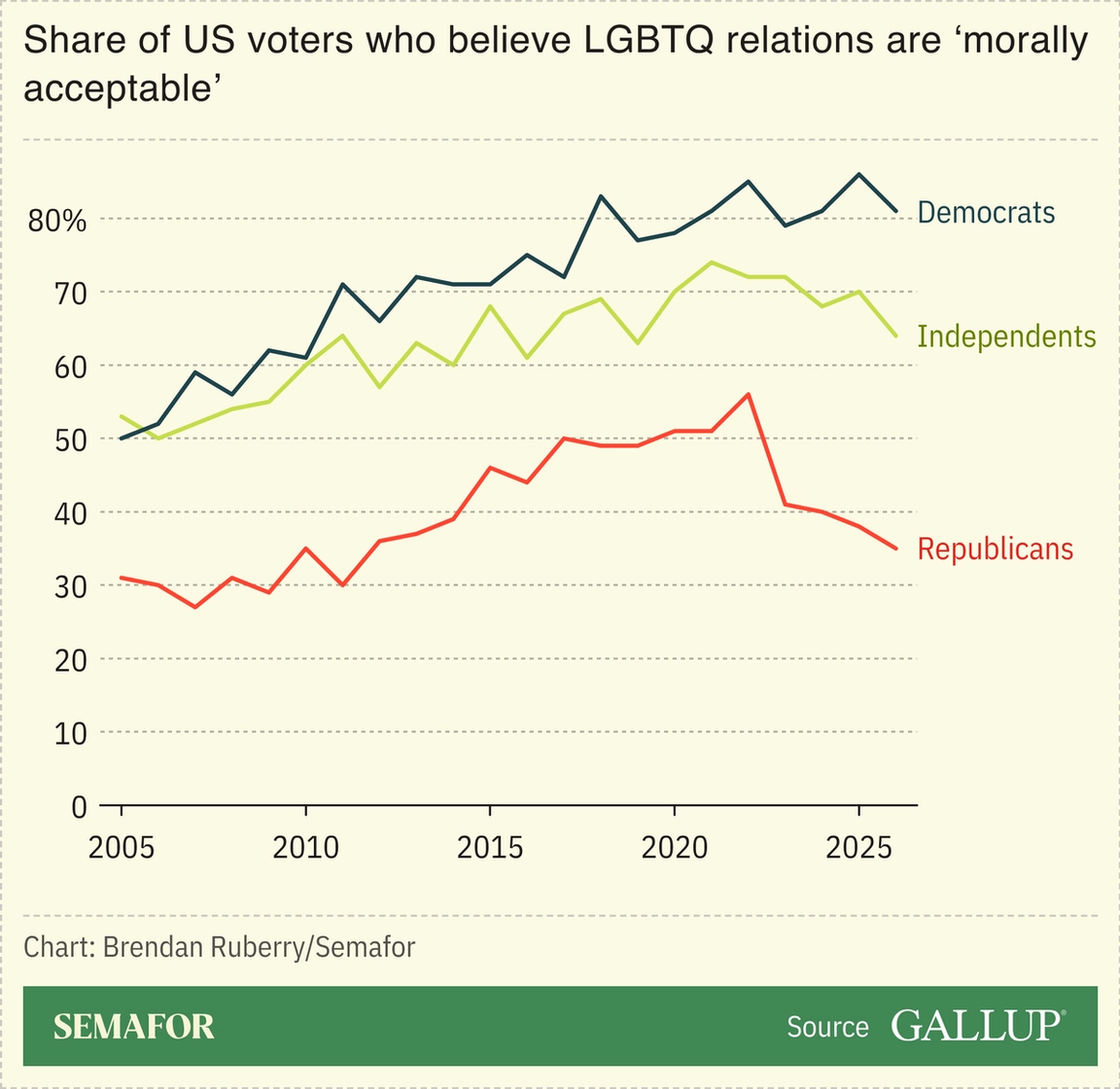 How did five red states come to celebrate pro-family, pro-faith alternatives to LGBTQ Pride Month? It started with two conservatives who didn’t know each other. One was Robert P. George, the Princeton professor and founder of the American Principles Project, an iconic figure on the right. The other was Lakie Derrick, a Tennessee college student who saw a mistranslated story about Italy’s prime minister recognizing “family month” — Giorgia Meloni had only appeared at a Catholic group’s pro-family event — and thought that an American “nuclear family month” sounded like a good idea. It’s now been officially recognized in her state, with similar proclamations in Alabama, Arkansas, Indiana, and Utah. In each state, the movement to “take back the rainbow” (as Indiana’s lieutenant governor put it) tracked with declining Republican support for LGBTQ rights and same-sex marriage. Gallup recently found just 35% of Republicans agreeing that “gay or lesbian relations” were “morally acceptable,” down 21 points from its high in 2022. Until 2024, Utah Gov. Spencer Cox had recognized Pride Month in his conservative state. That year, when he faced a serious primary challenge from his right, he stopped. Read the backstory here. → |
|
|
How Graham quashed the Republican anti-incumbent energy |
 Senator Lindsey Graham/YouTube Senator Lindsey Graham/YouTubeSen. Lindsey Graham, R-S.C., won his primary for a fifth term outright on Tuesday after publicly fretting that he might be forced to a runoff. Those worries sounded credible to South Carolina Republicans. Graham won just 56% of the GOP vote in 2014, after the compromise immigration bill he supported died in the House, and 68% of the vote in 2020, after four years of loyalty to Trump. MAGA conservatives saw an opportunity to humble Graham; Courage Conservatives PAC, founded 10 years ago to help Texas Sen. Ted Cruz’s presidential bid, put $700,000 into ads that attacked Graham for his past immigration work, and for not doing something when statues of John Calhoun and Robert E. Lee got yanked from Charleston and the US Capitol. Graham’s own ads, like “Civics 101,” mocked his strongest opponent as a lightweight who couldn’t answer basic questions about government. His positive spots, like “Darline,” reintroduced the senator as a self-sacrificing Christian with stronger character than his challengers. |
|
What Texas’ polls say about its electorate |
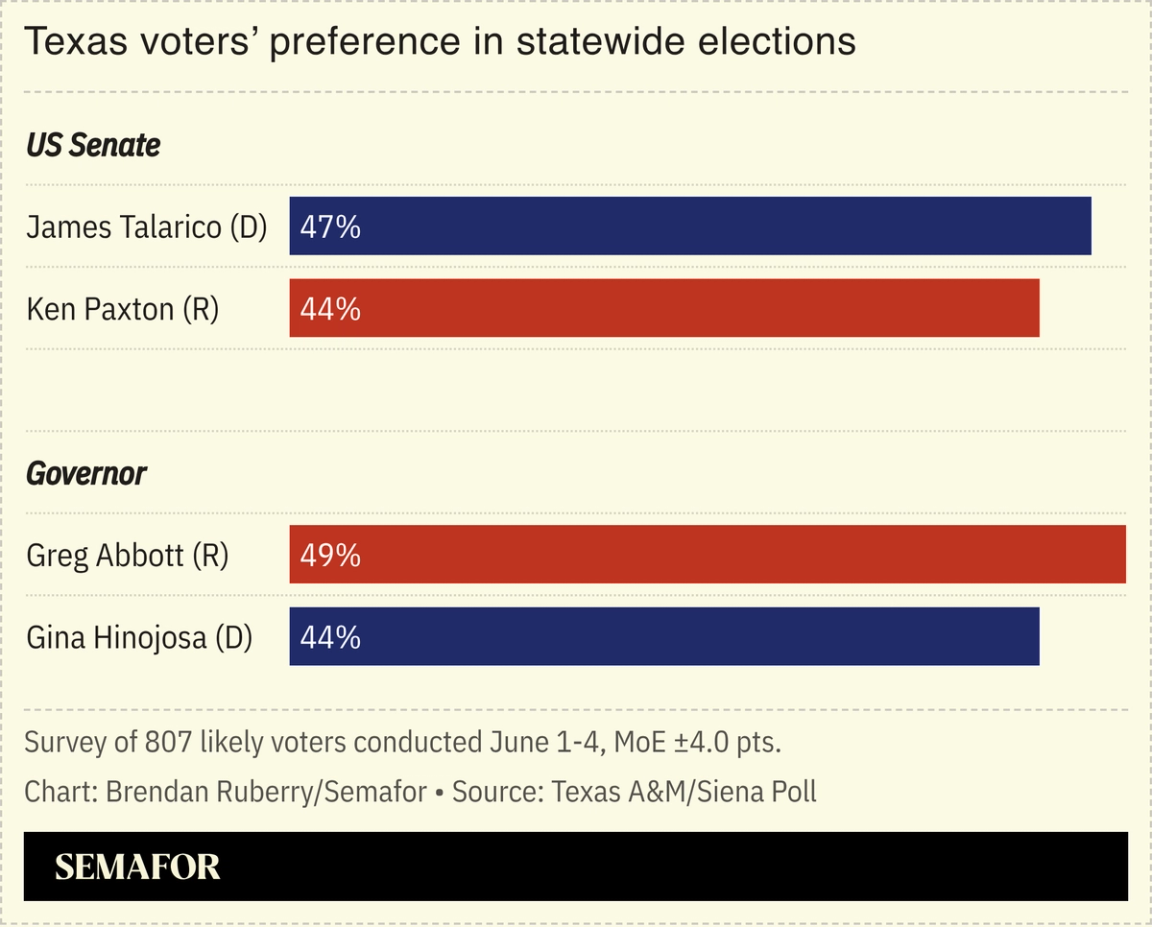 The bull case for Texas Republicans this year was Democrats’ habit of falling in love with candidates who failed to turn the state blue. The bear case: Why were Republicans spending so much money to save GOP Sen. John Cornyn if they didn’t think state Rep. James Talarico could beat Ken Paxton? In this poll, Talarico leads the state attorney general thanks to unusually strong support from white voters (42%), and Paxton trails by running behind the president with Latino voters (41%) and Black voters (11%). Gov. Greg Abbott, who is running against a Latina Democrat for the second time in four runs for governor, still outperforms Paxton with Latino voters, getting 44%. The GOP’s expansive plans for Texas, including its new congressional maps, were based on the president’s strong performance with Latino voters; some analyses suggest that he won 55% of them in Texas in 2024. After years of frustration with the surge in illegal border crossings under Joe Biden, Democrats had lost trust on immigration. But the latest Texas numbers suggest that Trump’s aggressive ICE enforcement, mostly outside of the state, has changed the electorate — and the drop in illegal crossings since Biden left office hasn’t generated much goodwill for Republicans. Just 36% of Texas Latinos view ICE favorably. |
|
 Brian Snyder/Reuters Brian Snyder/ReutersWhere did Platner come from? How did an oysterman with no political background become an instant progressive star and scare off his competition for a Senate nomination? This isn’t a hidden story, exactly; Fight Agency, the firm whose strategists perfected the launch of “unconventional,” rugged candidates, participated in several profiles before Platner’s coverage turned sour. But The Wall Street Journal’s Aaron Zitner beat everybody to an interview with Daniel Moraff and Leanne Fan, the Democrats who found Platner’s content about his oyster business and convinced him to become a candidate. “A healthy contempt for existing Democratic Party infrastructure is really essential,” Moraff told Zitner. |
|
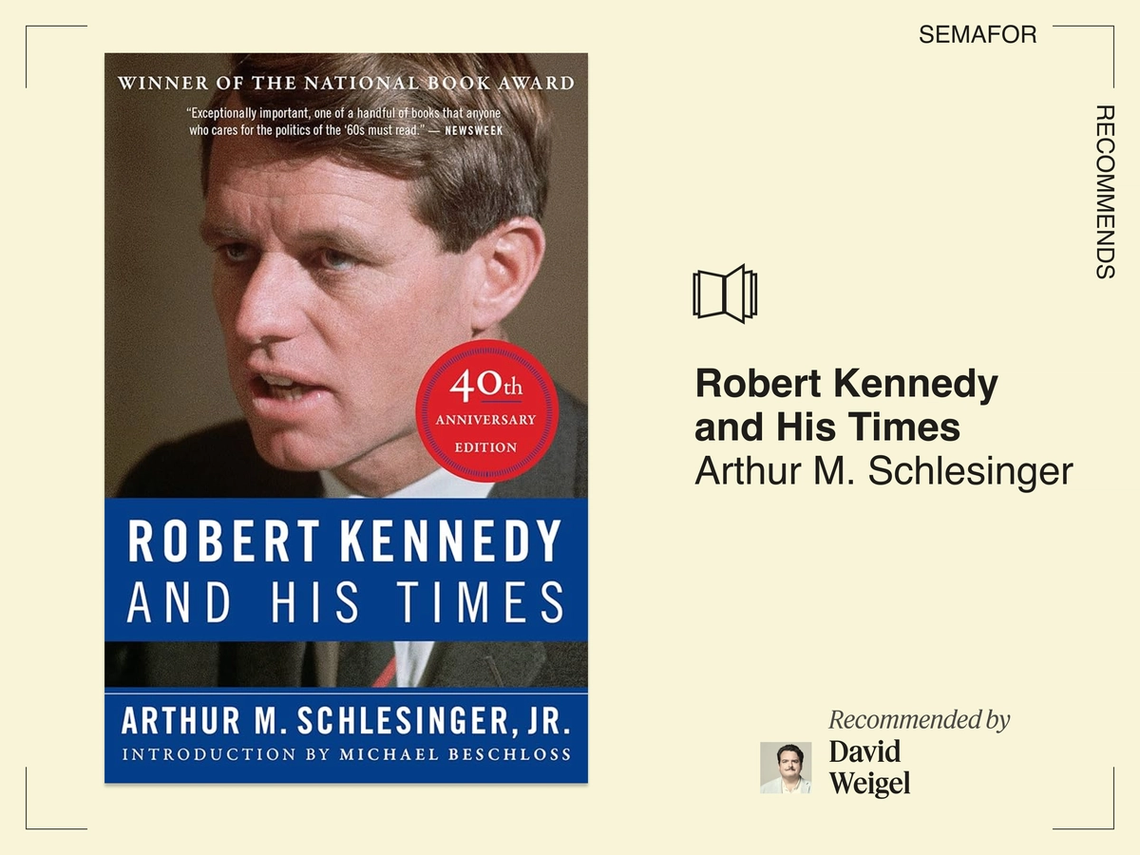 For some reason — laziness? Listening to a bookstore clerk with a grudge? — I’d assumed Arthur M. Schlesinger Jr.’s books about the Kennedys were hagiographic and superseded by authors who had access to more documents. But if there’s a better biography of Robert F. Kennedy, Jr. than Robert Kennedy and His Times, I haven’t seen it. The personal closeness of Schlesinger with the Kennedys enhances the project. (There’s a funny, early moment when they fight with each other in The New York Times letter pages, then make nice on an Adlai Stevenson campaign bus.) It’s a very good corrective to the simplified Kennedy mythos, which usually focuses on a few great speeches and photos of him on his final campaign trail. |
|
|


