| | In today’s edition: More strikes in the “ceasefire,” a Dubai property developer extends handover tim͏ ͏ ͏ ͏ ͏ ͏ |
| |  Doha Doha |  Washington DC Washington DC | Kuwait City |
 | Gulf |  |
| |
|
 - Iran, again, strikes Gulf
- Dubai property delays
- Kuwait-KKR-Nvidia deal
- Blue Owl in Abu Dhabi
- Saudi firm raises $96M
- Why success frays unity
 Brace for a flood of oil, and other weekend reads. |
|
Iran and US back on the offensive |
 Ministry of Interior of the Kingdom of Bahrain/Handout via Reuters Ministry of Interior of the Kingdom of Bahrain/Handout via ReutersMilitary exchanges between Iran and the US continued, as a two-month-old ceasefire crumbles and a peace deal remains elusive. The US carried out what it described as “self-defense strikes” on Iranian military targets on June 10 and has been firing on oil tankers trying to evade its maritime blockade on Iran. For its part, Iran targeted US military bases in Bahrain, Kuwait, and Jordan in the early hours of Thursday. Tehran also claimed it hit two vessels in the Strait of Hormuz and said the waterway will be “closed until further notice.” A day earlier, President Donald Trump had said the US controlled the strait, “NOT Iran,” and repeated his claim that his foe had been “defeated.” Despite that, Iran appears unwilling to bend to the US desire to reach a deal soon — something that is reportedly causing growing frustration in the White House. As ever, innocents are bearing the cost of conflict: Three Indian sailors were killed after their vessel was hit by the US, thousands of Iranians lost water supplies when local reservoirs were destroyed, and an 11-year-old girl was injured by shrapnel in Bahrain. |
|
Luxury property developer faces delays |
 Courtesy of Majid Al Futtaim Courtesy of Majid Al FuttaimOne of the UAE’s biggest family-owned conglomerates has told customers it won’t be able to deliver some of the homes it is building on schedule because of the disruptions caused by the Iran war, according to people familiar with the matter. Majid Al Futtaim, which owns some of the region’s largest malls and most luxurious property projects, has started informing buyers in parts of the Tilal Al Ghaf development in Dubai that it is invoking force majeure clauses, blaming circumstances beyond its control. The move is one of the first known cases of a privately held firm acknowledging the war’s impact on its operations. State-controlled energy companies, including Kuwait National Petroleum Co. and QatarEnergy, declared force majeure in March because they couldn’t get their oil and gas out of the Strait of Hormuz. Dubai’s property market has been one of the world’s strongest in recent years, leading globally in the sale of homes worth more than $10 million, according to real estate consultancy Knight Frank. Tilal Al Ghaf includes mansions that sell for more than $15 million, as well as smaller units often purchased by investors seeking rental income. Delays can be costly for the latter group. — Matthew Martin and Mohammed Sergie |
|
Kuwait joins AI infrastructure race |
 Jonathan Ernst/File Photo/Reuters Jonathan Ernst/File Photo/ReutersKuwait’s sovereign wealth fund is backing a new $10 billion AI infrastructure venture alongside KKR, Nvidia, and power company Vistra, the latest sign that Gulf investors are undeterred by the war in deploying capital globally. The new company, Helix Digital Infrastructure, will be led by former AWS chief Adam Selipsky and aims to build and finance the data centers, power generation plants, transmission networks, and fiber links needed by hyperscalers. The move comes as Gulf states pour hundreds of billions into AI in the region and globally: Saudi Arabia launched HUMAIN last year to create a national champion in the space, Qatar has Qai, and the UAE is leading the region through state-backed firms like G42, MGX, and Mubadala. |
|
Blue Owl nests in Abu Dhabi |
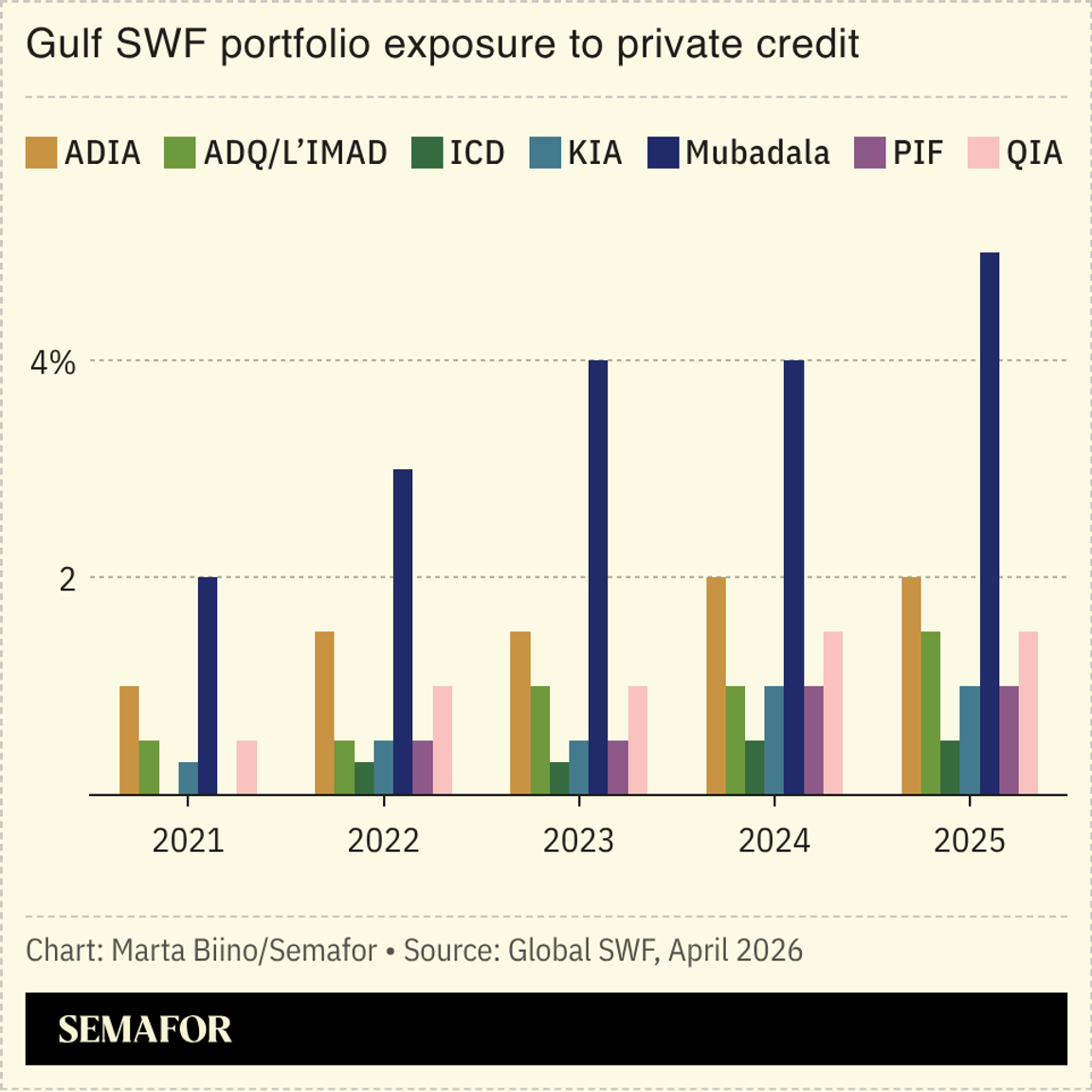 Private credit giant Blue Owl Capital is opening a regional headquarters — somewhat of a loaded term in the Gulf — in Abu Dhabi, an indicator that Wall Street firms are still betting on the UAE capital despite uncertainty over the Iran war. The firm, which manages $315 billion in assets, joins an increasingly crowded field at the city’s financial hub ADGM, which includes Bain Capital, Barings, BlackRock, Man Group, and Vista Equity Partners. They have been drawn in by proximity to sovereign wealth funds like ADIA and Mubadala, a growing number of family offices, and the region’s expanding appetite for private credit. Gulf sovereign funds quadrupled their private credit exposure between 2021 and 2025 — to roughly $80 billion — with Mubadala the most committed. But the asset class has recently come under strain: Defaults are rising and redemption requests have spiked, with developments at Blue Owl among the indications of potential cracks in the ecosystem. — Kelsey Warner |
|
Saudi firm closes first fund since Iran war |
 Saudi Arabia’s Growth Catalyst raised $96 million to back companies in the kingdom, making it one of the first private sector investors to close a fundraising round since the onset of the Iran war. The firm is aiming to more than double the size of the fund over the next six months before it reaches a final close, Growth Catalyst founder and chief executive Turki Al-Dayel told Semafor. The conflict with Iran didn’t significantly impact the fundraising, he said, and has “reinforced what experienced investors already recognise: That Saudi Arabia has become an anchor of stability and economic momentum in the region.” The new fund is backed by the government-linked Saudi Venture Capital and regional family offices. It will target investments in profitable businesses across the business services, consumer goods, healthcare, and technology sectors. — Matthew Martin |
|
View: From asabiyyah to rivalry |
  “Statue d’Ibn Khaldoun sur l’avenue Habib Bourguiba à Tunis (Tunisie)” by Kassus via Wikimedia Commons. Licensed under CC BY-SA 3.0, cropped from original. “Statue d’Ibn Khaldoun sur l’avenue Habib Bourguiba à Tunis (Tunisie)” by Kassus via Wikimedia Commons. Licensed under CC BY-SA 3.0, cropped from original.The 14th century Arab philosopher Ibn Khaldun observed a pattern: Groups rise through what he called asabiyyah — a powerful sense of social cohesion and shared purpose — but after they succeed, their wealth, security, and power gradually erode solidarity, Judah Taub, managing partner of Israeli early-stage investor Hetz Ventures, writes in a column for Semafor. This is a trap that the Gulf is at risk of falling into. “The region’s monarchies shared common challenges” and worked together to build economic stability, Taub writes. “Today, however, the Gulf is no longer merely a collection of wealthy energy exporters. Qatar, Saudi Arabia, and the UAE have become ambitious geopolitical actors with global aspirations. They compete over AI infrastructure, airlines, diplomatic influence, financial centers, logistics hubs, sports investments, and tourism.” |
|
 Deals- The EU has opened a review of the $24 billion in Gulf money backing Paramount’s $110 billion takeover of Warner Bros. Brussels is probing whether state-backed cash from Saudi Arabia’s PIF, Qatar Investment Authority, and Abu Dhabi’s L’IMAD Holding distorts competition. — Bloomberg
- Abu Dhabi’s sovereign wealth fund L’IMAD — controlled by the emirate’s crown prince Sheikh Khaled bin Mohamed — acquired a $5.9 billion stake in utility company TAQA from a firm owned by his uncle, Abu Dhabi’s deputy ruler Sheikh Tahnoon bin Zayed. — Reuters
Diplomacy- The war means Oman has a “historic opportunity” to invest in pipelines and railways to leverage its geographic position, according to one Omani businessman. Others, however, question Oman’s diplomatic positioning, wary of its warmth toward Tehran. — The New York Times
- Saudi Arabia lifted a ban on Lebanese imports that had been in place since late 2011 — a nod of support for a country under sustained bombardment from Israel.
People- The Future Investment Initiative Institute has named Saudi Arabia’s Princess Maha bint Mishari Al Saud as CEO, ending an almost year-long search after the previous CEO left shortly after taking the job.
World Cup- A 7,000-square-meter message wishing the Saudi national team good luck at the World Cup has been carved into the desert outside Riyadh by artist Lulwah Al Homoud, big enough to read from departing planes.
 @gymnation_me/Instagram @gymnation_me/Instagram |
|
 - Depending on who you talk to, the reopening of the Strait of Hormuz will either prompt a year-long effort to gradually restore oil flows, or production will be brought back online in a matter of days. With infrastructure relatively unscathed or already repaired, and ships in position to move crude, prepare for the flood, Bloomberg columnist Javier Blas writes.
- However the US-Iran war ends, Gulf countries will reconsider their security arrangements having seen Washington prioritize Israeli security while they shouldered much of the cost of the war. This may alter alignments in the region, with some Gulf countries moving closer to Israel and India, and others banding with Pakistan and Türkiye, Ishaan Tharoor writes in The New Yorker.
- The US-Israel decapitation strikes of Iran’s leadership at the start of the conflict have almost been forgotten after the deluge of drones and missiles, and the disruption of the Strait of Hormuz that followed. But the opening salvo based on pristine US and Israeli intelligence has been the most
|
|
|


