Welcome back to Buffering, where our fair-weather Knicks fandom is still recovering from Wednesday night’s game. Disney’s ABC-ESPN combo has been pulling in massive audiences for this series, with Monday’s game snagging the best numbers in three decades for an NBA Finals. Given how much NBCUniversal pays for regular season games, it has to sting that Disney gets the benefit of the biggest moment for the league in years.
This week’s newsletter has some insights on this month’s other big sports championship, the 2026 FIFA World Cup. We’ve dived into how various U.S. platforms are looking to benefit from the tournament, and who stands the gain the most. But first, we’ve got a first look at Nielsen’s final seven-day multi-ratings for the official 2025-’26 television season, and what they say about the shows viewers need to watch ASAP. Thanks for reading! |
|
|
|
Subscribe now to get unlimited access to everything New York, including subscriber-only newsletters, exclusive perks, the New York app, and more. |
|
| |
High Potential. Photo: Mitchell Haaseth/Disney |
Linear networks might not dominate the TV landscape the way they did even a decade ago, but there’s one thing they’re still pretty good at: getting viewers to quickly watch new episodes of shows, week after week. While streaming in general — and Netflix in particular — still accounts for a much bigger share of overall TV viewing, Nielsen data for the recently wrapped 2025–26 TV season shows the Big Three broadcast networks claimed 19 of the 25 most-watched shows across all platforms when measuring viewership during the first seven days that titles are available. It’s another sign that broadcast TV, for all its very real struggles, is not going down without a fight.
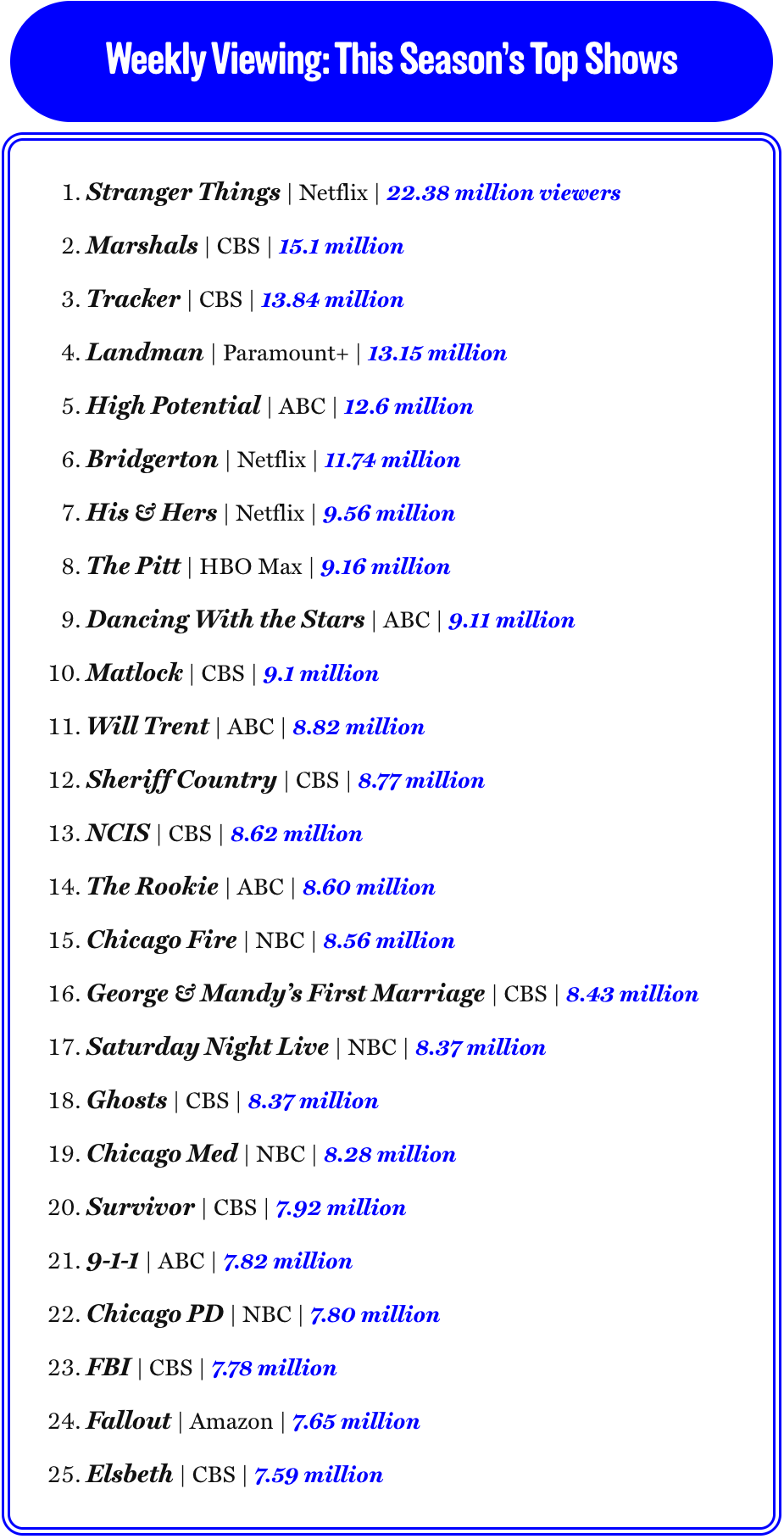
According to Nielsen’s so-called multi-platform plus seven ratings (MP+7), CBS continues to have the biggest collection of shows which reach a big audience quickly, thanks primarily to the big head start its programs get from viewers who still watch via live TV. The Paramount-owned network boasts ten of the top 25 biggest entertainment shows in the MP+7 metric, led by the Taylor Sheridan–created Marshals. It averages 7.6 million viewers every week just through Sunday night viewing on CBS, but it then adds 2.3 million viewers via DVR replays and roughly 5.2 million more viewers through streaming to tally up an overall one-week average audience of 15.1 million viewers. The only show on TV this season with a bigger MP+7 number is the final season of Netflix’s iconic hit Stranger Things, whose three batches of episodes last winter averaged a stunning 22.4 million viewers.
But while Netflix had, by far, the biggest series of the season in MP+7 ratings, only two other shows on its roster cracked the top 25: Bridgerton (11.7 million) and limited series His & Hers (9.6 million). By contrast, Disney’s ABC landed five titles in the MP+7 top 25, including two shows in the top ten: High Potential (12.6 million) and Dancing With the Stars (9.1 million). And while Comcast’s NBC didn’t have any top-ten MP+7 series, it has four spots in the top 25, including its biggest scripted hit, Chicago Fire (8.6 million). As for non-Netflix streamers, Paramount+, HBO Max, and Amazon’s Prime Video each have one show in the MP+7 top 25, thanks, respectively, to Landman (13.2 million), The Pitt (9.2 million), and Fallout (7.7 million).
It’s important to note that all of these shows actually reached more — in some cases, many more — viewers than what is captured in the MP+7 data. Nielsen keeps measuring audiences for shows all year long, and both broadcasters and streamers now regularly use a five-week viewing frame (the MP+35) to better capture the breadth of viewer interest in titles. (More on that below.) And when it comes to selling advertising time or figuring out whether to order more seasons of a show, networks and streamers have plenty of other metrics they use to make key decisions, including demographic ratings and internal data that’s rarely made public. In other words, neither MP+7 nor MP+35 viewership is definitive in terms of assessing how well shows are doing or how valuable they are to their respective platforms. This isn’t 1986 or even 2006, when the Nielsen weekly ratings report often directly translated to whether a program lived or died.
But MP+7 is still useful, both because it is often indicative of how shows will do in the longer term, and because it helps measure how much a show is connecting with audiences — how they prioritize a title in a sea of content. “We’re able to gauge urgency in how quickly people choose to watch something, and that intensity is an important metric for us,” says Ari Goldman, ABC Entertainment’s senior vice-president for content strategy and scheduling. Urgency is valuable to platforms not only because it means a show has broken through, but because programmers can harness that enthusiasm to build viewership for less established titles. “When viewers are intentionally coming to our platforms to watch something they’re excited about,” Goldman explains, “that energy often carries over into newer titles, too.”
Networks like ABC have done this for decades through lead-in scheduling — putting newer shows behind established hits. But Netflix and other streamers do something similar by giving audiences who come to a platform for the new season of a big hit something else to watch as soon as they’re done viewing their existing fave. It’s no coincidence that Apple TV dropped the first two episodes of thriller Cape Fear the same day season two of Your Friends & Neighbors wrapped, or that Netflix’s His & Hers — its biggest breakout this season, per Nielsen — bowed just one week after the Stranger Things finale debuted.
Some other interesting tidbits from the latest multi-platform ratings for the 2025–26 season: |
|
|
|
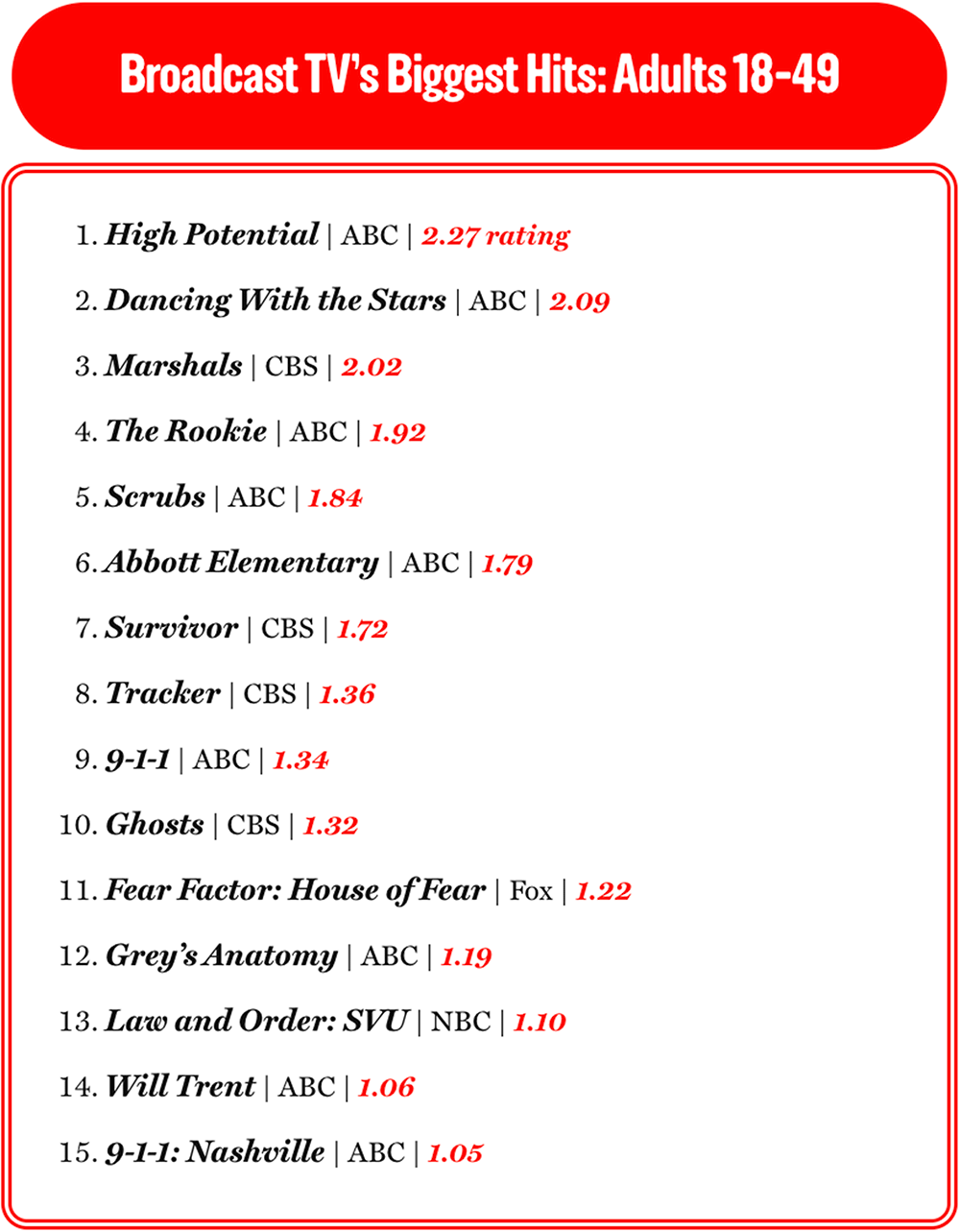
➽ Looking just at broadcast shows, ABC dominated the MP+7 numbers in key demographic groups. Among adults under 50 — the demo historically most coveted by advertisers — the Disney network had the top-rated drama (High Potential), comedy (Scrubs), and reality show (Dancing With the Stars), and snagged fully half of the top 20 broadcast shows in the demo, and six of the top ten. CBS, despite its reputation for skewing old, also had reason to be happy, claiming the other four shows in the demo top ten, including Sunday standout Marshals and its two seasons of Survivor. And among adults under 34, broadcast’s number-one show in MP+7 was the aforementioned DWTS. (Demo information for streaming-exclusive shows this season has not yet been released by Nielsen or platforms, but last season, per Variety, streamers accounted for 14 of the top 15 shows among adults under 50 as measured by MP+35, with High Potential ranking as the No. 1 broadcast show.)
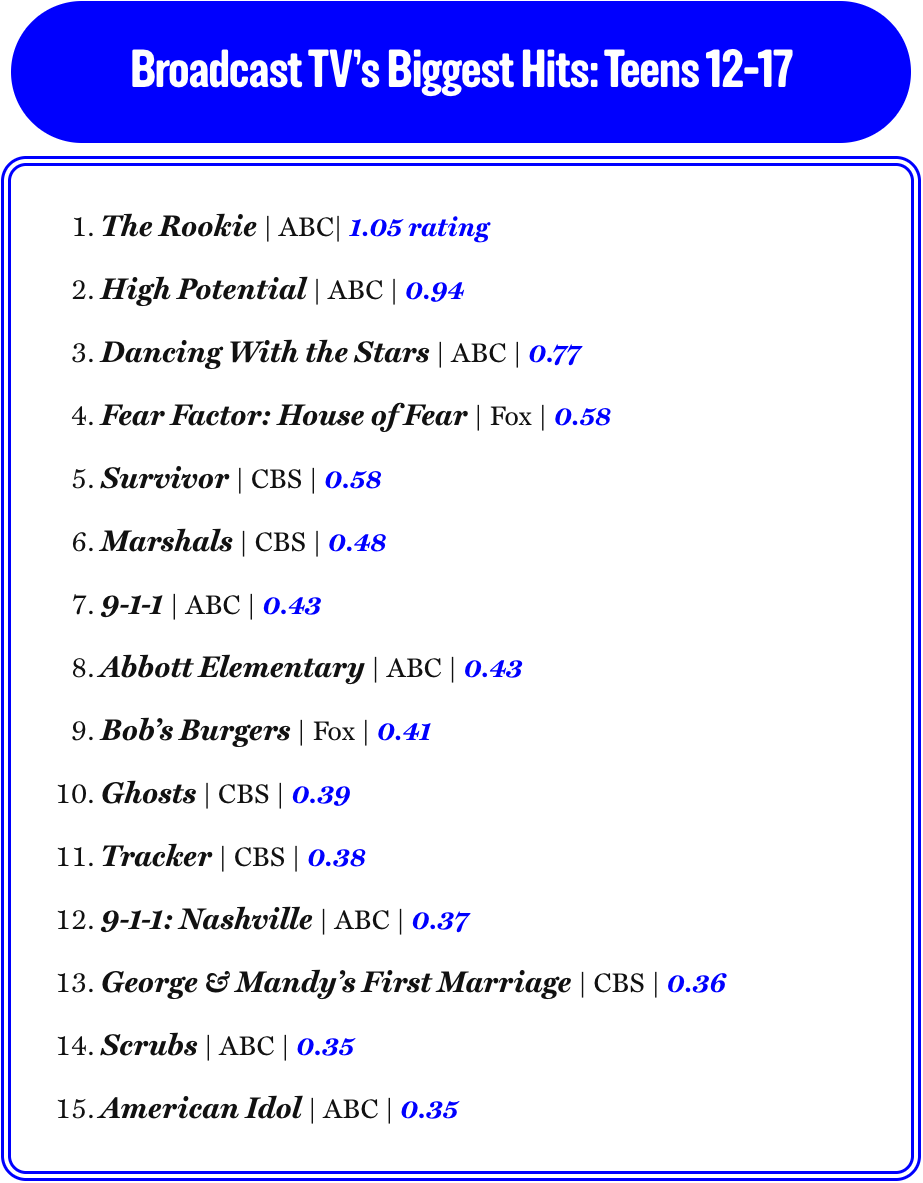
➽ While teens don’t watch a lot of broadcast TV these days, they do really love one linear show: The Rookie. ABC’s veteran cop show was this season’s No. 1 linear program with viewers age 12 to 17, per Nielsen’s MP+7 numbers. It was also the only show to earn above a 1.0 rating in the demo. “The Rookie continues to defy all the odds and just continues to grow,” ABC’s Goldman says. “The pilot had its biggest year ever in consumption last year, even though it’s been around for eight years. We just keep onboarding new viewers every day that goes by.” Much the way vinyl records and other physical media have experienced a comeback, the exec thinks “the week-over-week kind of appointment TV mechanism of broadcast” — see also: Dancing With the Stars — is connecting with Gen Z and Alpha. “I actually think younger audiences are discovering that they like being a part of something urgent and part of a cultural conversation,” Goldman says.
➽ As noted earlier, extending the ratings measurement period from seven days to five weeks — MP+35 — notably increases total viewership for many shows. It also particularly benefits streaming-only shows, which don’t have timeslots or the benefit of a big network launching pad. Case in point: His & Hers. The Netflix show did really well in its first week of release, generating an average audience of 9.6 million viewers in MP+7, good enough to land at No. 7 overall in that metric. But as viewers got wind of the series and found time to binge all six episodes, its audience absolutely exploded, tripling to 25.6 million viewers in MP+35 and soaring to No. 2 among all broadcast and cable shows in the extended frame.
We won’t have full-season MP+35 numbers until next month, but based on measurement through April 19, Netflix is likely to end up with eight shows in the MP+35 top 25 versus just three in MP+7 — including The Lincoln Lawyer and The Beast in Me — while Paramount+ and HBO Max are likely to snag two spots instead of just one. ABC is poised to have four top-25 shows (versus five in MP+7), while CBS could end up with seven shows instead of ten. And NBC? Right now, if current trends hold, the Peacock network has only one show with a shot at making the MP+35 top 25: Chicago Fire. It’s worth noting that NBC has shifted billions of dollars away from scripted programming to invest in more sports programming on the network and Peacock, making it not too surprising that it would have so few multi-platform scripted hits. Plus Peacock is by far the smallest of the major streaming services, which makes it harder for NBC network shows to reach digital audiences.
Here’s Nielsen’s list of the top 25 most-watched shows across broadcast and streaming this season, plus a look at how some broadcast shows performed in key demographic groups. |
Source: Cross-platform analysis of Nielsen linear and streaming data for broadcast and streaming series over first seven days of release, excluding sports, specials, news, and kids programming, between Sept. 14, 2025 and May 20, 2026. |
|
|
|
Source: Cross-platform analysis of Nielsen linear and streaming data for broadcast series over first seven days of release, excluding sports, specials, news, and kids programming, between September 14, 2025 and May 20, 2026. |
"Gooooooooooooal!” Photo: Bradley Collyer/PA Images via Getty Images |
Are you ready for some football? No, not the NFL. Today marks the official kick off for the FIFA World Cup, the latest quadrennial international tournament of which is taking place in the United States, Canada, and Mexico. It’s a huge deal for soccer fans, but also for a number of U.S.-based broadcast, cable and streaming platforms hoping to turn growing interest in the sport into a big financial win.
While nobody expects the World Cup to do Super Bowl-sized ratings here in the States — the most-watched match of the 2022 edition drew fewer viewers than the current NBA Finals — the fact that the event is being held in North America for the first time in more than three decades, plus the decision to expand the number of games and teams, means that cumulative viewership over the next month will almost certainly set ratings records in America. Here’s a look at which platforms have the most to gain from FIFA 2026, and how they’re planning to capitalize on the tournament:
|
|
|
|
Fox (Fox Broadcasting, Fox One, Fox Sports 1, Tubi) |
As the official U.S. broadcasting partner, Rupert Murdoch’s media empire is all in on the World Cup, with coverage planned on every one of the company’s platforms. And while the Fox broadcast network will be how most viewers here watch the biggest matches of FIFA 2026, Fox One — the company’s main streaming service — has the most riding on the tourney. Launched just last August, the platform hosts livestreams of the Fox network and virtually every Fox cable asset, including Fox Sports 1 (FS1), which means it will stream every one of the 104 planned matches. So for cord-cutters who don’t pay for YouTube TV, Fubo or similar services, Fox One will offer full access to FIFA 2026 at the most attractive price point — $19.99 per month — of any digital cable alternative. Fox One has been playing up that all-access element in promos, hoping to lure in FIFA fans scrambling to find a way to watch the tournament by offering a free three-day trial to the service. The hope, of course, is that folks who sign up to watch soccer for a month will stick around once FIFA is over.
Just how successful that strategy will prove is hard to tell: Unlike a Peacock or Hulu, Fox One doesn’t offer original scripted entertainment programming to keep audiences hooked between big live events. While it does provide in-season access to the Fox network’s handful of dramas and comedies, it’s mostly designed to appeal to audiences who want access to Fox News Channel and Fox’s sports offerings outside of the cable bundle. But that also means Fox isn’t investing billions in content just for Fox One, and as such, doesn’t need to pull in as many subscribers as its bigger rivals to be a success. So even if the World Cup only ends up netting Fox One a few hundred thousand subscribers, it could probably be considered a win for the nascent platform. (Fox One has not yet said how many subscribers it has.)
One way Fox will look to lure streaming viewers into the FIFA universe is through its free, ad-supported platform Tubi. The service streamed today's Mexico vs. South Africa match and will also run the June 12 game between the U.S. and Paraguay, along with opening ceremonies, meaning fans without cable or a broadcast antenna — the games will also be on the Fox broadcast network — can watch for free. There is a 100-percent chance Tubi will run spots for Fox One around the game, as well as for coverage on Fox, effectively serving as promotional arm for its sibling services. Tubi has also launched a World Cup Fox Hub on the platform which will be used to promote games throughout the tournament and to serve up soccer-related content, including a handful of Tubi original series themed around the sport.
As for the main Fox network, it will air most of the tournament’s biggest games, including every match from July 4th until the finals later in the month. Given how low ratings during the summer tend to be for all broadcast networks, Fox is guaranteed to dramatically boost its audience levels over the next month, and while that will obviously yield immediate financial dividends for it and Fox Sports (higher ad revenue), the network will be able to use what will be some of its biggest audiences of the year (outside of NFL Sunday games) to tout its current and upcoming Fox primetime fare, including new summer show Nation’s Dumbest plus next winter’s reboot of Baywatch.
|
|
|
|
NBCUniversal (Telemundo and Peacock) |
While Fox is the main English-language partner for FIFA 2026, NBCU’s Telemundo has Spanish-language rights to the tournament. The company will be airing 92 out of 104 games on its broadcast stations and via its connected Telemundo app, while a dozen matches will be seen on the Universo cable channel. All matches will also stream on Telemundo sibling Peacock — though, be warned, both the audio and closed-captions will be in Spanish. But NBCU isn’t treating this like some niche offering: It’s using much of the same interactive tech it’s brought to Olympics coverage to snazz up its Telemundo offering, including multi-view, an interactive schedule, and Pitchside Live, which offers multiple viewing angles for key matches. Coverage will also use Dolby Atmos for sound, which should make every “gooooooooooooal” sound amazing.
|
|
|
|
Other players (Roku, YouTube, and more) |
While Fox and NBCU are officially partnered with FIFA for the World Cup, just about any streaming platform which carries content from those companies will be looking to push coverage of the tournament over the next month. Roku, with its massive user base, will connect viewers via its Soccer Zone landing page, which will combine scores and links to highlights and live coverage on Fox One, Peacock and other apps. Virtual cable offerings such as Fubo will also be pushing themselves as ways for cord-cutters to watch the matches via Fox One or Peacock. And of course, Google’s YouTube and YouTube TV will be packed with FIFA-related fare. Meanwhile, for audiences more into programming about soccer than the actual tournament, streamers such as Netflix, BritBox, and HBO Max are taking advantage of FIFA-mania by rolling out a slew of timely programming: documentaries, comedy series, and at least one satirical film starring Diego Luna.
|
|
|
|
|