
|



I don’t work in a chat window anymore. I work in the Business Engineer’s harness.
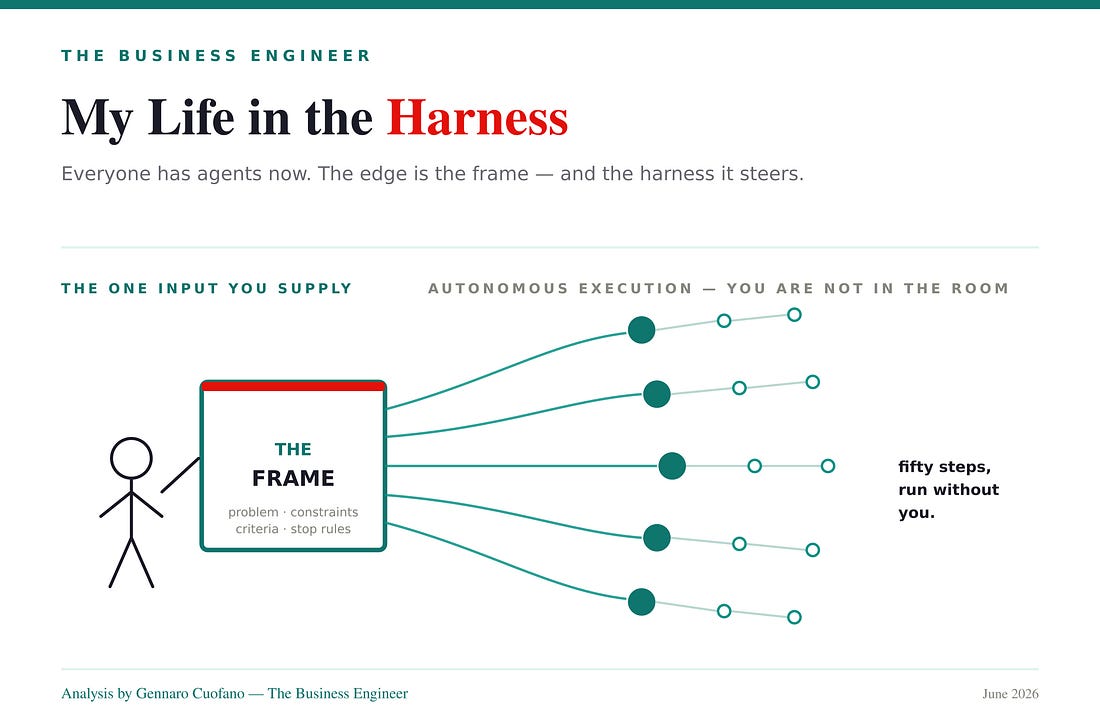
Somewhere in the last few months, the shape of how I produce has changed. I stopped typing prompts and reading answers one at a time, and started setting a frame in the morning and watching a swarm of agents carry it through the day — drafting, optimizing, scheduling, measuring, adjusting — while I did the one thing none of them can do for themselves: decide what was worth doing, and define what good meant before any of it ran.
And I’m rarely at a desk when it happens. I set the frame from a phone — in transit, between other things, walking — because the work no longer runs where I am. It runs in a runtime somewhere else, and the thing in my hand is just the surface I steer it through. The computer I spent thirty years sitting in front of has quietly left the room.
This isn’t a piece about tools. It’s about what’s left for a person to do once the tools can do almost everything. The answer is smaller and sharper than most people expect — and the whole map of it fits in six moves. Here they are, one at a time.
 |
The edge has moved to framing
The scarce, valuable skill is no longer operating the model. It’s framing the work before the model runs.
Here is the rule that governs every technology shift: when a capability becomes universal, it stops being an advantage, and the edge moves up the stack to whatever is still scarce.
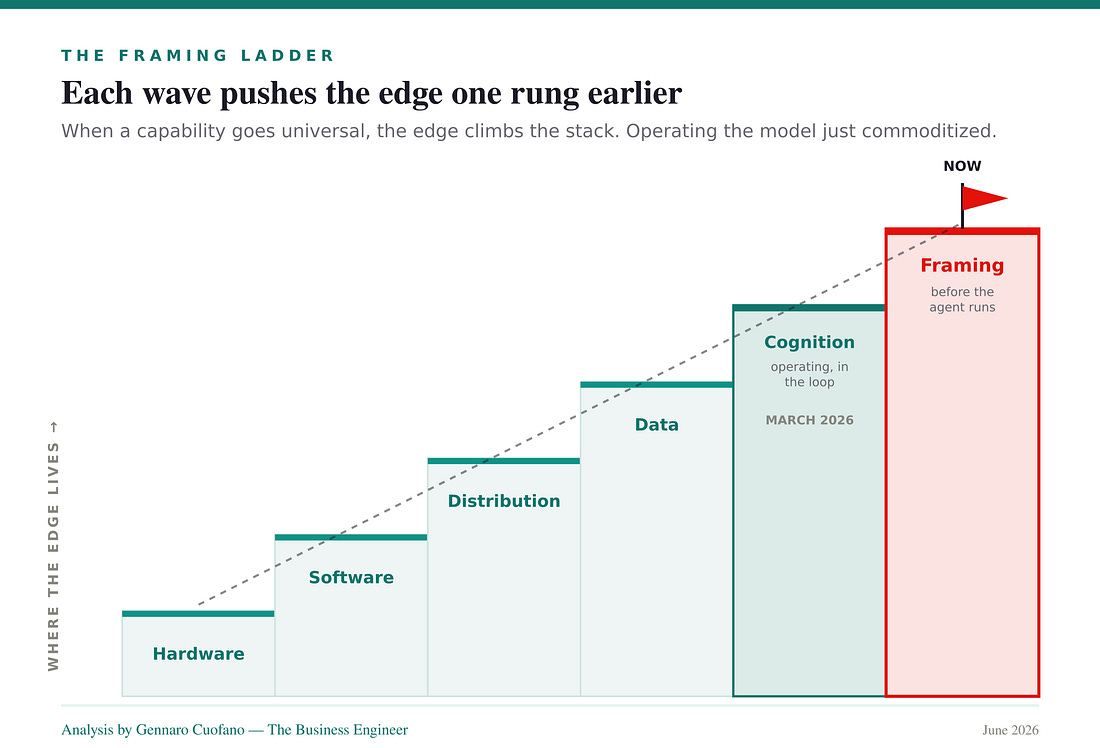 |
Trace it. Hardware was once the edge — until hardware became cheap and abundant, and the advantage moved up to software. Software commoditized, and the edge moved to distribution. Then to data. At each step, once everyone had the layer, it stopped being where the advantage lived, and the advantage climbed one rung higher.
AI capability has now reached that point. Everyone has the same frontier models. The compute is cheap, the interfaces are frictionless, and the gap between a well-funded team and a solo operator with a credit card has all but closed. So the edge has already left the model itself. For a short while it sat one rung up — in operating the model: the skill of working a chat window well, structuring the problem, reading the output, re-prompting toward something sharp.
That rung is commoditizing too, and fast — because of agents. An agent doesn’t wait for you to prompt it. It prompts itself, reads its own output, notices its own errors, and re-runs. The skill of working the chat window is being absorbed into the system. So operating, the thing that was briefly the edge, is becoming something the machine does for itself.
Which moves the edge up one final rung — to the one input the agent cannot generate on its own: the frame. Framing is everything you decide before the agent runs. It has four parts:
Problem definition — what is actually being solved, stated as a mechanism, not a wish.
Constraints — the boundaries any acceptable answer has to stay inside.
Evaluation criteria — what “good” looks like, specified in advance.
Stopping conditions — when the agent should halt, escalate, or hand back.
The frame is the whole of the human contribution. Everything downstream of it is execution. That is the first move, and the rest of the piece follows from it: if framing is the edge, then everything else — why it matters, who’s exposed, how to do it, what it steers, and what it does to the industry — is a consequence.
Autonomy removed the safety net
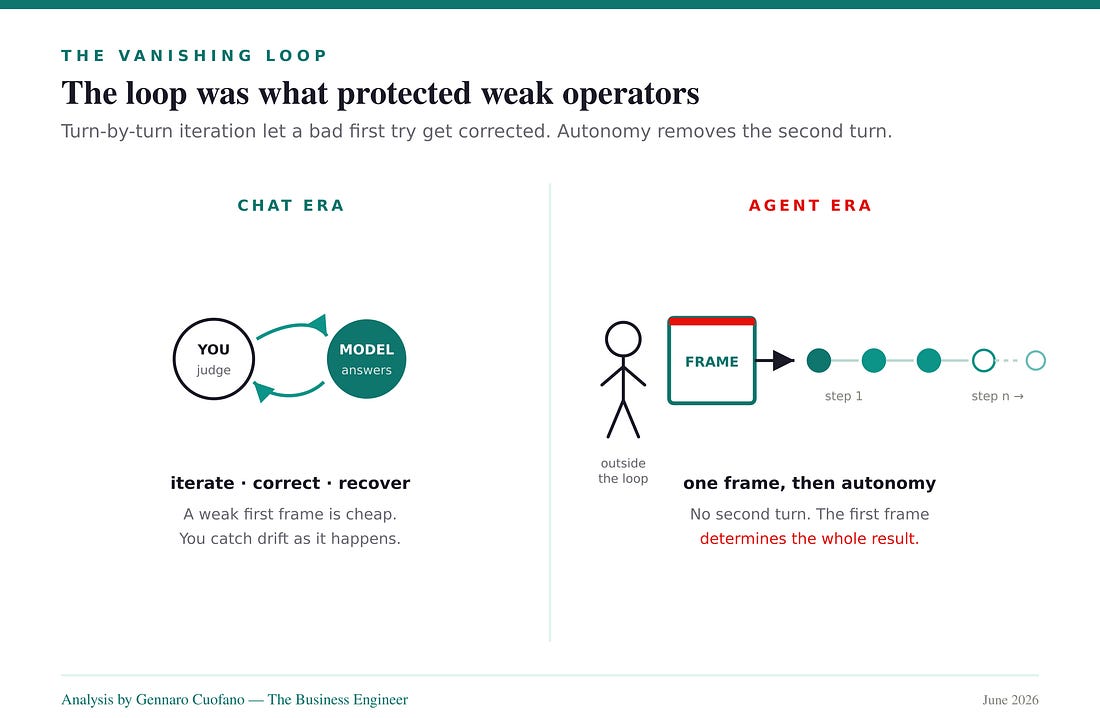 |
In the old way of working, a weak first attempt was cheap because you could fix it as you went. Autonomy removes that, so the first frame now decides the outcome.
Think about how working with a chat model used to go. You asked a rough question, got a rough answer, saw it was rough, and asked a better one. The cost of a bad first try was low, because you stayed in the loop turn by turn and caught the drift as it happened. Trial and error did a lot of the thinking for you. A careful operator and a careless one both reached a decent answer in the end — the careless one just took longer.
An autonomous agent removes that loop. It runs fifty steps without checking back. There is a frame at the start and a result at the end, and nothing in between where you correct course. If the frame was weak — wrong problem, soft constraints, no definition of “good” — the agent doesn’t notice. It executes the weak frame faithfully, confidently, and fast, and hands you a polished, internally consistent answer to the wrong question, delivered at a speed that makes it look authoritative.
That is the characteristic failure of this era, and it has a shape worth naming: confidently wrong at scale. A small error in the frame fans out into a large error in the output, because every autonomous step compounds the one before it. The old way punished a bad frame with a few wasted minutes. The new way punishes it with a finished deliverable that’s wrong in a way nobody catches until it ships.