
|



Back in 2022, I introduced my first analogy for what I believed would become the defining shape of the AI revolution.
As an analyst, a student of history, and someone deeply interested in structural realities, I see it as my responsibility to make a deliberate effort to contextualize, abstract, compress, and build mental models that help explain the world around us.
That is what The Business Engineer is about. For me, it is a lifelong quest.
So when ChatGPT was released, I felt it was essential to provide a framework, a mental model capable of making sense of the emerging AI era.
At the time, despite the relentless pace of progress in AI, it is easy to forget how many people believed everything would change within a single year. The expectations were immense. In that environment, I felt a better frame was needed.
That is where the AI Supercycle Thesis emerged.
And a word of caution: the term supercycle should not be interpreted as a purely economic concept. It goes far beyond economics. It describes the intersection of three powerful forces: geopolitics, cultural transformation, and economic change.
The economy is only one layer of the story. In many ways, it is the instrument through which deeper geopolitical and cultural shifts express themselves.
The AI Supercycle is ultimately an attempt to understand the thread connecting these forces and how, together, they shape the next era of human development.
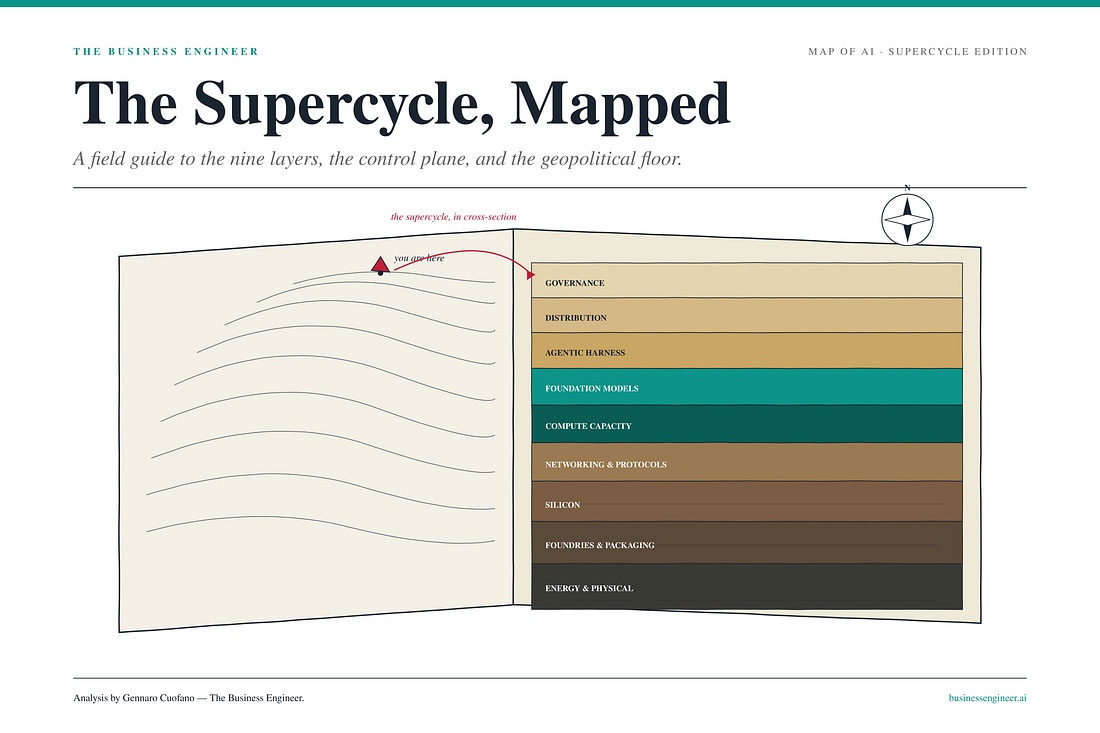
For that reason, the AI Supercycle is not a forecast. It is a structure. A thirty-to-fifty-year economic transformation comparable in scope to the Industrial Revolution, running on three nested clocks, exhibiting the paradoxical dual character of bubble and revolution at the same time, and operating through a nine-layer industrial stack that begins in mineral extraction and ends in geopolitical control. This piece is the map.
 |
 |
The Argument in One Paragraph
We are inside the first decade of a transformation that will run for half a century.
It has three nested cycles operating at different time horizons, a dual character that is simultaneously a bubble and a supercycle, and a layered industrial stack of nine layers, running from energy at the bedrock to governance at the ceiling.
The ceiling does not behave like a layer. It behaves like a control plane perpendicular to the whole stack — one that answers to geopolitics rather than engineering.
The floor does not behave like a market. It behaves like a geopolitical chokepoint — a small handful of countries deciding what the rest of the stack is allowed to build. Everything between the floor and the ceiling is where the next decade of competition lives.
What the Supercycle Actually Is
 |
The launch of ChatGPT on November 30, 2022 was not the arrival of AI. AI had been arriving for years before that night.
What changed is that AI reached the point where it could scale to billions of users on the same day. That capability threshold — distribution at consumer-internet scale — is what triggered the supercycle. It forced every layer of the existing technology economy to absorb a new substrate simultaneously, and substrate-level shifts of that magnitude are what produce multi-decade economic transformations.
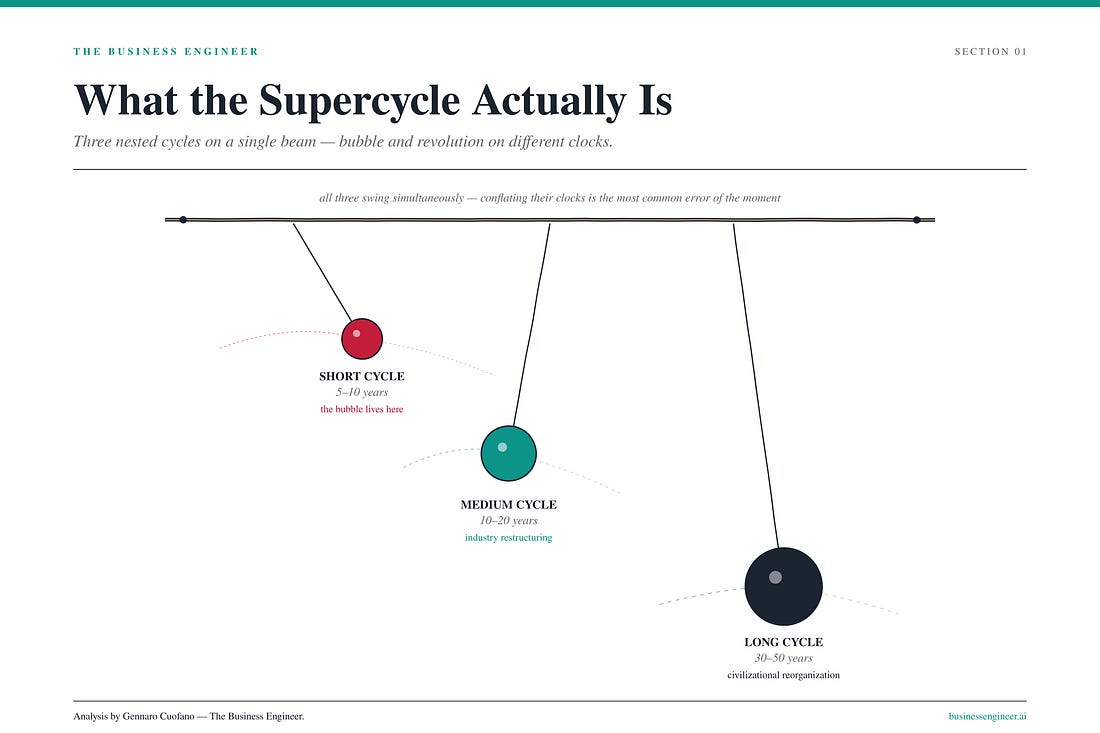
Three cycles run inside the supercycle, each on its own clock:
Short cycle (5–10 years): rapid capability improvements and market disruptions. Where the bubble lives. Where most pundits spend their attention.
Medium cycle (10–20 years): industry restructuring, business-model evolution, the end of incumbent dominance in software and search.
Long cycle (30–50 years): civilizational transformation. Comparable to the half-century electricity took to reorganize industrial production around itself between 1890 and 1940.
Conflating these clocks produces the most common analytical errors of the moment. The “AI is overhyped” camp and the “AI changes everything” camp are usually arguing about different cycles without realizing it.
The dual character is the most useful piece of intellectual scaffolding for navigating the present. AI exhibits genuine bubble characteristics — excessive hype, overvaluation, capex commitments that exceed the unit economics of any single application — at the same time as it exhibits genuine supercycle characteristics — real productivity gains, fundamental restructuring of profit pools, civilizational impact. Both are true.
The mistake is treating them as competing claims. They operate on different cycles. The bubble can pop on the short cycle while the supercycle continues uninterrupted on the long cycle, exactly the way the dot-com bust did not stop the internet from becoming the substrate of the next thirty years.