What matters in U.S. and global markets today

Start the day with Reuters on the stories moving U.S. and global markets. Subscribe for $1/week.


Morning Bid U.S.

Morning Bid U.S.

A Reuters Open Interest newsletter

What matters in U.S. and global markets today


By Anna Szymanski, Editor-in-Charge, Reuters Open Interest

Global stocks were steady on Wednesday as markets awaited new Federal Reserve Chair Kevin Warsh's debut meeting at the helm of the U.S. central bank. Policymakers are widely expected to keep interest rates unchanged today, so investor focus will be on the messaging.

Meanwhile, oil prices steadied after dipping under $80 per barrel for the first time in months on Tuesday, as more details about the U.S.-Iran memorandum of understanding emerged, including the potential lifting of sanctions on Iranian oil.

I'll get into that and more below.

But first, listen to the latest episode of the Morning Bid daily podcast. Subscribe to hear Reuters journalists discuss the biggest news in markets and finance seven days a week.


Data refreshes every time you open this email. For more U.S. market news, click here. Please send any feedback to morningbid@thomsonreuters.com.


Today's Market Minute

  • A $300 billion private fund designed to trigger investment into Iran is outlined in the U.S.-Iran framework agreement and more than half that sum has already been committed, according to a Reuters exclusive.
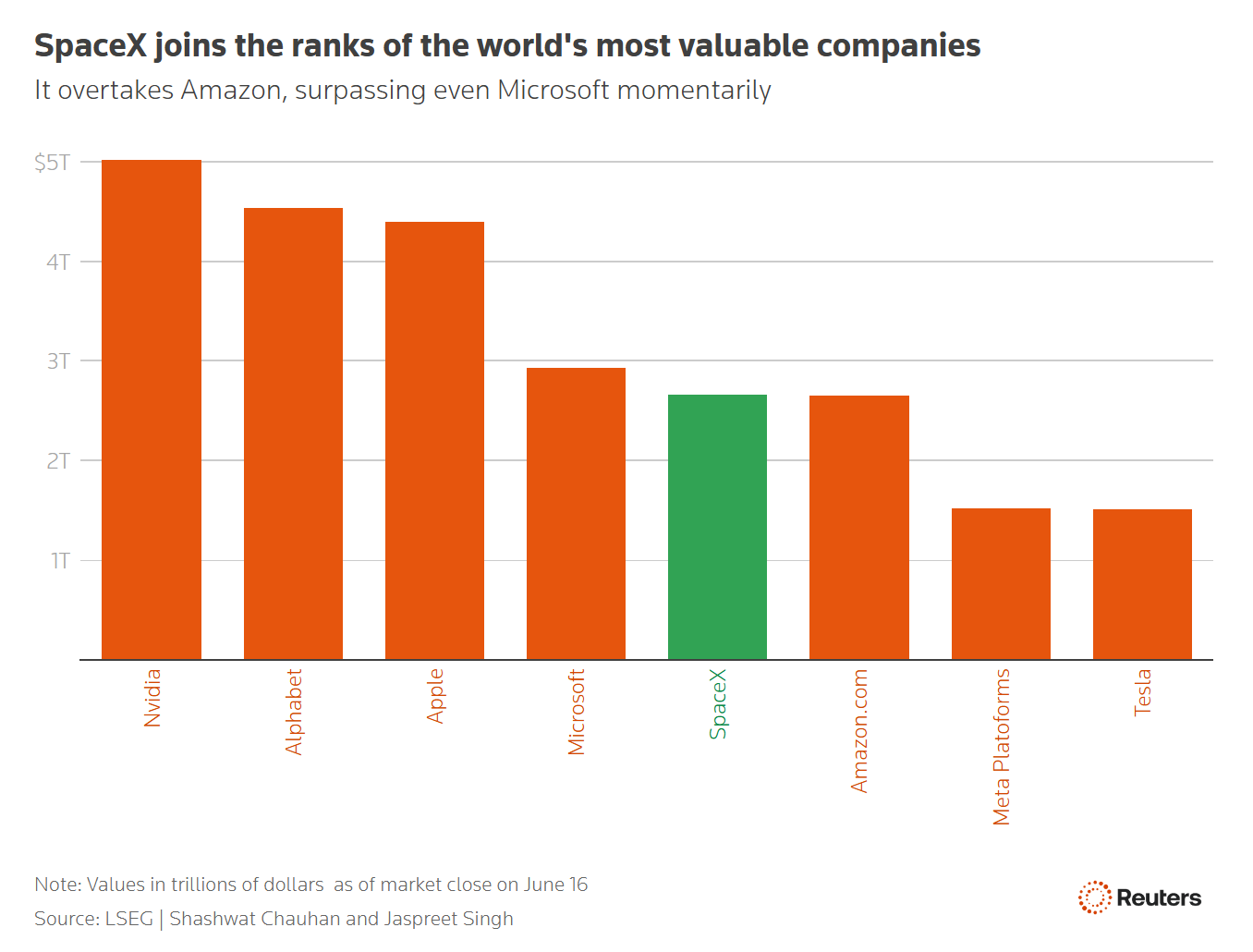
  • SpaceX roared past Amazon's market valuation on Tuesday and briefly topped that of Microsoft, rapidly scaling the list of the world's most valuable companies on a topsy-turvy trading day.
  • The Iran war has dampened global growth, but leaders of G7 economies are unlikely to blame U.S. President Donald Trump as they seek to avoid a clash when they meet in France to discuss the economy on Wednesday.
  • Kevin Warsh has pledged to communicate less as Fed Chair, but is reticence really an asset? Former Reuters Senior Editor Mike Peacock breaks down the importance of effective central bank communication and why quality may beat quantity.
  • Europe's natural gas market appears to have passed the Hormuz stress test, but structural trends could raise pressure over time and hasten a transition away from gas, argue Martin Vladimirov of the Center for the Study of Democracy and Borbala Toth of the Regional Centre for Energy Policy Research.
 

Welcome to the Warsh era

While policymakers aren't expected to change the federal funds rate for now, markets will pay close attention to how Warsh himself votes and the language he uses at the press conference this afternoon.

President Donald Trump, who appointed Warsh, repeatedly called for dramatic rate cuts under previous Fed Chair Jerome Powell. Trump has since reiterated his preference for looser policy, though he has indicated that he will give Warsh room to act as he sees fit.

The problem for Warsh is that markets will likely view his words and actions through a political lens regardless, making effective communication that much harder.

The big question today is whether Warsh leans against the market's more hawkish tilt in recent months. The Iran war-driven energy squeeze and relatively healthy turn in U.S. economic data have upped bets for rate hikes this year - something individual policymakers have signalled an openness to down the line.

Of course, the preliminary deal between the U.S. and Iran will impact projections for inflation and rates - though by how much remains to be seen.

On that note, bond yields fell on Wednesday as oil prices slid in early trading, with global benchmark Brent crude hovering around $79 a barrel. The catalyst for this latest drop appears to be reports that the U.S. will waive sanctions on Iranian oil for a defined period of time, with all U.S. and UN sanctions on Iran expected to be lifted if a final deal is signed.

Still, it's far too early to say how much oil and gas will be coming out of the Strait of Hormuz in the coming months, given all the unknowns about the deal itself and the damage to energy facilities caused by the war in the Gulf. This suggests that we could see some volatility ahead as the market finds its new balance.

Meanwhile, pressure on U.S. tech stocks yesterday dragged the S&P 500 and Nasdaq lower, while the Dow closed at a record high for a second straight day. Despite that, Elon Musk's SpaceX continued to rise, closing up nearly 5%, surpassing Amazon's market valuation - and even briefly eclipsing Microsoft's. Wall Street futures are pointing up slightly before the bell.

Elsewhere, a cooler-than-expected UK CPI print on Wednesday showed that inflation there unexpectedly held at 2.8% in May. Coming one day before the Bank of England meets, this print provides more justification for keeping rates steady, which is what the BoE is widely expected to do.


Today's key chart  


Graphics are produced by Reuters.

On Tuesday, SpaceX's market value surpassed Amazon's at $2.646 trillion and briefly topped Microsoft's $2.92 trillion. Next up are Apple, Alphabet and Nvidia, all above $4 trillion in market value.


Today's events to watch

  • U.S. Federal Reserve interest rate decision (2 p.m. EDT) and news conference (2:3