
|
 |



The software development industry has spent decades refining the relationship between developers and security teams. Secure development lifecycles, code reviews, static analysis tools and penetration testing all evolved around a central assumption: humans write software, and security professionals evaluate what those humans produce.
By 2026, that assumption is becoming increasingly difficult to defend. The emergence of so-called “vibe coding” has fundamentally altered how software is created. Rather than manually implementing functionality line by line, developers increasingly describe outcomes to AI-powered coding assistants that generate substantial portions of the resulting application. In many organisations, software engineers now spend as much time reviewing, refining and directing generated code as they do writing it themselves.
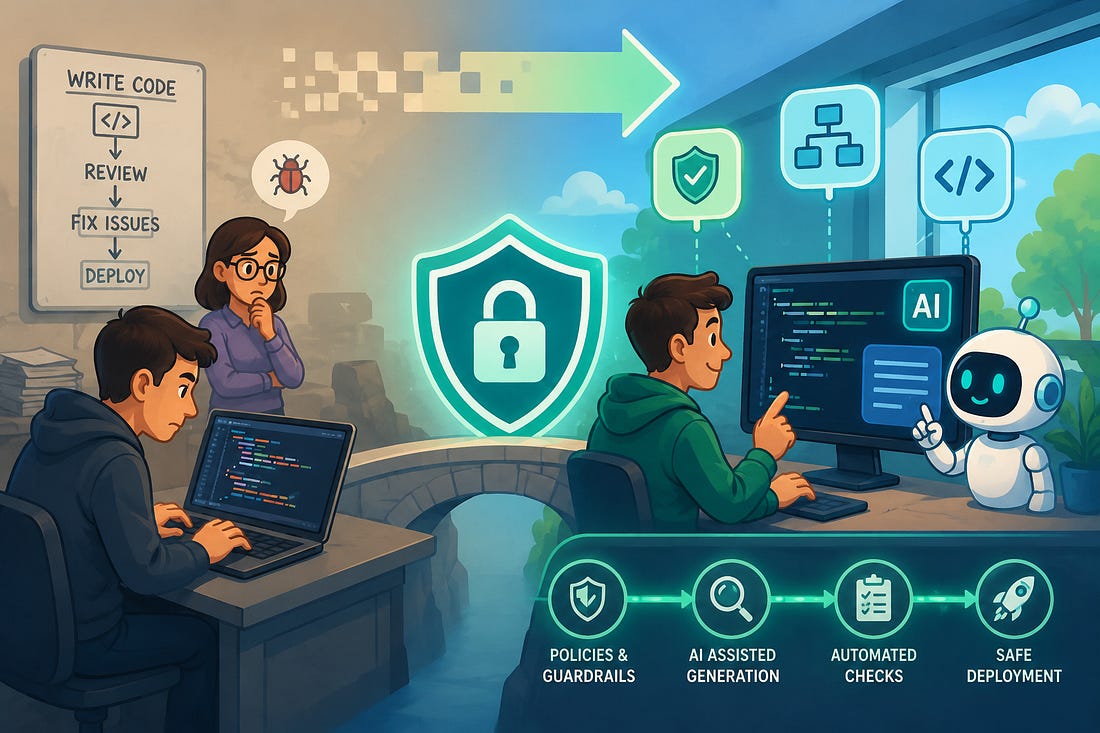
This shift has profound implications for cybersecurity. While discussions around AI-generated code often focus on whether it is secure, the more significant question is whether existing security practices are designed for a world in which software is produced at machine speed. As organisations continue to embrace AI-assisted development, cybersecurity teams are discovering that the traditional security perimeter has moved. The challenge is no longer simply securing code after it has been written. Instead, security must become embedded within the systems, workflows and guardrails that govern how software is generated in the first place.
 |
The End of the Secure Coding Bottleneck
For much of modern software development, security operated as a quality assurance function. Developers produced code, security specialists reviewed it, and vulnerabilities were identified before deployment. While imperfect, the model was broadly compatible with the pace of software delivery.
AI-assisted development changes that equation.
A developer using a modern coding assistant can generate thousands of lines of code in minutes. Entire application components, infrastructure definitions, database schemas and API integrations can be created through natural language prompts. Even experienced engineers who remain cautious about AI-generated output often use these tools to accelerate routine development work.
The productivity gains are substantial, but they introduce a scaling problem for security teams. If code can be generated ten times faster than before, security review processes do not automatically become ten times faster. Traditional manual review approaches struggle to keep pace with the volume of software being created.
This creates a bottleneck that many organisations experienced throughout 2025 and into 2026. Security teams found themselves reviewing larger quantities of code while maintaining responsibility for vulnerability management, compliance requirements and risk assessment. The result was an increasing recognition that existing review processes were not designed for AI-driven development environments.
The solution has not been to abandon security review. Instead, organisations have begun moving security controls earlier in the development process, focusing on influencing what AI generates rather than solely inspecting the results afterwards.
A New Threat Model for Software Development
Vibe coding introduces risks that differ from those associated with conventional development.
Historically, security programmes concentrated on developer mistakes. Vulnerabilities often emerged because engineers misunderstood security requirements, implemented flawed logic or failed to follow secure coding practices.
AI-generated code introduces additional considerations.
Large language models are trained on vast quantities of publicly available code, documentation and technical content. While this enables them to generate functional software rapidly, it also means they can reproduce insecure patterns that appear within their training data. Vulnerabilities that security professionals have spent years attempting to eliminate can reappear through generated implementations that appear reasonable at first inspection.
The challenge is compounded by the probabilistic nature of AI systems. Two developers providing similar prompts may receive different implementations of the same functionality. Traditional security governance relies heavily on consistency and repeatability. AI-generated software introduces variability that can make risk assessment more difficult.
Another concern involves ownership and traceability. When developers manually write software, it is usually possible to determine who implemented a particular feature and why specific technical decisions were made. Generated code can obscure these relationships, particularly when teams fail to document prompts, review decisions or modifications to AI-produced output.
As a result, security teams increasingly view AI-generated software as a supply chain challenge. The focus is not solely on the final code but also on understanding the processes, tools and models that contributed to its creation.
Why Application Security Had to Move Left Again
The concept of “shifting left” has been a recurring theme within cybersecurity for many years. The principle is straightforward: identify security issues earlier in the development lifecycle when they are cheaper and easier to resolve.
The rise of vibe coding has accelerated this trend. In traditional environments, shifting left often meant introducing static analysis tools into development pipelines or providing developers with secure coding training. In 2026, shifting left increasingly means influencing AI systems directly.
Security teams are developing prompt engineering standards, defining approved development workflows and creating security-aware coding environments. Rather than reviewing every line of generated software manually, they are establishing mechanisms that encourage AI tools to produce secure outputs from the outset.
This approach reflects a broader change in cybersecurity strategy. Security professionals are spending less time acting as reviewers and more time acting as architects of development processes. Their role increasingly involves designing systems that reduce the likelihood of insecure code being generated in the first place.
In many organisations, application security teams now work closely with platform engineering groups to build secure development environments that integrate policy enforcement, automated testing and AI governance controls. The objective is not merely to identify vulnerabilities but to make insecure development paths difficult or impossible to follow.
The Rise of Security Guardrails
One of the defining security developments of 2026 has been the widespread adoption of AI guardrails.
Guardrails are controls that constrain how AI systems operate within development environments. They may include secure coding policies, approved architectural patterns, dependency restrictions and automated validation mechanisms.
For example, a coding assistant might be configured to avoid insecure authentication methods, recommend approved cryptographic libraries or automatically flag potentially dangerous code before it reaches production. Some organisations have developed internal rule sets that are applied to every AI