
|



Your agents are still missing the context they need (Sponsored)
 |
AI shows up in 60% of engineering work. But only about a fifth of it can be handed off without someone babysitting the output. That’s because agents are missing context.
This 8-stage context maturity model gives a real answer on why you still get inconsistent output for all the tokens burned.
Join Unblocked live on June 24 (FREE) to learn:
Why more MCPs provides agents access but not understanding
What it takes to deploy agents you can trust without supervision
How a context layer solves for quality, efficiency and cost
This week’s system design refresher:
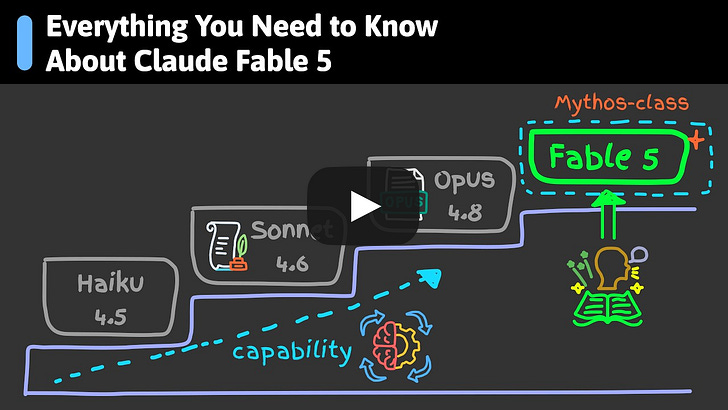
Claude Fable 5: Everything You Need to Know! (Youtube video)
12 Open-source LLMs
SLMs vs. LLMs, Clearly Explained
Single Agent vs. Multi-Agent Architecture
7 Permission Modes Every Claude Code User Should Know
Claude Fable 5: Everything You Need to Know!
12 Open-source LLMs
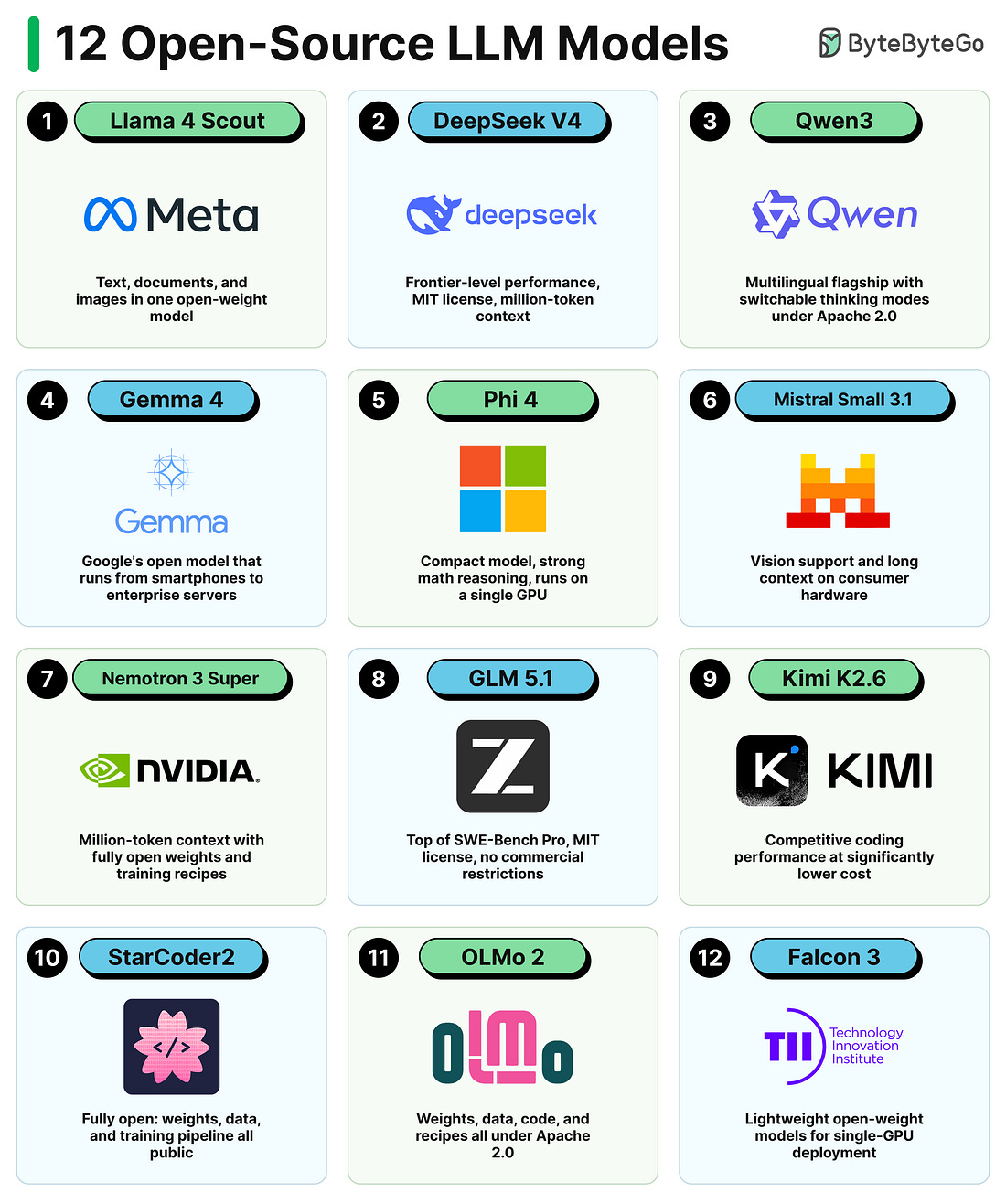 |
Twelve models worth knowing in 2026, each with one standout strength.
Llama 4 Scout: Meta's first natively multimodal open-weight model.
DeepSeek V4: A Mixture-of-Experts model under MIT license with a native million-token context window. Near-frontier performance at a fraction of the cost per token.
Qwen3: Alibaba's flagship open-weight model with switchable thinking and non-thinking modes, all under Apache 2.0.
Gemma 4: Google's open-weight family released under Apache 2.0, with the widest language coverage of any model on this list.
Phi 4: Microsoft’s compact model trained almost entirely on synthetic, curated data. A practical choice for edge and on-device deployment.
Mistral Small 3.1: A VLM with a long context window that fits on a consumer laptop.
Nemotron 3 Super: NVIDIA’s hybrid MoE with a million-token context window. Fully open weights, datasets, and recipes, with strong results on agentic coding benchmarks.
GLM 5.1: The first open-weight model to top SWE-Bench Pro. Released under MIT with no commercial restrictions.
Kimi K2.6: Competitive with leading closed models on coding while costing far less per million tokens. Available on Hugging Face under a Modified MIT license.
StarCoder2: One of the most transparent code models available.
OLMo 2 (AI2): The most complete example of open-source reproducibility on this list. Weights, training data, code, and full recipes all released under Apache 2.0.
Falcon 3: A family of lightweight open-weight models built to run on a single GPU.
Over to you: which open-source model would you add to this list?