
|



Ship Auth directly from your terminal (Sponsored)
 |
Run npx workos@latest to launch an AI agent that reads your project, detects your framework, and writes the auth integration directly into your codebase. No account required upfront. WorkOS automatically creates your environment and keys, then lets your claim the project when you're ready.
Once installed, manage users, orgs, and environments directly from the terminal.
This is Part 2 of our series with Shah Rahman, Global Head of Autonomous ML Iteration & Optimization for Ads at Meta, where he architects AI-native infrastructure and multi-agent systems at hyperscale. Connect with him on LinkedIn.
Part 1, published two weeks ago, was written for the individual engineer. Shah covered:
The shift from engineer to orchestrator
The four core practices: context engineering, spec-driven development, critical verification, and problem decomposition
The Agentic Development Life Cycle (ADLC)
The security guardrails that are no longer optional
Part 1 was about the person. Part 2 is about the organization. Here we cover:
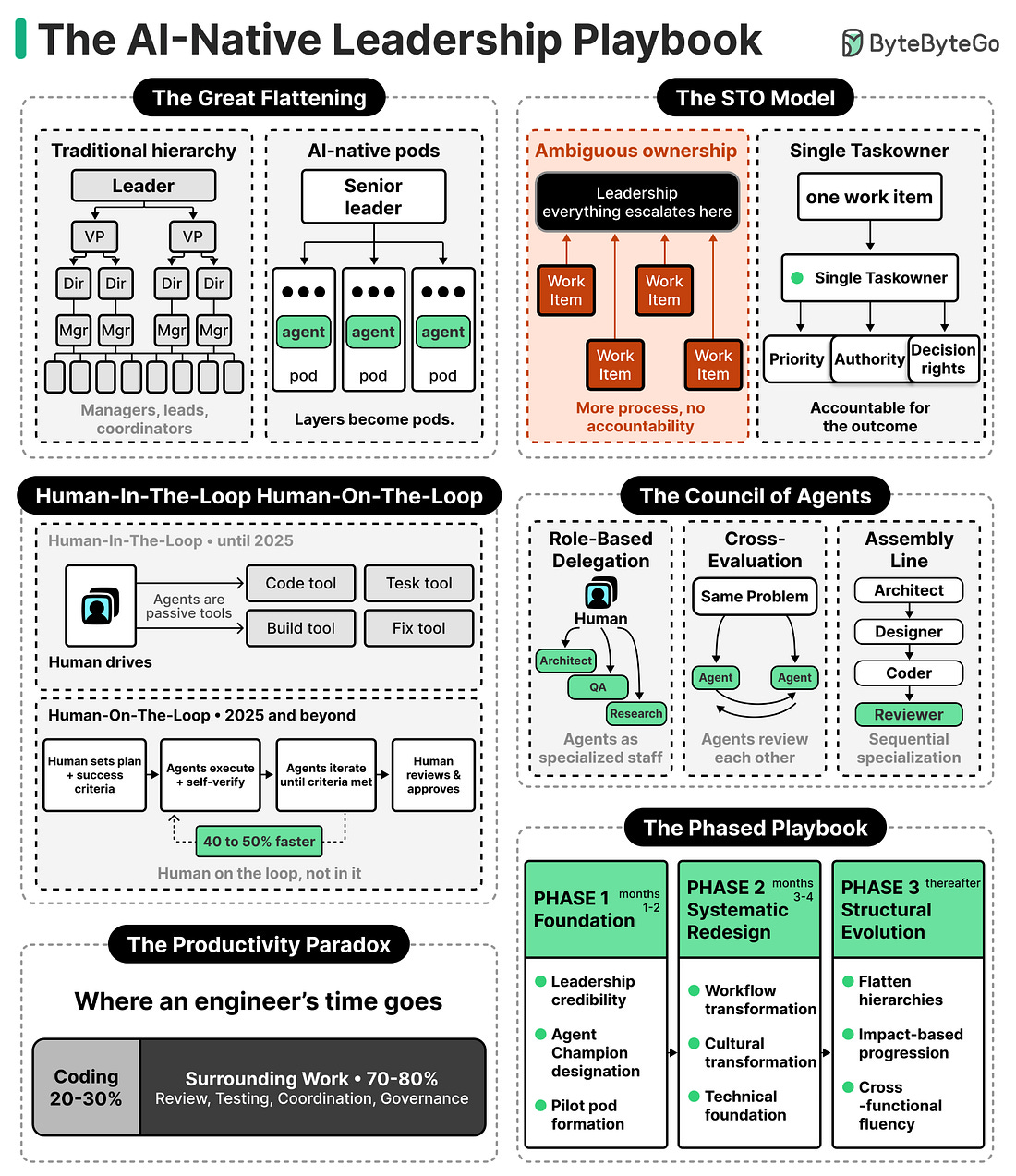
Pod-based structures and the Agent Champion model
The leadership crisis from first principles: ownership, empathy, and deciding what to build
A phased transformation playbook, plus the metrics that prove it worked
Individual gains do not become organizational gains on their own. This is the playbook for making that leap. Let’s dive in.
 |
The Great Restructuring
AI-native leadership is the most significant organizational transformation since the industry moved to agile more than a decade ago. Several companies watched AI-generated code climb from zero to 50 or 60% of their output inside a single year. Select teams have posted 2 to 10x productivity gains.
But we keep learning the hard way: individual tool usage produces individual gains, while systemic improvement takes deliberate leadership and a redesign of how work flows.
The evidence is hard to argue with. Around 70% of transformation success comes from operational and cultural change rather than from deploying technology. And most organizations get this wrong. They distribute tools, measure adoption rates, and then wonder why velocity refuses to move.
But some organizations are getting real results. At Shopify, CEO Tobi Lutke told employees that AI usage is now a baseline expectation, and that teams have to show why a task cannot be done by AI before they ask for more headcount. At Klarna, AI-driven restructuring reduced the workforce by more than a thousand people. These organizations treat AI as a fundamental operating model change, not a tooling upgrade. Almost everyone else is now racing to catch up.
Podified Organizational Structure
This is the atomic unit of AI-native engineering is the small, cross-functional team: 3 to 5 people operating autonomously with AI agents and tools. The hierarchies established during the dot-com era, all those layers of managers, leads, and coordinators, are being dismantled.
When a 10x engineer armed with AI tools can do what used to take a much larger group, the organizational consequences are significant. Some pods now report directly to senior leaders based on strategic importance. Team impact gets redefined around outcomes rather than headcount.
The results from one established team’s pod pilot were striking: 3 projects running on self-sufficient agentic loops, more than 90% engineer adoption across the org in under two months, and features built in hours rather than days using agent-assisted development loops.
Roles become fluid in this setup. Engineers may design, designers may code, and product managers may prototype directly. This is not role confusion, it is capability amplification. AI removes the traditional skill bottlenecks, so teams operate with more judgment and less procedural overhead.
 |