
|
 |
Does AI Really Prefer Markdown?
Nic Gould's critique highlights an important misunderstanding about how AI systems consume our documentation
|

| |||||||||||||||


Every few months a new claim appears in AI circles and quickly hardens into conventional wisdom. One of the latest is that “AI systems prefer Markdown.”
The argument usually goes something like this: Markdown is clean, lightweight, and easy to parse, therefore it must be better for AI.
Converting technical documentation to Markdown is often presented as a step in the right direction. Nic Gould, a linked data specialist Information and Data Architect for Delinian, recently challenged that assumption, and his argument is worth a closer look because it exposes a larger misunderstanding about how AI systems consume information.
The problem isn’t that Markdown is bad; it’s that too many people are treating markup syntax as though it were responsible for comprehension.
Some Tech Writers Already Know This Lesson
A markup language can represent meaning, but what it can’t do is create meaning where none exists. You can wrap a paragraph in tags, identify headings, define a table, a note, a warning, or a code sample. Structure helps both people and machines navigate information.
What structure cannot do is compensate for missing context, inconsistent terminology, undocumented assumptions, or unclear relationships between concepts.
If a procedure says:
Approve the request after validation completes.
the markup language isn’t the problem.
👉🏼 Who approves it?
👉🏼 What validation?
👉🏼 What event signals completion?
👉🏼 Where is the request located?
Those questions need answers whether the content is written in Markdown, HTML, or DITA XML.
 |
The Confusion Comes From Mixing Layers
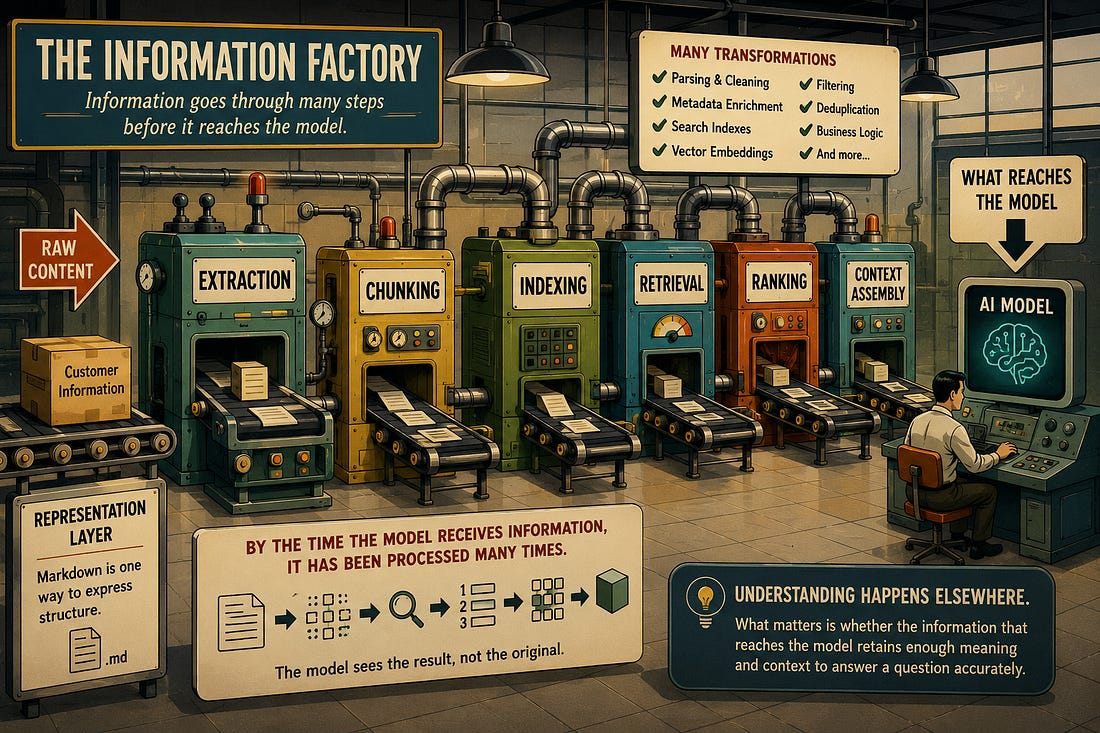
People often blur the distinction between representation and understanding. Markdown lives in the representation layer. It’s one way to express structure.
Understanding happens elsewhere.
Before information reaches a language model, it may pass through extractors, chunking systems, search indexes, retrieval pipelines, ranking algorithms, vector databases, APIs, and application logic. By the time the model receives information, it is working with tokens derived from content that has already been processed several times.
The model isn’t looking at a Markdown file and deciding it likes what it sees. 👀
What matters is whether the information that reaches the model retains enough meaning and context to answer a question accurately.
Why This Matters For Documentation Teams
The appeal of the “AI prefers Markdown” argument is obvious. It offers a relatively simple solution.
Content migrations are tangible. Converting repositories creates visible progress. Teams can point to a completed project and say they have done something to prepare for AI.
Improving information quality is much harder.
It requires identifying ambiguity, defining terminology consistently, documenting assumptions (that experienced employees carry around in their heads). And, it often requires untangling a content hairball that was built from the content debt accumulated over years.
There’s no conversion utility for that work.
Yet those activities frequently have more influence on answer quality than the choice of markup language. A retrieval system can find content quickly, yes it can. That’s a super power. But, it can’t reliably infer details that were never documented.
 |
This is one reason technical writers have become increasingly important in AI projects.
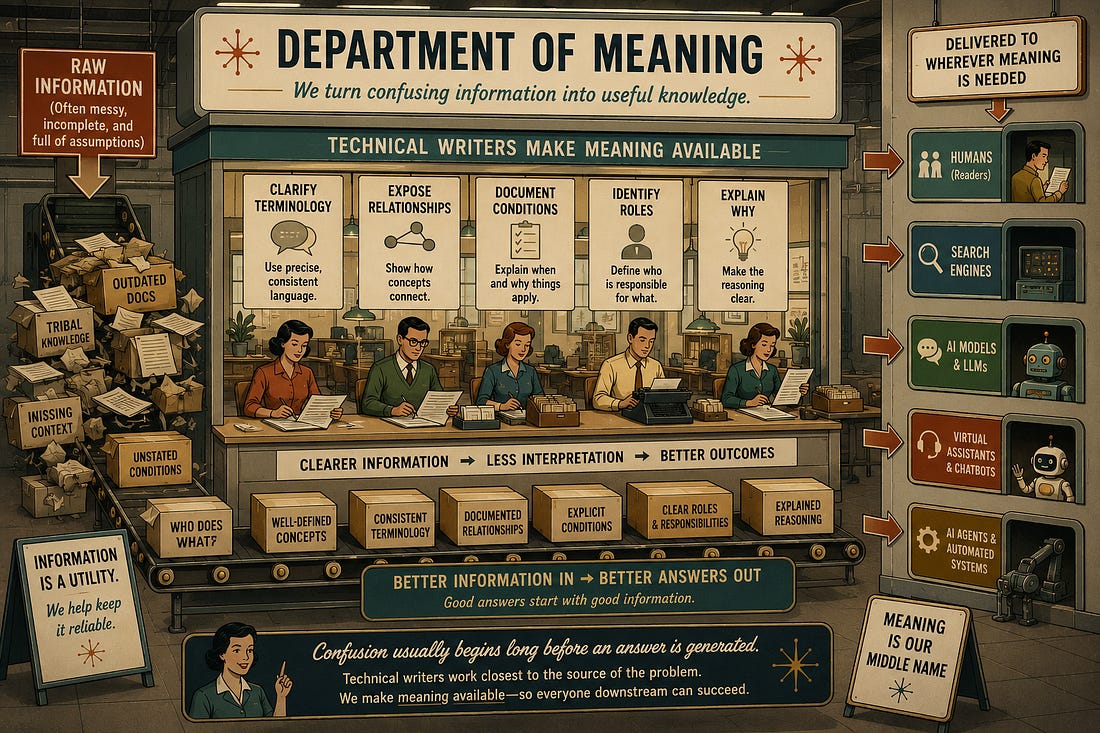
The challenge isn’t simply making content available to AI systems. The challenge is making meaning available.
What Tech Writers Bring To The AI Party
When tech writers clarify terminology, expose relationships between concepts, document conditions, identify roles, and explain why something happens, they reduce the amount of interpretation required downstream. That benefits readers; and, it also benefits retrieval systems, search engines, virtual assistants, AI agents, and language models.
Much of the current discussion around AI focuses on models, prompts, tools, and platforms. Those topics matter, but they often draw attention away from the information itself.
Tech writers sit closer to the source of the problem. We know that confusion usually begins long before an answer is generated.