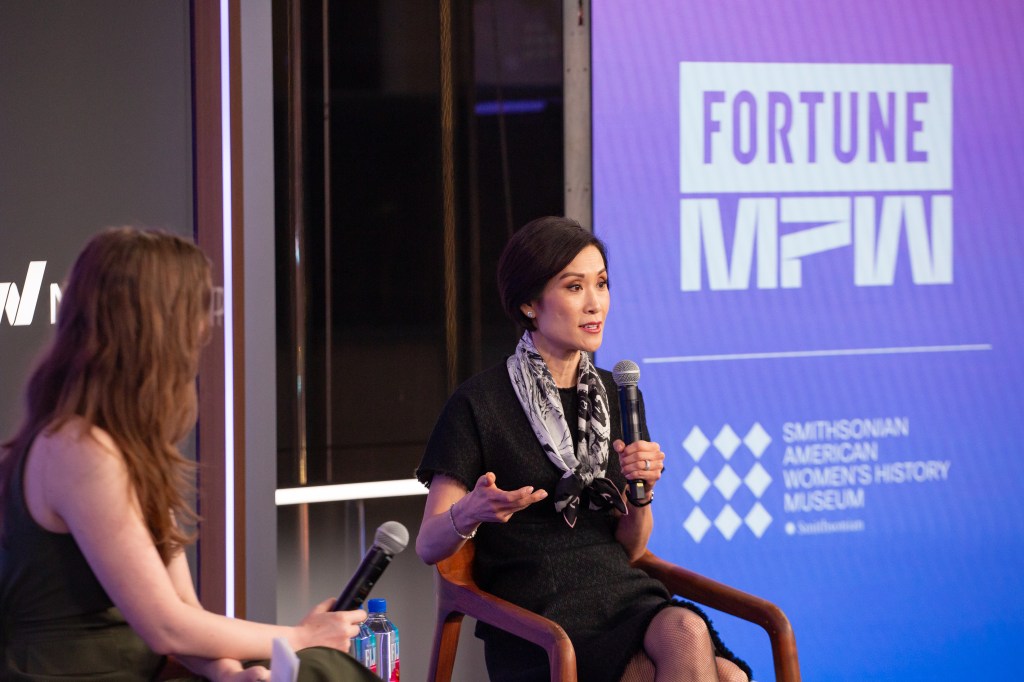
As America approaches the 250th anniversary of the signing of the Declaration of Independence, one theme is, of course, just how much independence women and people of color have had over those 250 years. For women, gaining financial independence has been a critical step to broader liberty, through efforts like the Equal Credit Opportunity Act of 1974, which granted women full rights to access credit in their own names for the first time.
Today, financial independence is often about knowledge—and career opportunity—as a precursor to power. So we were thrilled to partner with the Smithsonian American Women’s History Museum for a Fortune Most Powerful Women event at Nasdaq last night that tackled this exact topic. The forthcoming museum (which doesn’t yet have a permanent home in D.C.) has explored women’s financial independence through a project called
We Do Declare, in which curator Rachel Seidman interviewed women across generations about women’s access to credit, financial services, and economic opportunity.
We were joined last night by experts in these fields, including
Asahi Pompey, who as president of the Goldman Sachs Foundation oversees major initiatives like 10,000 Small Businesses and One Million Black Women; Tory Burch Foundation president Tiffany Dufu, who is working to execute the foundation’s goal to add $1 billion to the U.S. economy through women entrepreneurs by 2030 (it’s
halfway there); and Anne Ackerley, who led BlackRock’s retirement group. Ackerley observed the basic gaps in knowledge that even the most successful women in business sometimes have when it comes to their personal finances, while Pompey reframed the more than $100 trillion Great Wealth Transfer—women aren’t just sitting around, waiting to inherit, she says. And, in fact, they did much of the work that created that wealth in the first place—often without credit.
I interviewed Ida Liu, the Citi alum who is now CEO of HSBC Private Bank. (She was featured in this newsletter
a few weeks ago.) At Citi, she built the bank’s media and fashion practice and saw the differences between women who build wealth through entrepreneurship and those who inherit or come into money through marriage or divorce. Liu has fielded calls from recent widows, who tell her they don’t know how to log into their family’s accounts. But self-made women don’t have it all figured out either. “What I hear from them most of the time is, ‘I don’t have time to do that,'” Liu says. Liu’s work spans the globe, but she says ultra-wealthy women don’t behave that differently in different geographies. “Investing
with purpose and impact—that’s a global phenomenon,” she says.
Women don’t respond to advisors or private bankers who immediately enter “pitch mode” without getting to know them or their goals first, she has seen. And her advice to any woman figuring out her finances, even without billions to invest: make clear your personal risk tolerance, be clear on your objectives, and if you’re working with an advisor, look for someone with global and cultural fluency. And make sure to do an annual health check on the full scope of your finances. That’s how women take wealth and turn it into power.
Thanks to the Smithsonian American Women’s History Museum for partnering with us on this special evening. And, everyone, listen to Liu’s advice!
Emma Hinchliffeemma.hinchliffe@fortune.comThe Most Powerful Women Daily newsletter is Fortune’
s daily briefing for and about the women leading the business world. Subscribe here.