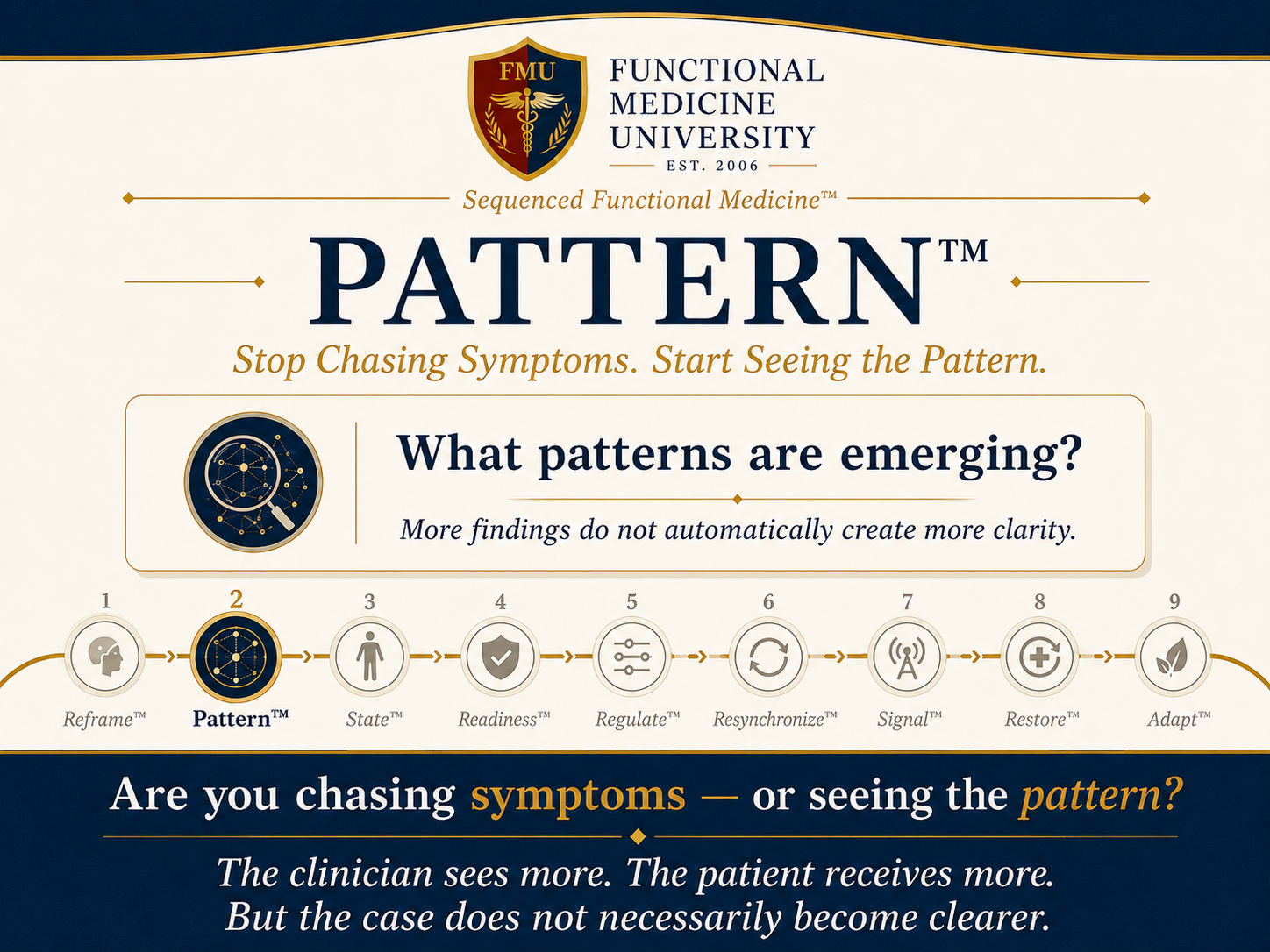
Pattern™ helps turn scattered symptoms, labs, history, and patient response into a clearer clinical direction.
Dear Colleague and Friend,
Yesterday, I introduced the first step in the FMU Nine-Step Sequencing Method™:
Reframe™.
Reframe™ asks:
What story am I telling myself about this patient?
That question matters
because the first story we tell ourselves can quietly govern the entire case.
Today, I want to move to the second step:
Pattern™
Pattern™ asks:
What patterns are emerging?
That may sound simple, but this is where many complex cases either begin to organize—or become even more confusing.
A patient may present with fatigue, bloating, poor sleep, anxiety, pain, weight gain, brain fog, inflammation, blood sugar instability, thyroid changes, and abnormal labs.
The natural reaction is to see a list:
A gut symptom. A thyroid marker. A sleep problem. A blood sugar issue. A stress physiology concern. A hormone pattern. An inflammatory signal.
Because each finding may be real, the clinician may feel pressure to address every one of them.
But that is where the case can begin to scatter.
The goal of Pattern™ is not to chase every symptom.
The goal is to ask:
What is this case trying to tell me when I place the symptoms, history,
labs, lifestyle, previous treatment response, and patient capacity together?
That is a very different question.
Without Pattern™, the clinician may treat bloating as a gut issue, fatigue as a mitochondrial issue, anxiety as a stress issue,
weight gain as a metabolic issue, and abnormal labs as separate correction targets.
Before long, the patient receives a larger plan—but not necessarily a clearer one.
More findings do not automatically create more clarity.
Sometimes, more findings simply create more possible directions.
Pattern™
helps the clinician slow down and ask:
What is connected?
What keeps repeating?
What appears to be driving the instability?
What is the patient least able to compensate for right now?
How does the patient’s previous treatment response change the meaning of the case?
Think again about Mary.
Mary has fatigue, brain fog, poor sleep, widespread muscle pain, anxiety, bloating after meals, weight gain, exercise intolerance, and several abnormal laboratory findings.
One clinician may see a gut case.
Another may
see blood sugar.
Another may see thyroid.
Another may see inflammation, stress physiology, or poor recovery capacity.
Each clinician may be noticing something real.
But Pattern™ asks something deeper:
Are these separate problems—or connected expressions of a larger pattern?
That question changes the case.
Suppose Mary has already tried supplements, several diets, a gut protocol, and hormone support—and feels worse every time something new is added.
The pattern may not simply be “gut dysfunction”
or “hormone imbalance.”
The emerging pattern may be:
low treatment tolerance, poor recovery capacity, unstable regulation, and a system that cannot yet handle more clinical load.
Once you see that pattern, the first clinical decision changes.
You may still care about the gut.
You may still care about hormones, blood sugar, and inflammation.
But you no
longer treat every finding as an isolated target.
You begin asking:
What does this pattern require first?
That is where Sequenced Functional Medicine™ becomes so important.
Sequenced Functional Medicine™ does not dismiss individual findings.
It organizes them.
It helps the
clinician move from:
“What else is wrong?”
to:
“What pattern is emerging—and what does that pattern require next?”
For the newer clinician, Pattern™ reduces overwhelm by revealing the organizing theme within a long list of symptoms.
For the experienced clinician, Pattern™ sharpens judgment by challenging us to ask whether our strongest clinical lens is
helping us see the complete pattern—or only the part we know best.
This is why Pattern™ follows Reframe™.
Reframe™ tests the first story.
Pattern™ organizes the scattered pieces.
Before your next complex patient, ask yourself:
Am I treating separate findings—or am I seeing the pattern that connects
them?
Then ask:
What is this patient least able to compensate for right now
That single
question may change what you do first.