
| Forwarded this email? Subscribe for more |



 |
| By The Free Press |
It’s Monday, July 13. This is The Front Page, your daily window into the world of The Free Press—and our take on the world at large. Today: Can AI really think? What do Maine Democrats do now? Why does Wikipedia think Lionel Messi is a Mossad agent? And much more.
But first: The death of Lindsey Graham.
In the 24 hours since Lindsey Graham’s sudden death was announced, the punditocracy has raced to define South Carolina’s senior senator. Even as he was being praised by President Donald Trump, Israeli prime minister Benjamin Netanyahu, and Ukraine president Volodymyr Zelensky, his critics focused on his willingness to ally himself with a man he had once described as “a wrecking ball for the future of the Republican Party.” In The New Yorker, Ruth Marcus said that in befriending Trump, Graham had abandoned most of his principles. On X, Steve Schmidt, a “Never Trumper” and former adviser to the late senator John McCain, called him “a simple, tragic man” who “lacked a moral core.”
Our Eli Lake has a less jaundiced and, we dare say, more dispassionate view. By making his peace with Trump’s victory—and becoming the president’s friend and adviser—Graham was able to “catch more flies with honey than vinegar.” Graham’s advice, writes Eli, “helped guide Trump to take military action against Iran, reconsider a premature and sudden withdrawal of U.S. forces from Syria, and perhaps avoid a full breakup with NATO.” Unlike so many other politicians who couldn’t countenance working with Trump, Graham got results.
“The republic lost a giant,” Eli writes. Read his appreciation to understand the full breadth of Graham’s influence.
—The Editors
 |
Sentient Robots and Cheating Students: Two Dispatches from the AI Revolution
Last week, Anthropic published a paper arguing that its Claude AI models have “developed a small collection of internal neural patterns,” and that the AI has private thoughts. It is the latest example of Silicon Valley claiming AI might be more than just a tool used by humans—and that it could have a consciousness all its own. Not so fast, says Spencer Klavan, who pushes back on the creeping movement to equate AI with humans, as if large language models that use mountains of data are reasoning the way humans do. Read Spencer’s column to understand why AI really is a machine—nothing less, but nothing more.
On the other hand, if there is one thing AI has become very good at, it’s helping students cheat on their exams. Brown University professor Roberto Serrano estimates that half his students are using AI to cheat. That would be bad enough. But then Serrano alerted the school—and was shocked to discover that administrators didn’t seem much interested in punishing the cheaters. “What happened in my class should be a lesson to all,” Serrano writes: “In our new AI era, if you do not expose and punish cheating, you will encourage it. We must all have the strength to choose otherwise.”
 |
Ditching Platner May Not Be a Win for Democrats | |||||
 | |||||
|
Why Antisemitism Is a Bigger Problem on the Left | |||||
 | |||||
|
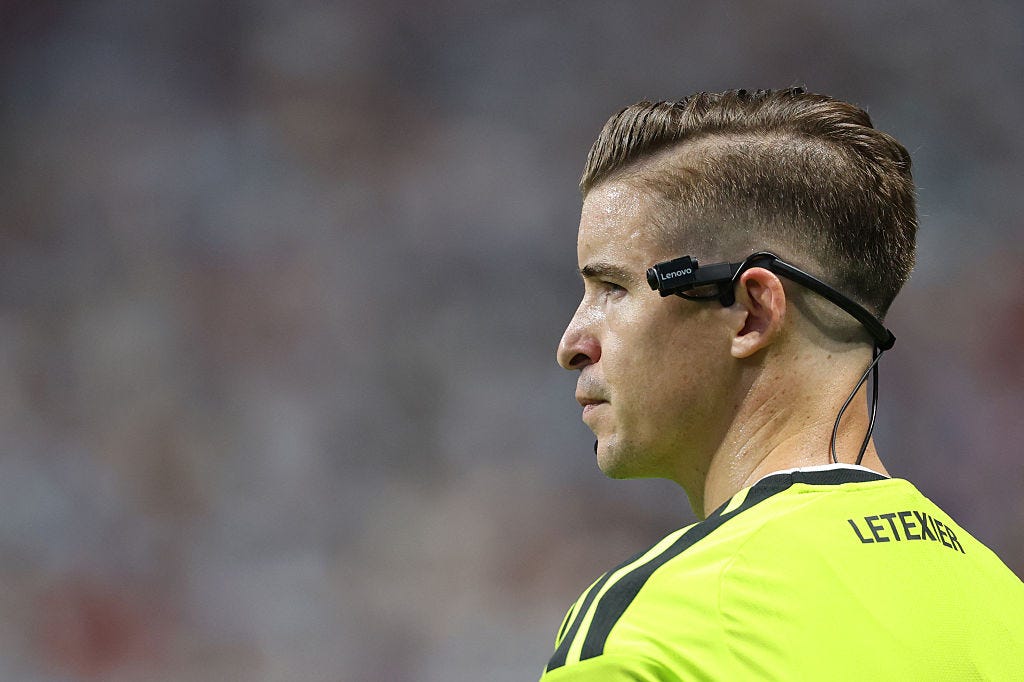
How Wikipedia Turned a World Cup Controversy Into an Antisemitic Conspiracy Theory | |||||
 | |||||
|
