
|


 |
If you ask most people, beauty is for stuffed shirts with too much time on their hands. But if you ask them about their favorite film, or artist, they will whirl toward you with judgments of beauty and declarations of the personal meaning it has for them.
What do people mean by the meaning beauty has for them? They do not mean the straightforward sense of ordinary communication. Rather, they recognize the fact that an atmosphere of meaningfulness hangs around things we consider beautiful. Beauty promises importance, significance, communion with the most vital and compelling forces in the world. In the idiom of common reactions to beauty, it “speaks to us,” though when we put words to the experience, we often find them falling short of the meaning we intuit.
“Correspondances,” a famous poem in Charles Baudelaire’s collection Les Fleurs du Mal, exemplifies beauty’s uncertain atmosphere of meaningfulness. “Nature,” he says, “is a temple in which living pillars / Sometimes give voice to confused words” (William Aggeler translation). Baudelaire’s words suggest that nature’s beauty speaks, but it speaks confusingly. Nature always seems to suggest more than what is actively said. Baudelaire’s poem provides a vision where beauty and meaning are perpetually coming in and out of our awareness, that each new look suggests further depths and further darknesses.
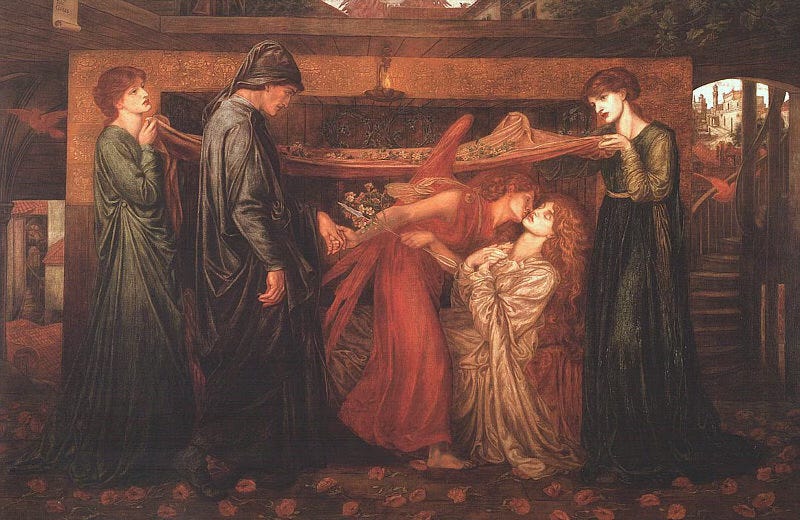
Beauty asks us to discover what it means. My favorite example of this quest comes from La Vita Nuova, or The New Life, the earliest work of Dante Alighieri, the famous medieval author of The Divine Comedy. Compiled when Dante was about thirty, The New Life combines Dante’s early poems with an autobiographical account of the inspiration of the poems and the role they played in his life.
The new life Dante describes is about Beatrice, his great infatuation and the muse of his greatest poetry. Probably Beatrice Portinari, the daughter of a Florentine banker, Beatrice was a young woman of Dante’s own age, about whom we know very little. In Dante’s poetry, however, she is the embodiment of human virtue, a sign of the miraculous deliverance of God, and the incarnation of all beauty. Dante meets her at nine years old, again at eighteen years old, and sporadically thereafter. Though he does not have a significant relationship with Beatrice, her beauty enthralls and captivates him, even when he is not in her presence.
La Vita Nuova is an effort to uncover the meaning of the beauty Dante glimpsed in those early encounters. In the opening chapter, he promises to show “the significance” that exists in his memory of Beatrice. Mysteriously, the life of Beatrice seems surrounded by the number nine. Dante first meets her at a party when they both are but nine years old. He feels the mysterious discombobulation of love even then. The second time they meet is nine years later, when she is eighteen, walking along the street dressed in white flanked by two older women. Much to Dante’s surprise and joy, she greets him, and this greeting overwhelms him. He runs to his room, where he falls asleep and dreams he sees the God of Love feeding her his heart. His dream occurs at the ninth hour of the night. The obscure repetition of nine draws him on like the confused words of Baudelaire’s living temple of nature.
Like any young man, Dante is thrown into confusion by his newborn feelings of romantic love. He writes poems attempting to put words to his feelings. Some of these poems are slight exercises compared to the achievements of Dante’s mature period. But they testify to a mind astounded by beauty and attempting to explain “the significance” this beauty should have for his life, poetry, and, finally, for his soul.
It is only when Beatrice dies that Dante begins to understand the meaning of her beauty. In his grief, Dante realizes why Beatrice “was a nine.” Nine is three times three, the number of the Holy Trinity. All this indicates that she was a product of the Trinity, meaning she was a miracle born from God’s miraculous triform existence. Dante comes to understand Beatrice as a reflection of Christ. Her beauty draws him upward to the source and end of all happiness in God, a journey that forms the center of the Divine Comedy.
But he had to look for this meaning, to repeat the encounter with beauty, including in the contemplative mind. The meaning was not visible, but it was also through visibility that the meaning drew him toward it.
Did Dante make or discover this meaning? The text does not definitively tell us. Even the miracle of the nines is given only as his opinion. Regardless, Dante’s perception of beauty invigorates a lifelong quest for meaning. Beatrice’s meaning is never fully exhausted. He includes her as his guide in Paradiso, the last part of The Divine Comedy, which he works on in the last years of his life.
Dante’s experience is a lesson in how to interpret beauty. My own field, literary interpretation, is essentially a romance with beauty. Often students in literature class are quick to try to fix the meaning of a poem or novel. It is better for them to sit with the meaningfulness for a while. They should commune with the confused words of Baudelaire’s temple, with the young Dante’s amazement over Beatrice’s beauty. A genuine literary interpretation is not merely the reception of the meaning an author intended or his culture would have received. It must also be a reckoning with the fact of beauty itself.
The true end of a literary education is the ability both to understand and to appreciate—to reconcile the author’s meanings with the meaningfulness that arises from its beauty. This reconciliation can only be partial in this life, for the meaningfulness of a work is never exhausted, and the meanings of a work assume new aspects as life and experience change. But if a scholarly reading dispenses altogether with the meaningfulness of a first encounter, that scholar has lost his connection to the primary taproot of the experience of art—beauty and its mysterious meaningfulness.
The meaningfulness of beauty prompts us to seek out meanings, which are experienced as a form of recognition in the way they seem to “explain” the beauty. At that point the recognition of beauty becomes the recognition of a specific meaning—beauty transforming into conceptual understanding. But beauty troubles these clear meanings. The meaningfulness remains, confused words awaiting reinterpretation. This is not because beauty is meaningless, but because beauty exceeds conceptual understanding. The effort to gather that something into our understanding is like the effort to reclaim a beach from the sea. It can be done for a time, but the sea will always wash back upon us.
Clay Greene is Assistant Professor of Literature at the University of Austin (UATX). He received his Ph.D. in English and Renaissance Studies from Yale University. His research focuses on Renaissance literature, intellectual history, and the intersections of poetry, philosophy, and religion in the early modern period. He is currently completing a book on the doctrine of the preexistence of the soul in seventeenth-century England.
 |
