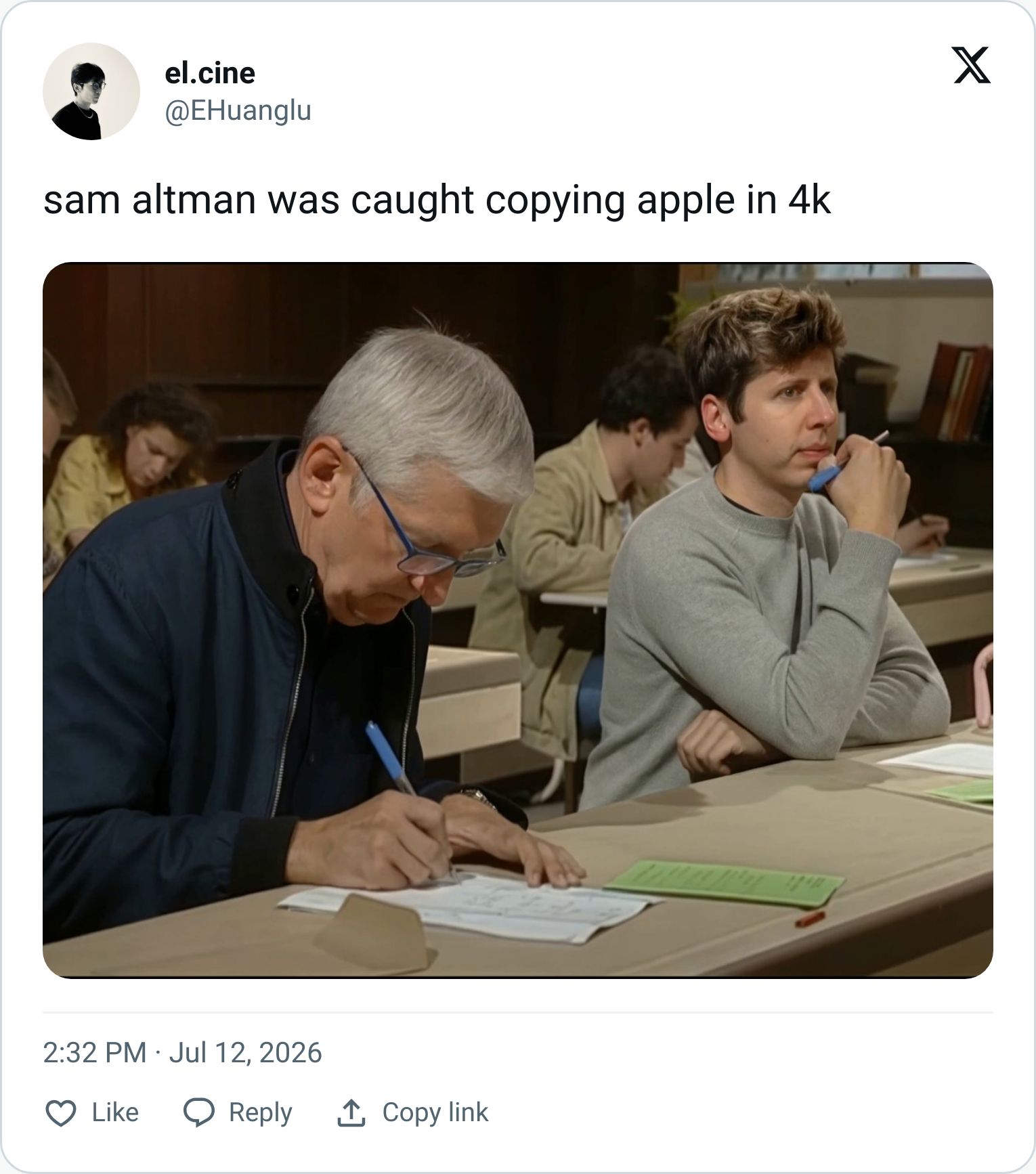
Top News | Nearly 200 economists, AI researchers, and tech leaders – including 15 Nobel laureates and the chief economists of OpenAI and Anthropic – have signed a statement warning that AI could bring large-scale job displacement and economic disruption faster than policymakers are prepared to handle. The New York Times has more here. | Twelve state attorneys general are suing to block Paramount Skydance’s $110 billion acquisition of Warner Bros. Discovery, arguing the deal would reduce competition in theatrical film distribution and basic cable licensing while giving Paramount control of 27% of U.S. film distribution. TechCrunch has more here. | Apple says former engineer Chang Liu exploited a “rare” authentication bug after leaving for OpenAI to download confidential hardware files, including unreleased product details, engineering presentations, and technical specifications, escalating its trade-secrets fight with the AI company. TechCrunch has more here. (Also, check out the wildest allegations in Apple’s lawsuit against OpenAI here.) | | |
Should investors still use the Rule of 40? | For a decade, investors have used the Rule of 40 to quickly measure the financial strength of their portfolio companies. But how often are companies actually meeting this threshold, and do they stay there? We analyzed 1,377 venture-backed private companies reporting financials through Standard Metrics to find out. Read the report. | | Satya Nadella Has Issued a Shocking Warning to Companies Using AI |  | Image Credits: Image Credits: Justin Sullivan / Getty Images |
| By Julie Bort | Of all the debates raging about the potential downsides of AI, there is one worry causing the most hand-wringing among AI enthusiasts in Silicon Valley. Their fear is that the giant AI labs that sell proprietary models are somehow acting like Trojan horses. | The concern is that, as startups and enterprises use AI models from labs like OpenAI and Anthropic, the labs gain ever-increasing access to those companies’ most sensitive business information. The model makers can then use that knowledge for themselves, potentially becoming competitors to their own customers. Those issuing such warnings range from VCs like Jason Calacanis to Palantir CEO Alex Karp. | Now, in a surprising blog post published on Sunday, Microsoft CEO Satya Nadella has joined this crowd. Nadella warns that AI users (the “buyers” as he calls them) are paying twice. They knowingly spend for AI token usage but they also, obliviously, hand over valuable data in the process. | “You essentially pay for intelligence twice, once with money, and again with something even more valuable: the proprietary knowledge you must reveal to make that intelligence useful. The better you want the model to perform, the more of that knowledge you have to feed it!” he writes. | Most dangerously, enterprises are literally teaching the models about the nuances of their businesses, he argues. | “Models learn from ‘exhaust,’ the prompts people write, the tools agents use, and especially the corrections people make when the model is wrong. Every correction is distilled into institutional know-how,” he writes. | | | Massive Fundings | Digantara, an eight-year-old Bengaluru startup that builds satellites, sensors, and analytics software to track space debris and missile launches, raised a $50 million Series B round led by Reliance Industries’ venture arm, with 360 ONE Asset, SBI Investments Co Japan, Ronnie Screwvala, Peak XV Partners, and Kalaari Capital also participating. The company has raised a total of about $65 million. Forbes has more here. | Gauntlet Networks, an eight-year-old New York startup that models portfolio, liquidity, and protocol risks for institutions using tokenized assets, stablecoins, and decentralized finance, raised a $125 million Series C round led by SBI Holdings USA. More here. | Helsing, a five-year-old Munich startup that builds drones, underwater surveillance systems, and AI software for military applications, raised a $1.8 billion round at an $18 billion post-money valuation. Investors included JPMorgan Chase, Lightspeed Venture Partners, and Iconiq. CNBC has more here. | Moneybox, an 11-year-old London company that helps UK consumers save, invest spare change, manage ISAs and pensions, and plan for home purchases, sold $60.2 million worth of secondary shares at a $1.1 billion valuation. Tech Funding News has more here. | Nous Research, a three-year-old Austin startup that develops open-source AI agents and language models, is reportedly finalizing a $75+ million round led by Robot Ventures at a $1.5 billion valuation, with significant participation from USV and other investors. TechCrunch has the scoop here. | Valarian, a six-year-old London startup that builds software to help governments and enterprises control how AI systems and sensitive applications access data across cloud infrastructure, raised a $50 million Series A round led by NEA, with Lightbank, XTX Markets, Sequel, LitVC, Gokul Rajaram, and Nikesh Arora also joining in. The company has raised a total of $70 million. Fortune has more here. | | Big-But-Not-Crazy-Big Fundings | Augmodo, a three-year-old Seattle startup that makes wearable camera badges that help retail and operations teams track inventory, warehouse pallets, maintenance work, and safety alerts, raised a $21 million round at a $350 million post-money valuation. The deal was led by previous investor TQ Ventures, with Lerer Hippeau, Jefferson River Capital, Arena Holdings, Chemist Warehouse, New Fare, Interlace, and Webb Investment Network also participating. More here. | | Smaller Fundings | Finto, a one-year-old Munich startup that builds AI agents that handle invoice verification, account coding, and purchase-order matching for European finance teams, raised a $3.4 million seed round. Investors included Y Combinator, Gradient, and Lightspeed. Tech.eu has more here. | Piq Energy, a three-year-old San Francisco startup that automates grid engineering studies for utilities and energy developers to help connect new power projects faster, raised a $5 million seed round led by Active Impact Investments, with Cisco Foundation, Mobilize AI x Energy Ventures, New Climate Ventures, Ascent Energy Ventures, Umami Capital, CLAI Ventures, and 9Zero also digging in. More here. | Ravee Optics, a two-year-old startup based in Dayton, OH, that builds compact laser communications terminals for satellite operators to send more data from orbit with smaller, lighter hardware, raised a $6 million round led by BIG Global Investment JSC, with CincyTech Fund VI and JobsOhio Growth Capital Fund also engaging. Payload has more here. | | |
General Compute is making a $300m bet against GPUs | General Compute raised $15m to build the world’s first ASIC cloud. By removing the GPU bottleneck, it runs frontier LLMs up to 16x faster than standard GPU clouds. ASIC silicon is also far more energy efficient, so it deploys in air-cooled data centers, making growth and expansion dramatically easier. Learn more here. | | New Funds | B Capital, a nine-year-old venture firm based in San Francisco and Singapore and co-founded by Facebook co-founder Eduardo Saverin, raised a $500 million early-stage fund to back seed through Series B AI companies in technology, energy, and healthcare across North America and Asia. ConnectMoney has more here. | | Going Public | Shein is scheduled for a Hong Kong IPO hearing on Thursday after receiving Chinese regulatory approval, bringing the fast-fashion retailer closer to a potential September or October listing at a sharply reduced $40 billion to $50 billion valuation. Reuters has more here. | | People | A weekend feud between Sam Altman and Elon Musk highlighted doubts about SpaceX’s orbital data-center ambitions, with Altman mocking Musk for selling investors on “short-term space datacenters” and TechCrunch noting that experts see meaningful space-based AI compute as unlikely before the 2030s. More here. | TechCrunch examines a provocative argument from George Hotz, the famed hacker and Comma.ai founder, who says truly user-aligned AI should do anything a user asks, such as ordering meth-lab equipment or planning the murder of a spouse. TechCrunch has more here. | Anthropic hired Monzo co-founder and former Y Combinator partner Tom Blomfield to join its compute team. Connie notes that the move is part of a broadening trend. | Odyssey director Christopher Nolan dismissed as “nonsense” the idea that AI will replace human creativity wholesale, saying that while the technology may become a useful filmmaking tool, it will not supplant human artists. The Guardian has more here. | | Post-Its | | | Essential Reads | Washington is debating how to stop Chinese AI companies from training on U.S. models through “adversarial distillation,” with U.S. officials estimating unauthorized distillation costs American AI labs as much as $6 billion a year in lost income. Bloomberg has more here. | Scientists at the Technical University of Denmark demonstrated a rare practical use case for quantum computing, using a printer-sized machine from ORCA Computing to improve a generative AI drug-discovery model and produce novel peptides that bound to target proteins more successfully than a classical model. Wired has |
|