Orbits and racetracks have something fundamental in common.
Yes, one’s celestial and the other’s terrestrial, populated by spaceships and satellites versus race cars. But both environments are also wildly unforgiving places: On racetracks, cars must withstand heat, collisions, and relentless mechanical stress. Meanwhile, satellites in orbit face radiation exposure and an airless landscape—hardware must stand alone against temperature and time, with no help on the way. For both satellites and race cars, tiny miscalculations become calamitous.
“Orbits and racetracks are
very inhospitable environments,” said Jim Adler, founder and general partner at Toyota Ventures, the $251 billion automaker’s corporate venture arm.
Adler’s been considering the parallels between space and racing since 2024, when Apex CEO and cofounder Ian Cinnamon (who’s devoted his life to the complex challenge of mass-producing satellites) came to him with a pitch: Could Toyota Racing Development—which builds Toyota and Lexus’s race cars, including for NASCAR—help Apex with manufacturing certain satellite parts?
“Apex is really built around the premise of thinking about building satellites using automotive skills,” said Cinnamon. “Race cars are the prime example, in everything from how you manage your supply chain, to how you think about the quality bar. When you’re dealing with a race car going 100-plus miles per hour, carrying a human, that thing cannot fail. And you need to be building them at some scale. Scale, I think, is the keyword.”
Adler—who spearheaded Toyota Ventures’s 2023 investment in now-$2.3 billion Apex—quickly connected Cinnamon with Jack Irving, Toyota Racing Development USA’s general manager, who’s been working with the division since 2010. It was a surprising but fast philosophical match.
“If there’s ever an issue with our engine, it’s a pretty big deal,” said Irving. “All of the details have to matter. If your satellite suddenly has an issue in orbit, it’s a monstrous problem… Their measurement of a catastrophe is exactly like ours.”
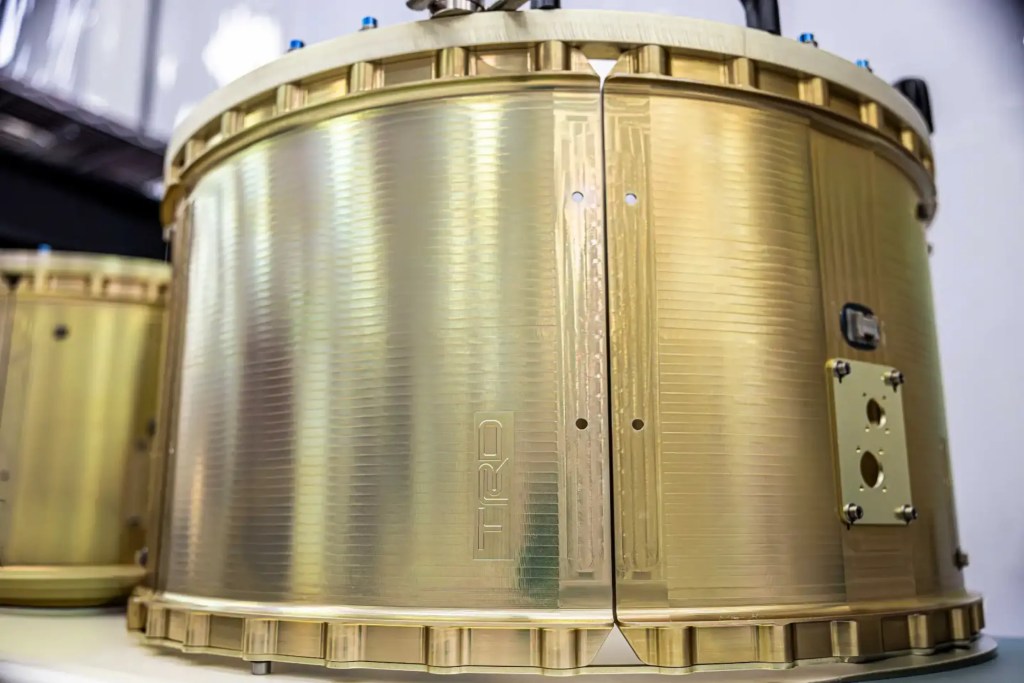
The result is a space mobility partnership that’s a first of its kind for Toyota. Toyota Racing Development, or TRD, has been working with Los Angeles-based Apex since 2025 to build structural components for the startup’s satellites. This includes key parts like top decks, base decks, bulkheads, pass-through cylinders, and smaller pieces that demand “ridiculous tolerances,” according to Irving.
This partnership, yes, has the hallmarks of something cool. Space, satellites, and race cars! But underneath, it derives from Cinnamon’s longstanding criticism of traditional aerospace: He says that aerospace manufacturing norms are too low-volume and bespoke, and that the encroaching future demands satellites that are standardized, high-quality, and produced closer to the scale of cars.
“TRD is the perfect middle ground,” said Cinnamon, who cofounded Apex in 2022. “For a race car, it’s a much higher quality bar than for a normal automotive vehicle, and you’re still working at a much higher [manufacturing] volume than aerospace. It’s the exact right middle ground for us.”
And it’s in that middle ground that the
Alice In Wonderland-esque “why is a race car like a satellite” riddle is answered.
“At the highest echelons [of racing], you’re all within thousandths of a second of each other, and you’re just trying to eke out an extra 100th or 1,000th every lap to try to advance,” said Irving. “It’s to the point of just buffing parts, as insane as that sounds…And you’re going to find [that precision] is necessary in all extreme engineering endeavors.”
Zooming out, there’s a lot here that’s not about Apex at all. For one, Adler has identified space as Toyota’s next growth area: “With 100,000 satellites that need to be built over the next five years, it’s not just what space can bring to automotive, but what the automotive industry can bring to the space industry,” Adler told
Fortune. “Space may be the next mode of mobility that Toyota moves into.”
There are also the broader societal questions the U.S. faces about the future of onshore manufacturing—government officials, entrepreneurs, investors, and more have in recent years been grappling with the decline of the country’s industrial base, and what a resurrection might look like. (Japan-based Toyota has a substantial manufacturing footprint in North America.) To Cinnamon, there’s an intellectual shift that has to happen.
“We have to think about manufacturing from the perspective of not just how we build something, but how we build it when we’re factoring in all the variables that matter—quality, speed of production, and affordability,” said Cinnamon. “Too often we say, ‘Oh, we can build a bunch.’ Well, how long does it take? Or, ‘We can build them really cheap.’ Okay, but are they high-quality? We need to find the middle ground between those core elements. And if we can do that, the U.S. manufacturing base can really fall into its stride.”
See you tomorrow,
Allie Garfinkle
X: @agarfinksEmail: alexandra.garfinkle@fortune.comSubmit a deal for the Term Sheet newsletter
here.
Joey Abrams curated the deals section of today’s newsletter. Subscribe here.