
|
 |





The National Mall has a new feature. No, not the once-again-drained Reflecting Pool. And no, not the mysterious gash the president insists some vandal (or “Vandal”) made in it—the length of which has grown, somehow, to 300 feet since the last time he complained about it. No, the new feature is a 10-foot “participation trophy” to Donald Trump for his war in Iran, installed by an anonymous protest-art group near the Martin Luther King Memorial. Not everyone can be a winner, right? Happy Tuesday.
A couple programming notes: Tim has Pete Buttigieg on today’s Bulwark Podcast and Bulwark+ members will get early access to the show starting this morning.
But first: Tune in for Morning Shots Live at 10:30 a.m. EDT here and then watch your inbox for Tim’s exclusive interview from Iowa with Mayor Pete.
|

 |
Destruction Alone Doesn’t Win Wars
by Mark Hertling
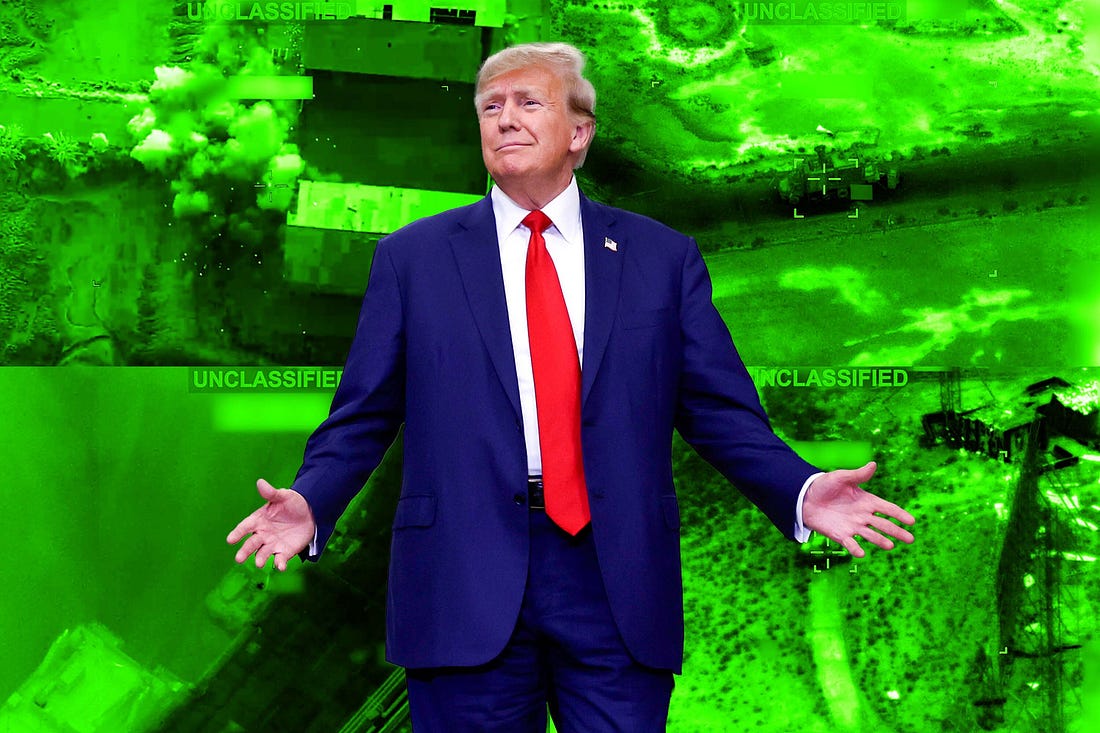
The United States can destroy more targets than Iran. It can sink ships, eliminate missile batteries, strike command centers, and impose military losses that Tehran cannot reciprocate. But Iran does not have to match American firepower to achieve its goals. It must only keep commercial shipping at risk, energy markets unsettled, Gulf governments nervous, American bases under threat, and U.S. forces responding to the next crisis.
Washington may be winning most exchanges of fire, but Tehran has the initiative: It still decides, for the most part, where the conflict occurs, which American assets must be defended, and how many additional missions U.S. forces must assume.
The Memorandum of Understanding between the United States and Iran called for an “immediate and permanent termination of military operations,” but it was never a peace settlement. Its vague language governing commercial shipping through the strait virtually guaranteed competing interpretations. Halfway through the MOU’s sixty-day negotiating period, questions about Iran’s nuclear program, sanctions, and U.S. force posture also remain unresolved.
With the resumption of combat in the Strait of Hormuz, the United States is being pulled into multiple overlapping campaigns: striking Iranian nuclear and military capabilities, protecting commercial shipping, suppressing coastal missile systems, defending regional bases, and reassuring Gulf partners. But there is no clearly articulated political end state. This is mission creep.
The Islamic Revolutionary Guard Corps, meanwhile, appears willing to absorb extraordinary punishment. Iranian facilities have been destroyed, missile and drone systems attacked, and commanders killed, yet Tehran continues launching weapons, threatening shipping, and striking facilities across the region. This exposes the critical difference between punishment and coercion: The United States is unquestionably punishing Iran, but not compelling it to change its behavior.
Strategy should start with a desired political outcome and then direct military, diplomatic, and economic power toward achieving it. It should not be assembled one retaliatory strike at a time.
America’s Gulf partners understand the danger. They fear Iran, but they also fear an unlimited American–Iranian war fought across their region. They want Washington to deter Iranian aggression and protect freedom of navigation, but they do not want their cities, energy infrastructure, airfields, and populations threatened or bombarded.
The United States can destroy more, but Iran can disrupt more. Iran can lose every tactical encounter and still produce strategic effects. It can raise shipping costs, disrupt energy markets, strain American alliances, expose regional bases, and draw the United States deeper into an open-ended campaign.