Get expert insight into the technologies and trends shaping the global automotive industry on Reuters.com. Subscribe for $1/week.
|
|
|
|
Greetings from London!
Volkswagen CEO Oliver Blume’s historic pitch to the company’s supervisory board to slash jobs and close four car assembly plants in Germany was easily defeated by labor representatives on the board. That was hardly a shock, given the union’s strong position on the supervisory board.
What was surprising was that, on the same day, Volkswagen announced plans to cut its lineup by up to half and reduce production capacity.
Blume confirmed in an internal memo on Monday that Volkswagen’s management seeks to double previously planned job cuts to 100,000 workers globally. If it comes to slashing VW’s lineup, history tells us the German automaker will cut low-volume, low-margin models.
If the plants that make those models don’t get new ones, then Volkswagen may find it easier to close them and cut jobs than trying to get the supervisory board to agree to a grand restructuring plan. Either way, Volkswagen’s saga will continue. Which brings us to today’s Auto File… |
|
|
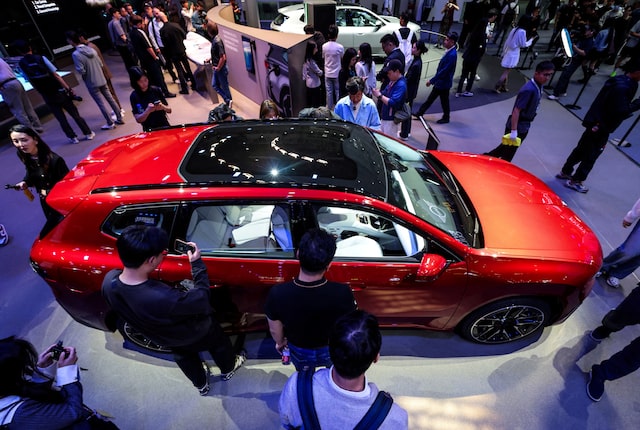
BMW's new iX3 could be old by the time it launches in China - REUTERS/Maxim Shemetov. |
For years, BMW’s slogan was “The Ultimate Driving Machine,” emphasizing its technological edge and the driving pleasure that its pricy cars provided.
But the German premium automaker’s edge has faded in China, where its Neue Klasse, or new class, of EVs look set to be old before they even hit the world’s largest and fastest-moving market. You can read all about it here.
After three China-related profit warnings in under three years, BMW badly needs a win in China. The company’s sales have fallen in China for two consecutive years and are on track for a third, despite heavy discounts on its cars there.
Even if BMW’s EVs do sell well in China, those discounts now look baked in because Chinese rivals are selling premium models at lower prices. Fixing its China business will likely be priority number one for BMW’s new CEO Milan Nedeljkovic. |
|
|
|
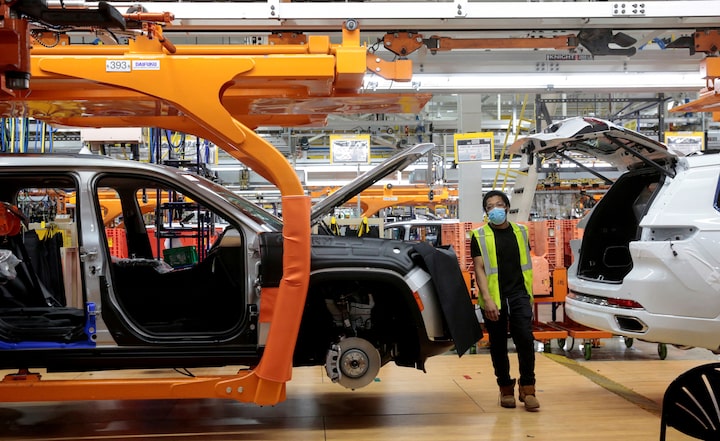
Stellantis' U.S. sales are up - REUTERS/Rebecca Cook. |
When Antonio Filosa was named CEO of Stellantis last year, a core part of his brief was to revive sales in the U.S. market — where high-margin pickup trucks and SUVs have driven profits at the world’s No. 4 automaker. At the company’s investor day in May, management presentations were heavy on adding even more RAM pickups and Jeeps to those it has already launched.
The early signs are that this back-to-basics strategy is paying off. Stellantis reported a 38% increase in North American sales in the second quarter. You can read all about it here.
That sales jump was supported by new or refreshed models, including the Ram 1500 8-cylinder light-duty truck and its high-performance, off-road TRX SRT version, the refreshed Jeep Grand Wagoneer and Grand Cherokee, and the Chrysler Pacifica.
Investors were unimpressed at the investor day by Filosa’s €60 billion ($68 billion) new business plan to 2030 focused on new model launches, brand portfolio reorganisation and new partnerships in technology and manufacturing. But if it can maintain that U.S. momentum, it could lift Stellantis’ shares out of the doldrums. |
|
|
|
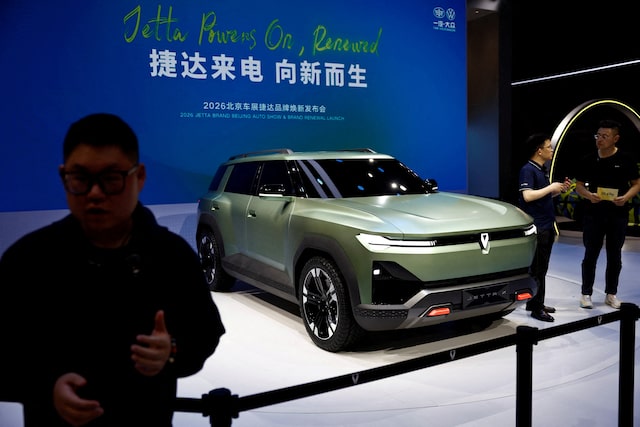
German carmakers are struggling in China - REUTERS/Tingshu Wang. |
It’s not just BMW that has hit a long slump in China. Germany’s carmakers are all struggling there. As Reuters colleague Rachel More reports, they all had a dismal second quarter in the world’s largest car market. You can read all about it here.
Volkswagen, Mercedes-Benz and BMW all saw a sales drop of at least 30% from April to June in China. VW had the worst quarter, with sales plunging almost 37%. After years as China’s top-selling automaker, Volkswagen was knocked into second place by BYD in 2024 and into third place last year. And Porsche, which has been in a tailspin in China for several years, saw its sales drop 32% there. |
|
|
|
Trump's job-killing energy policies? |
U.S. President Donald Trump moved quickly last year to scale back EV-friendly policies, including a $7,500 federal tax subsidy for electric cars. Trump is also not a fan of renewable energy.
As Reuters colleagues Valerie Volcovici and Nichola Groom report, labor and environmental coalition BlueGreen Alliance says that reduced federal support for clean energy has caused the cancellation or delay of $83 billion in investment across hundreds of projects. You can read all about it here.
The group’s analysis found that 223 manufacturing and clean energy projects representing $82.9 billion in investment and 111,765 jobs have stalled or been cancelled during Trump's second presidency. |
|
|
|
|