Hello!
Today’s focus is all about data centers as a growing number of governments, regulators and cities around the world are moving to freeze, restrict or ban their construction. Activists and residents have aired out their growing concerns over electricity costs, strained water supplies, land scarcity and the burden data centers, being built to power the AI boom, have on local communities.
We’ll take a look at the one-year moratorium New York imposed this week, becoming the first U.S. state to halt construction of large new data centers, before turning to a Reuters deep-dive on xAI’s hyperscalers hitting predominantly Black neighborhoods the hardest, by our data journalist Disha Raychaudhuri and energy and environment reporter Valerie Volcovici.
Before we explore these major data center developments, do check out these climate solution and adaptation stories below: |
|
|
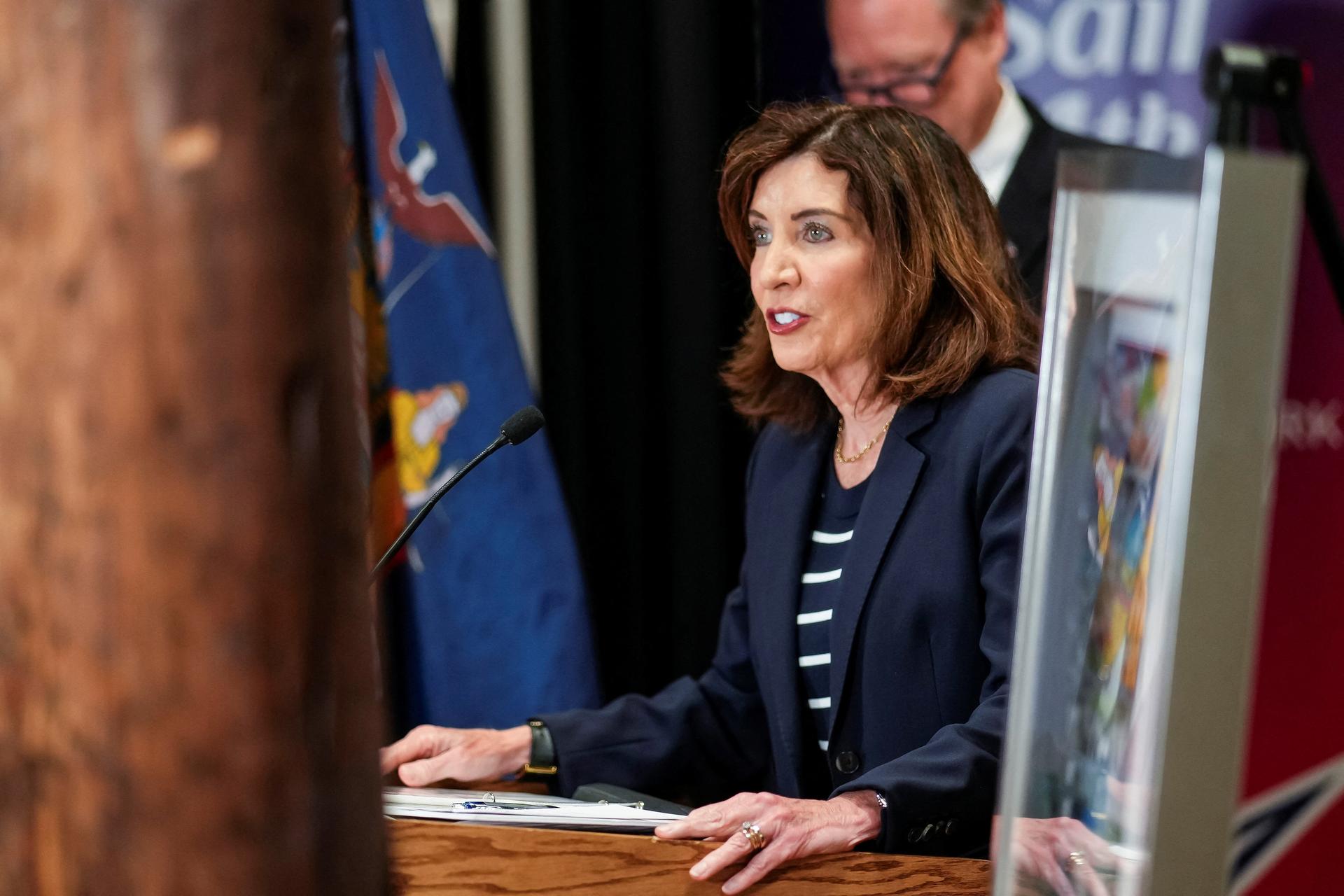
New York Governor Kathy Hochul speaks during a press conference in New York City, U.S. REUTERS/Eduardo Munoz |
NY moratorium on data centers |
New York has become the first U.S. state to stop construction of large new data centers, imposing a one-year moratorium due to growing concerns over power costs, water supplies and the burden on local communities.
"As data center development threatens to hike up utility bills, deplete our natural resources, and create uncertainty for New Yorkers, it's my responsibility to take action and lead," said New York Governor Kathy Hochul. She added that she would also pursue legislation to repeal sales tax exemptions for large data centers.
The construction ban will apply to data centers that use 50 megawatts or more of power, officials in the governor's office said. A 50-megawatt power supply can provide enough electricity for roughly 50,000 U.S. homes, according to U.S. household electricity consumption data by the U.S. Energy Information Administration.
The state currently has more than 130 data centers, according to Data Center Map, compared with more than 600 in Virginia and about 500 in Texas. Only one in three Americans approve of the fast pace of data-center construction and most would oppose building one in their own community, according to a recent Reuters/Ipsos poll.
Click here for a list of the authorities that are restricting data centers from Ireland to Australia. |
|
|
|
xAI’s hyperscalers in Tennessee |
Elon Musk’s artificial intelligence company xAI has installed 59 natural gas turbines for its Colossus 2 data center project in Tennessee without securing federal clean air permits, according to communications between regulators and xAI representatives.
A Reuters analysis based on government data and information in the correspondence with regulators found that potential emissions from the turbines are far beyond the threshold that would require a federal permit and would be released near predominantly Black communities already estimated to be suffering disproportionately high rates of lung disease.
The findings, which have not been previously reported, reflect how exploding electricity demand from AI data centers is driving companies to build off-grid power plants at a pace outstripping environmental oversight, with potentially big risks to public health. The number of unpermitted turbines identified by Reuters is about double what xAI has publicly acknowledged.
xAI did not respond to Reuters’ request for comment. The company previously said it was running 27 unpermitted turbines for Colossus 2 as of January and has argued the permits are not required. At least 57 of the 59 turbines are located in Mississippi, just over the state line from Tennessee where the data center is located.
Civil rights groups including the NAACP and the Southern Environmental Law Center sued xAI in April to halt their operations, arguing the turbines produce emissions subject to the federal Clean Air Act and shouldn’t be operated without permits. They contend the turbines are polluting homes, schools and churches in historically Black communities.
I wrote about the NAACP’s notification letter to authorities earlier this year – click here to revisit that for additional context.
Click here for the full Reuters deep dive for more case studies on the communities affected by xAI’s hyperscalers. |
A man walks while The New York City skyline and the Empire State Building are seen through a cover of wildfire smoke as seen from Newport, New Jersey, U.S. REUTERS/Eduardo Munoz |
-
Air quality post wildfires: Wildfires raging across the United States and Canada are spreading smoke over major cities, prompting health warnings and calls to limit outdoor activities due to poor air quality. Environment Canada reported an Air Quality Health Index reading of 10+, or "very high risk," in Toronto, with hazardous conditions forecast through Thursday night. New York City has also been affected ahead of Sunday's World Cup final in neighboring New Jersey. The National Weather Service said smoke could linger through the end of the week.
-
Algeria orphanage fire: Eleven people were killed and 19 injured in a fire at an orphanage in the Mohammadia district in the eastern suburbs of Algeria’s capital Algiers early on Thursday, state media reported. Algeria has been gripped by a heatwave in recent days, with civil protection units extinguishing 913 fires nationwide since July 8, state news agency APS reported on Wednesday, citing the General Directorate of Civil Protection.
-
Sudan gum trade and war: The United Nations human rights office called on states, businesses and parties linked to Sudan's gum arabic trade to uphold international law, warning that companies could be exposed to human rights risks as its profits are helping sustain the country's civil war. Gum arabic is a natural substance harvested from acacia trees and widely used to mix, stabilise and thicken ingredients in mass-market products including soft drinks, pharmaceuticals and cosmetics. Click here for the full story.
-
U.S. climate litigation: Nine environmental groups have filed a suit in a Seattle federal court against the U.S. Fish and Wildlife Service and National Marine Fisheries Service claiming that its recent decision to rescind a more than 50-year-old definition of "harm" imperiled wildlife. Rescinding the definition of harm violates that law's plain language, defies reason, is arbitrary and capricious, and should be overturned, the complaint said. The defendants in Tuesday's lawsuit include the two agencies, which are part of the Interior Department and Commerce Department respectively, as well as Interior Secretary Doug Burgum and Commerce Secretary Howard Lutnick. The Interior Department said in a statement on Wednesday that it was reversing a "regulatory overreach" not authorized by Congress, and will defend its authority to honor the law's plain text.
-
U.S. civil rights march: A coalition of civil rights leaders – led by Rev. Al Sharpton's National Action Network and joined by Martin Luther King III, Arndrea Waters King, and labor and civil rights groups – have announced plans for a Washington march next month to defend voting rights after a recent court decision weakened key federal protections against racial discrimination in voting. Click here for the full article by Reuters U.S. race and justice correspondent Bianca Flowers.
|
|
|
|
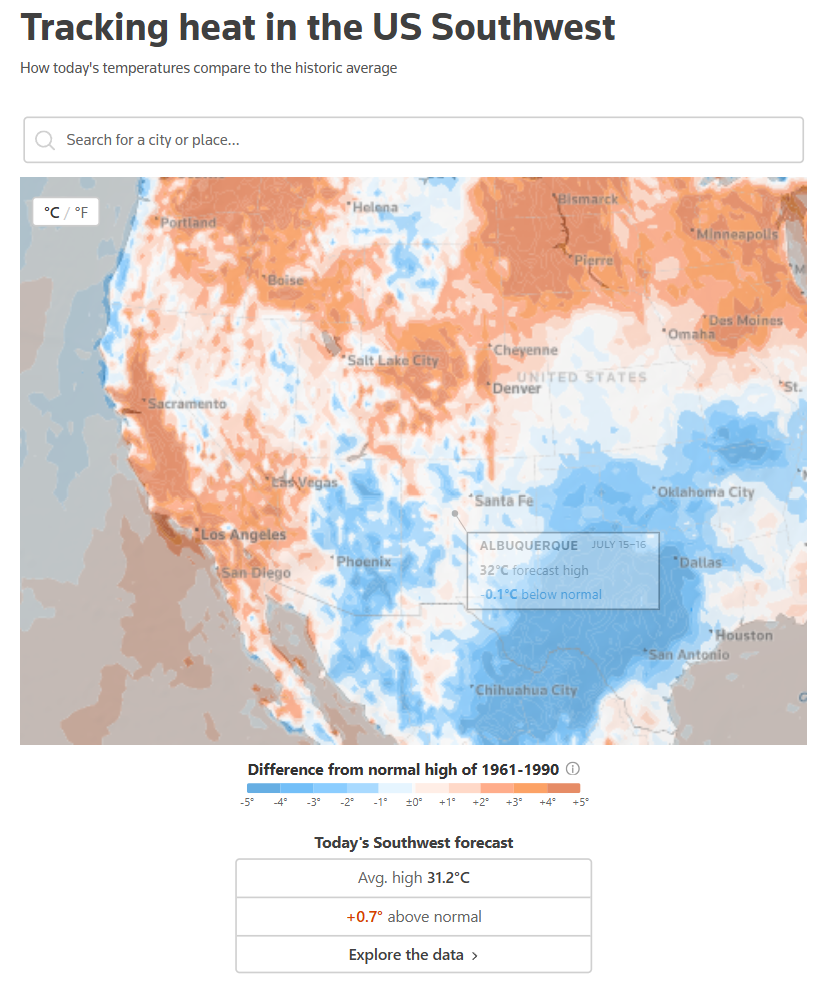
The northern hemisphere continues to experience extreme weather and severe heatwaves with wildfires blazing across Europe and North America. The average high worldwide is forecast to be 18.8 degrees Celsius (65.8 degrees Fahrenheit), which is 1 C above the normal high for July 16 from 1961-1990, according to the Reuters Climate Monitor.
Click here to track the U.S. Southwest heatwave or search for your area to find out how it’s impacted by global rising temperatures. |
|
|
|
|