
|
 |



A Complimentary Pen Test from the Team That Tests the Whole Product
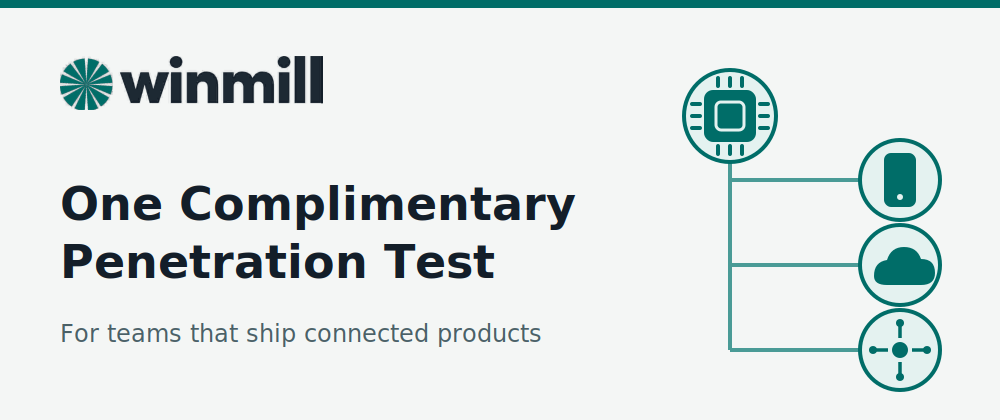 |
Most product teams test components in isolation. Winmill tests the product ecosystem as one connected surface: the device, hardware, and firmware, the OS and communication protocols, the web, mobile, and API applications that connect to it, and the cloud backend and network behind it, in one engagement, so every attack surface is covered.
The timing matters. For companies selling connected products into the EU, the Cyber Resilience Act and the Radio Equipment Directive are active obligations. Winmill testing aligns with EN 18031 (RED), with accredited laboratory engagements available when your compliance path requires them.
No scoping delays. Testing starts within days, with severity ranked findings delivered in a live portal.
To see our approach firsthand, we are offering SecPro readers a complimentary penetration test.
Key Takeaways
In a rush? Take a look at our key takeaways and come back when you have a little more time.
The defining change in cybercrime over the coming decade is unlikely to be the emergence of entirely new motivations or threat actors.
The rapid decline in the technical barriers that once restricted sophisticated offensive capability to highly experienced individuals and well-resourced organisations.
Artificial intelligence is reshaping the economics of expertise, allowing determined attackers to learn faster, coordinate more effectively and execute increasingly complex operations with fewer resources.
For defenders, this means traditional assumptions about who poses a credible threat are becoming outdated.
Successful organisations will be those that prepare for a world in which offensive capability is more widely distributed, attacks increasingly target trust rather than technology alone, and adversaries are defined less by their background than by their ability to orchestrate increasingly capable autonomous systems.
When two young individuals were sentenced for their roles in the cyber attacks against Transport for London (TfL), much of the public discussion focused on their age. Headlines naturally gravitated towards the idea that teenagers had been responsible for disrupting one of the UK’s largest public transport organisations, reinforcing the familiar narrative of the gifted young hacker capable of outsmarting major institutions. While age makes for compelling news coverage, it is arguably the least important aspect of the story from a cybersecurity perspective: indeed, the more significant lesson is that the characteristics which once defined a capable cyber adversary are changing rapidly, and organisations need to reconsider how they model the threats they face.
For decades, cybersecurity has categorised adversaries according to motivation or affiliation. We distinguish between nation-state actors, organised cybercriminal groups, hacktivists, insiders and opportunistic attackers because these categories traditionally reflected differences in capability, resources and operational maturity. Those distinctions remain useful today, but they are becoming less predictive of what an attacker can actually accomplish. As artificial intelligence becomes integrated into every stage of offensive operations, technical expertise is no longer the primary limiting factor it once was. Instead, access to capable AI systems, combined with determination and creativity, is steadily reducing the barriers that once separated amateur attackers from experienced professionals.
This shift mirrors many of the broader transformations already taking place across the cybersecurity industry. AI-assisted software development has reduced the time required to build applications. Autonomous security platforms have begun reducing the manual effort involved in detection and response. Identity has become the primary mechanism for establishing trust in increasingly distributed environments. It should therefore come as little surprise that the same technological forces are also reshaping the adversary, changing not only how attacks are conducted but also who is capable of conducting them.
Expertise Is No Longer the Primary Barrier
Historically, becoming an effective cyber attacker required years of technical development—it was very much a business which expected the practitioners to be experts and demanded their expertise if they wanted to “achieve” anything. Individuals needed to understand operating systems, networking protocols, programming languages, authentication mechanisms and vulnerability research before they could reliably compromise complex environments. Even after acquiring those skills, they often needed experience developing malware, performing reconnaissance, evading detection, and maintaining persistence within enterprise networks. The learning curve was steep enough that sophisticated attacks were largely confined to experienced professionals, well-resourced criminal organisations or “nation state” attackers.
Artificial intelligence is compressing that learning curve. Modern language models can explain unfamiliar protocols, generate scripts, troubleshoot programming errors, summarise technical documentation and help users understand offensive tooling at a pace that would have been unimaginable only a few years ago. They do not eliminate the need for human judgement, nor do they magically produce sophisticated exploits on demand, but they dramatically reduce the amount of time required to acquire practical competence. An individual who previously spent months understanding Active Directory, PowerShell or cloud infrastructure can now receive interactive guidance, explanations and working examples within minutes.
This distinction is important because AI is not replacing expertise; it is accelerating its acquisition. Experienced penetration testers, malware developers and reverse engineers still possess a considerable advantage over inexperienced operators. However, the gap between novice and intermediate capability is narrowing, allowing motivated individuals to reach operational effectiveness far more quickly than previous generations of attackers. Security teams should therefore expect to encounter adversaries whose technical backgrounds are increasingly difficult to infer from the sophistication of their attacks.