Plus, why oil prices haven't gone crazy.

Go beyond the headlines with Reuters on the stories shaping the day. Subscribe for $1/week.


Daily Briefing

Daily Briefing

By Kate Turton

Hello. The Houthis announce a Saudi naval blockade, Modi calls for a foolproof exam system in India after youth protests, and Burnham targets lower energy bills in his first move as UK prime minister.

Plus, why oil prices haven't gone crazy despite months of war.

Today's Top News


 Boats sail near the coast of Bab el-Mandeb, Yemen April 2, 2026. REUTERS

Middle East

  • Yemen's Iran-aligned Houthis said they would impose a naval blockade on Saudi Arabia, opening a potential new front against the United States in its war with Iran and raising the threat to global energy supplies and trade beyond the Gulf.
  • Aid agencies, U.N. officials and Palestinian health authorities warn that Gaza is facing an unprecedented collapse of its water and sanitation systems, leaving much of the population trapped between immediate thirst and a longer-term environmental crisis whose consequences could last decades.
  • US President Donald Trump said that Israeli Prime Minister Benjamin Netanyahu will not be arrested when he visits the US, after New York City Mayor Zohran Mamdani said he was still considering the move.

In other news

  • Indian Prime Minister Narendra Modi called for setting up a foolproof public examination system in the country, a day after supporters of the youth-led "cockroach" movement clashed with police as ‌they marched on parliament to protest against question paper leaks. Our photographers document the protests here.
  • Voters will go to the polls in Arizona to choose nominees for the US Congress and governor, with races ‌that will set the tone for November's midterm elections in a state known for its competitive elections. You can ask Reuters anything about the midterm elections. Our reporters will answer questions in the Politics US newsletter.
  • Nicaragua's long-serving president Daniel Ortega said the Central American country will no longer hold elections, eliminating the possibility ‌of an electoral challenge when his term ends next year and further entrenching the rule he shares with his wife.
  • New British Prime Minister Andy Burnham said he would cut taxes on electricity bills in his first attempt to ease a lengthy cost-of-living crisis that has angered the public and helped stoke political instability.
  • Global hunger declined for a third consecutive year in 2025, with improvements recorded across every continent, although mounting risks from climate ‌shocks and trade disruption could threaten further progress, a United Nations report said.
 

Business & Markets


A drone view shows containers at the Manzanillo seaport, in Manzanillo, Mexico. REUTERS/Daniel Becerril/File Photo

  • US and Mexican trade negotiators will meet for a third round of bilateral talks to try to push forward with revising the North American trade agreement, just as Trump slaps Canada with a new set of ‌punitive duties.
  • Brazil's Pix, one of the world's most successful instant-payment systems, has become a flashpoint between Brasília and Washington as the Trump administration aims to protect US firms from the model's growing appeal in dozens of countries.
  • The United States and China are planning to hold talks over AI in September, five sources familiar with ‌the matter told Reuters, as the superpowers confront how to regulate the risks posed by their increasingly powerful rival frontier models. Read our exclusive.
  • Taco Bell is facing a wave of lawsuits after contaminated lettuce left hundreds sick and more than 100 hospitalized. Legal Reporter Jenna Greene explains why, under strict liability laws, plaintiffs don't even need to prove the chain did anything wrong. Listen now.
  • As Russia deploys growing numbers of faster jet-propelled versions of its Shahed attack drone, some defence companies are racing to develop a new generation of faster interceptors.
  • It’s 20 years since the economist Nicholas Stern made the financial case for stopping global warming. Though temperatures have risen, green energy is cheaper. In this episode of The Big View podcast, he tells Peter Thal Larsen that needed investments can boost the economy and the planet.
 

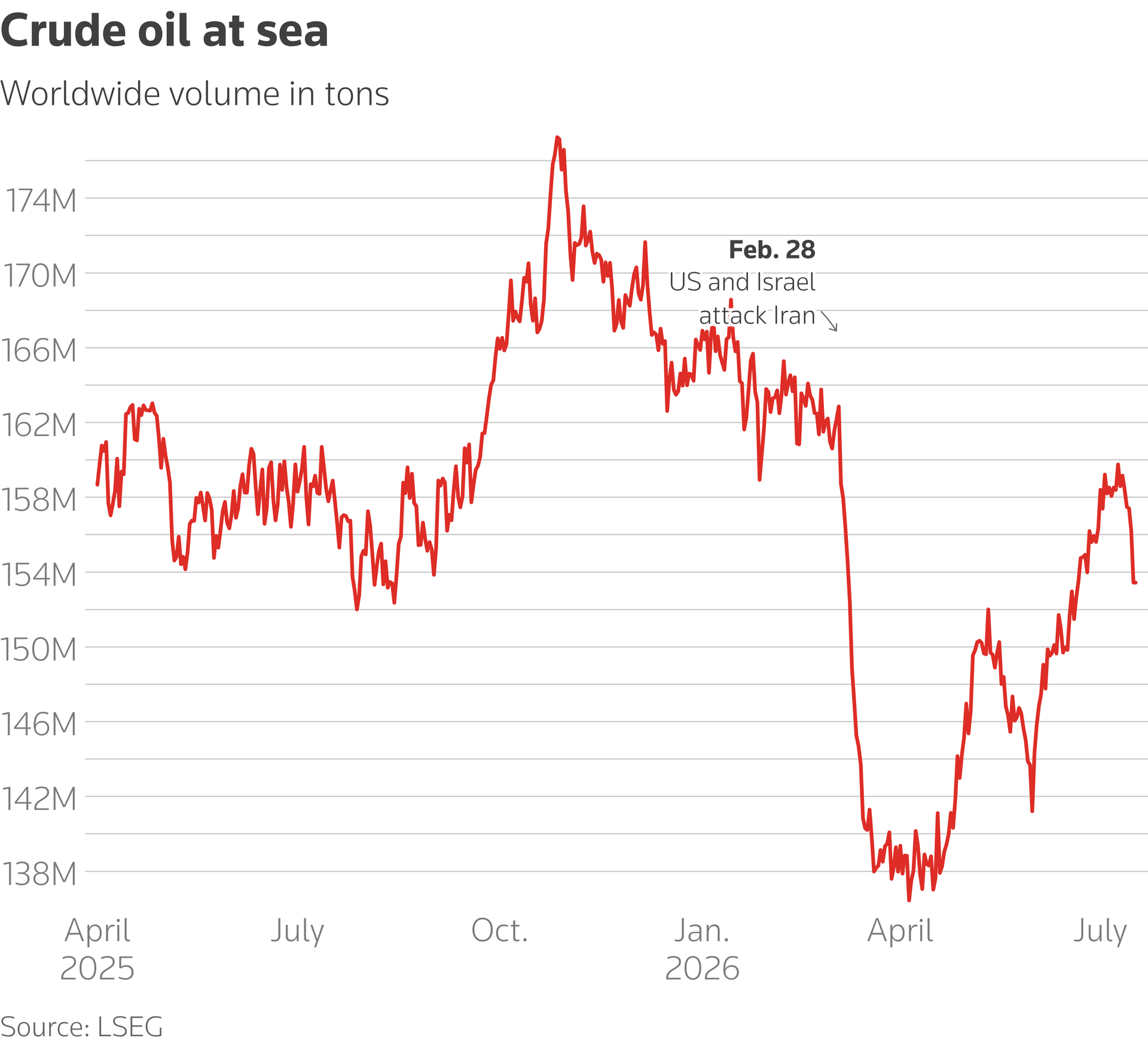
Why oil prices haven't gone crazy despite 5 months of US-Iran war


As the United States and Israel went to war with Iran at the end of February, analysts predicted the price of crude oil could hit $150 a barrel or even rise as far as $200, with the fifth ‌of global supply that transits the vital Strait of Hormuz suddenly cut off from world markets.

But, Brent crude futures peaked around $126 — comfortably below 2008's all-time high of $147 — and averaged just $101 a barrel between the start of the conflict on February 28 and June 11 when Donald Trump called off strikes on Iran, before briefly retreating to pre-war levels of $70 in early July.

Read more
 

And Finally...