Listen first. The Sequence Gap may change how you see complex cases.
Dear Colleague and Friend,
There are moments in your professional life when a decision represents more than enrolling in another educational program.
This may be one of those moments.
Enrollment in Functional Medicine University closes on Monday,
July 27, at 11:00 p.m. Eastern.
That means you have three days remaining — not simply to enroll in FMU, but to decide whether you want to become part of what I believe may be the next important evolution in clinical reasoning.
I recorded a
10-minute audio for you today because I believe this message is better heard than skimmed.
▶ Listen
First: One Case, One Movement, and Three Days Remain
If the audio link above does not open, copy and paste this URL into your browser:
Functional Medicine changed what clinicians could see.
It helped move healthcare beyond simply asking, “What disease does this patient have?” and encouraged clinicians to ask a much deeper question:
“Why is this happening?”
That was an important transformation.
Functional Medicine helped clinicians look for underlying contributors, recognize interconnected systems, and treat the patient as a whole person rather than as a collection of isolated diagnoses.
But today, Functional Medicine and Integrative Medicine are facing a new challenge.
Clinicians now have more information than ever before. More testing. More labs. More protocols. More supplements. More clinical strategies. More possible directions.
But more information does not automatically create greater clinical clarity.
A complex patient may have gastrointestinal dysfunction, immune activation, mitochondrial impairment, blood-sugar dysregulation, hormone changes, poor sleep, environmental exposures, autonomic imbalance, and nutritional deficiencies — all at the
same time.
Everything may matter.
But everything cannot be treated first.
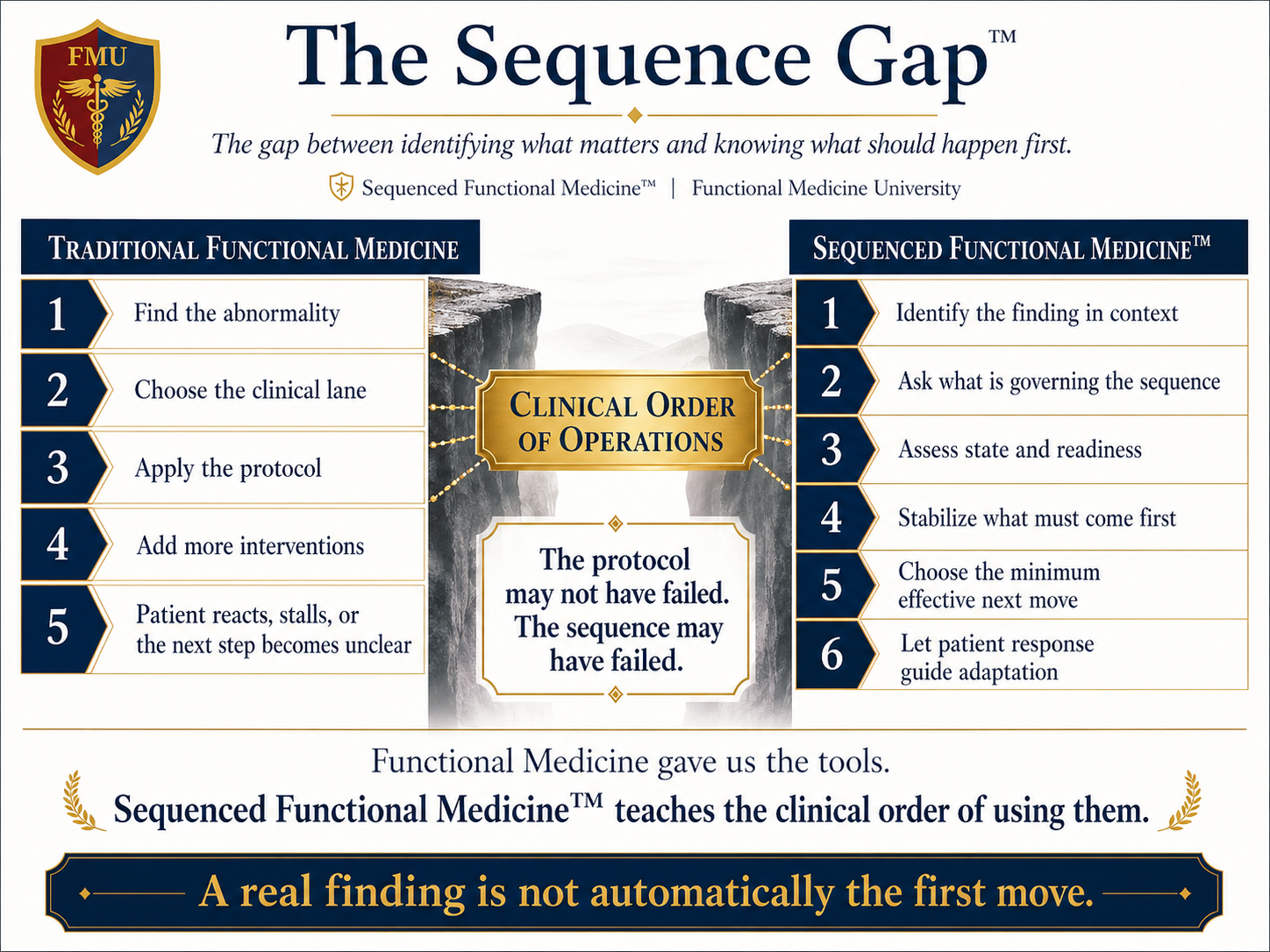
That is the Sequence
Gap™.
The Sequence Gap™ is the gap between identifying
what matters and knowing what should happen first.
And this is where Sequenced Functional Medicine™ begins to change the conversation.
Sequenced Functional Medicine™ does not replace Functional
Medicine.
It builds upon it.
Functional Medicine helps clinicians identify what may be contributing to the patient’s condition. Sequenced Functional Medicine™ helps determine what deserves priority now.
Functional Medicine expanded the clinical map. Sequencing provides the navigation system.
Let me show you what I mean.
Imagine a 42-year-old woman who walks into your office after nearly six years of searching for answers.
She has seen multiple specialists. She has worked with several practitioners. Her file is enormous. She has completed advanced stool testing, hormone panels, organic acids testing, mycotoxin testing, food sensitivity testing, genetic testing,
routine bloodwork, and multiple specialty reports.
Every report has been interpreted. Every abnormal marker has been addressed. She has completed gut protocols, detoxification programs, hormone support, antimicrobial programs, mitochondrial support, and multiple supplement strategies.
Her supplement cabinet looks like a small pharmacy.
And yet she is still exhausted. She is still bloated. She is still foggy. She is still anxious. She is still reactive. She still does not feel like herself.
Now pause for a moment.
The problem in this case is probably not that no one cared. The problem is probably not that no one looked deeply enough. The problem is probably not that Functional Medicine tools have no value.
In
fact, many of the tools may have been appropriate.
The gut work may have mattered. The hormone patterns may have mattered. The detoxification burden may have mattered. The mitochondrial stress may have mattered. The inflammatory markers may have mattered. The nutritional findings may have mattered.
But here is the question that changes the case:
What if the patient received many reasonable interventions, but they were never organized into the right clinical order?
That is the Sequence Gap™ in real life.
Because now the question is no longer simply, “What else can we test?” or “What other protocol should we try?”
The better question becomes:
What must happen first so this patient has a better opportunity to tolerate, respond, and move forward?
That question changes everything.
A patient can need gut work and still not be ready for aggressive gut work. A patient can need detoxification support and still not be ready for detoxification. A patient can need hormone support and still not have the rhythm, reserve, or stability to respond well.
A patient can need many things and still need one clear
next step.
This is why sequencing matters.
It does not guarantee a specific outcome. No honest educator should promise that.
But it can create a better clinical opportunity.
A sequenced approach may reduce overload, improve tolerance, create a clearer clinical signal, protect the patient from unnecessary treatment burden, restore confidence in the plan, and create a better opportunity for later repair work to actually hold.
That is not just clinical theory.
That is the difference between a patient receiving more interventions and a patient receiving a more coherent path forward.
And it can also change the clinician .
Because once you begin seeing patient care through the lens of sequencing, it becomes difficult to return to the old way of thinking.
You begin to understand that
identifying a root cause does not automatically tell you where treatment should begin.
You begin to recognize that a clinically reasonable intervention introduced at the wrong time may still be the wrong next decision.
You begin to see that the order
in which care is delivered may be just as important as the treatment being delivered.
Once you see the Sequence Gap™, it becomes almost impossible to unsee it.
That is why I believe this is larger than any
one course.
Important movements rarely look obvious at the beginning.
There was a time when Functional Medicine itself was practiced by a much smaller group of clinicians and was not yet widely understood.
There was a time when many new ideas in healthcare, technology, and education began quietly before the world understood what they could become.
I am not suggesting that every new idea becomes transformative. Nor can any honest educator guarantee exactly how large Sequenced
Functional Medicine™ will become.
Its future must be earned through responsible clinical application, documented outcomes, professional standards, research, publication, and the integrity of the practitioners who carry it forward.
But I do believe we
are witnessing the early formation of something important.
And its potential is substantial.
Students entering FMU today are not merely learning a method after everyone else has already accepted it.
They have the opportunity to become some of the earliest clinicians formally trained in Sequenced Functional Medicine™ while the framework is being introduced, tested, refined, documented, and established.
That distinction matters.
Future practitioners may learn the framework after its terminology, standards, case applications, and clinical pathways have become widely established.
Today’s students have the opportunity to help establish them.
They may become the practitioners who apply sequencing to real clinical cases, help document and strengthen the framework, establish responsible professional standards, mentor the clinicians who come after them, and bring this model to new practices, communities, and countries.
This is not about being early for recognition
or bragging rights.
It is about being early enough to participate in building something.
There is a meaningful difference between joining a movement after the world recognizes it and helping the world recognize it in the first
place.
That is the opportunity in front of you.
And I want to be very clear about the consequence of waiting.
I will not tell you that this is your only opportunity ever to study Functional Medicine. It is not.
Nor will I promise that enrolling will guarantee professional success, financial success, or a particular patient outcome. That would not be honest.
But there is one thing you cannot recover later:
You cannot return to the beginning of a movement after it has already grown.
You may be able to learn Sequenced Functional Medicine™ at another time. But you may
no longer be among the early clinicians who studied it while the framework was being introduced, tested, refined, and established.
There is also a more immediate professional consequence.
Without a disciplined sequencing framework, you may continue
accumulating more tests, more tools, more protocols, and more information — while still struggling with the question that matters most when a complex patient is sitting in front of you:
What do I do first?
You may continue knowing
many things that could help while remaining uncertain about which decision should come next.
That is the problem FMU is working to solve.
Imagine the collective impact if clinicians throughout the world became better at identifying the safest and
most appropriate first decision.
Imagine fewer patients being overwhelmed by ten interventions at once.
Imagine clinicians recognizing when a patient needs stabilization before aggressive treatment.
Imagine care plans becoming clearer, more coherent, more individualized, and more responsive to the patient’s changing state.
Imagine practitioners no longer asking only, “What can I give this patient?” but also, “What is this patient ready for?”
The impact would not end with the clinicians who receive the training.
It would extend to every patient they serve, every practitioner they mentor, every case they document, and every community in which they introduce this way of thinking.
That is how a clinical framework has the potential to touch many lives — not through one person or one institution, but through a growing community of trained clinicians making better decisions around the world.
After more than two decades in Functional Medicine, I believe the
Sequence Gap™ is real.
I believe complex patients need more than additional protocols.
I believe clinicians need a disciplined way to determine what to do first, what to do next, and what to delay.
And I believe Sequenced Functional Medicine™ has the potential to become an important part of the future of Functional Medicine, Integrative Medicine, and healthcare more broadly.
I have chosen to devote this next chapter of my professional life to
teaching it, refining it, documenting it, and building it responsibly.
And I would be honored to teach it to you.
You have not missed this opportunity.
But the opportunity is now directly in front of you.
Enrollment closes on Monday, July 27, at 11:00 p.m. Eastern.
Three days from now, you will either have made the decision
to become part of this early movement — or you will have allowed this particular opportunity to pass.
The question is not merely whether you want to take another course.
The question is:
Do you want to watch this movement develop from the outside — or do you want to help build it from the beginning?
Functional Medicine taught us to see more.
Sequenced Functional Medicine™ is teaching us what to do first.
The future of this movement has not yet been fully written.
You still have an opportunity to become part of writing it.
With respect and purpose, Ronald Grisanti, D.C., D.A.B.C.O., D.A.C.B.N., M.S., DIANM, CFMP Founder, Functional Medicine University Creator of Sequenced Functional Medicine™
P.S. The case above is the point. The issue was not simply that the patient needed more testing, more supplements, or another protocol. The deeper issue was
clinical order. Once you see the Sequence Gap™, it becomes hard to unsee it. Enrollment closes Monday at 11:00 p.m. Eastern.
2123 Old Spartanburg Road #348 Greer South Carolina 29650 USA