
|



Chainable compute. Right on queue. (Sponsored)
 |
Define tasks with Render’s lightweight SDK and chain them into long-running, distributed workflows. Launch your agents and batch jobs on demand. Render Workflows handles queuing, orchestration, and retries.
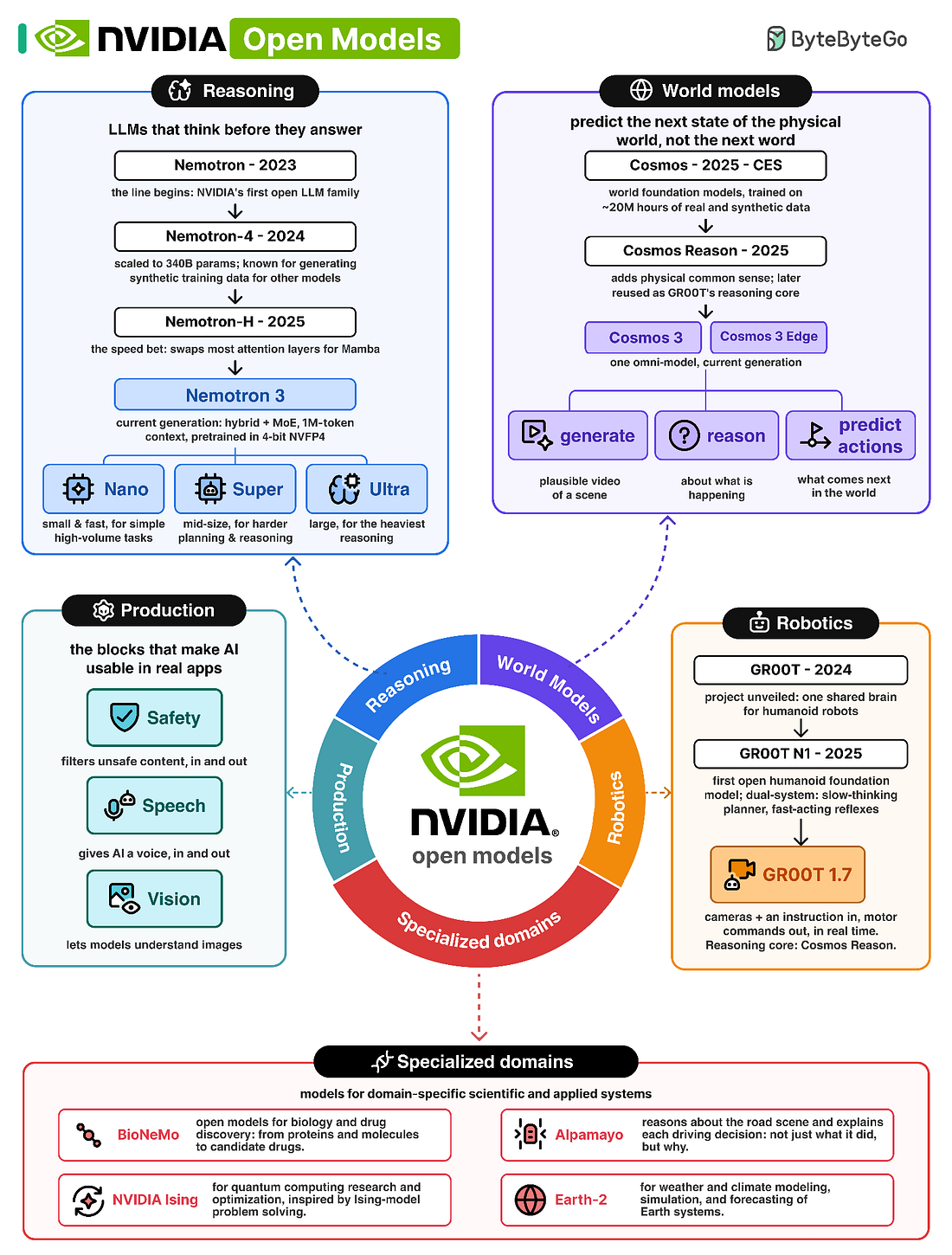
You probably know NVIDIA sells GPUs. But did you know it is also the largest publisher of open AI models in the world? Its models rank among the most downloaded on Hugging Face, and the lineup goes way beyond chatbots: reasoning models, world models, models for humanoid robots, self-driving cars, even drug discovery, quantum computing, and global forecasting.
This raises two questions. How does a company best known for hardware build so many strong models across so many domains? And why give them away for free, when those same models run on the GPUs NVIDIA sells?
To understand both, we spoke with Bryan Catanzaro, VP of Applied Deep Learning Research at NVIDIA. He walked us through how his team builds the company’s open models, the reasoning behind their architecture, and why NVIDIA open-sources so much of it. Our thanks to Bryan for taking the time to share the team’s work in such detail.
In this article, you’ll learn:
What open models NVIDIA has built, and what they do
How NVIDIA makes its models both fast and powerful
How one foundation lets a small team build many models
What open really means and why releasing the data matters as much as the weights
Why NVIDIA gives it all away, and the lessons the team has learned shipping in the open
 |
NVIDIA’s Open Model Ecosystem
 |
NVIDIA’s open models sit at two ends of AI. At one end are models that work with symbols, the language, code, and reasoning that lives on a screen. At the other are models that work in the physical world, where robots and autonomous vehicles (AVs) have to perceive their surroundings and act. Most of the lineup falls somewhere along that line.
The simplest way to see the ecosystem is to group them by what each family is for.
 |
1. Reasoning models
Reasoning models are large language models that are trained to produce intermediate tokens before the final answer. This is what lets them think through tasks such as math and coding. Most frontier models you see these days are powered by a reasoning model. Claude Opus, GLM-5.2, Kimi K2.7.