July 31, 2026
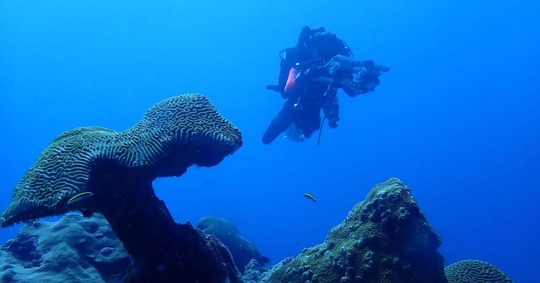
Flower Garden Banks National Marine Sanctuary (FGBNMS) consists of 160 miles of dispersed banks with underwater mountains, ridges, and troughs over 80 miles off the coasts of Texas and Louisiana, and it hosts the highest recorded coral cover of any reef within the greater U.S. Atlantic region. While the relatively shallow coral reef caps of East and West Flower Garden Banks specifically have remained remarkably stable despite global declines, those reefs found in the region’s “twilight zone” pushing 100 to 500 feet may play a vital role in the future of these essential and vast ecosystems. To investigate them, scientists at NOAA’s Atlantic Oceanographic & Meteorological Laboratory (AOML) and Cooperative Institute for Marine & Atmospheric Studies (CIMAS) are preparing to explore those depths.
Under a highly collaborative, five-year project recently funded by the NOAA RESTORE Science Program and led by FGBNMS and the National Marine Sanctuary Foundation, scientists at CIMAS and AOML will extend existing long-term coral reef monitoring efforts that the team currently leads into deeper waters to mesophotic coral ecosystems.
The goals of the new collaboration are to track the long-term trends in FGBNMS coral communities and oceanic conditions, and to create a comprehensive FGBNMS Reef Resilience and Adaptation Strategy. Michael Studivan, Ph.D., a CIMAS Associate Scientist with AOML’s Coral Program and a co-Principal Investigator on the project, and his team will lead the AOML component, expanding monitoring efforts to mesophotic coral ecosystems – in the range of 150 to 300 feet – with dive expeditions set for 2026 through 2030. However, reaching these depths requires advanced technical diving with intensive training that the team is actively completing.
Read more: https://www.aoml.noaa.gov/scientists-at-aoml-push-boundaries-to-investigate-coral-resilience-of-mesophotic-reefs/
Back to school is on the horizon! Flower Garden Banks National Marine Sanctuary aims to provide teachers with resources to support ocean literacy. Check out the collection of online resources for teachers, perfect for every school and classroom.
|
|