Welcome back to Buffering, where we’re still in awe of Steve Kornacki’s stamina this past Tuesday night (and Wednesday morning). NBC News is building a subscription product for him, which is fine, but what the network really needs to do is just replace the normal programming on NBC News Now with Kornacki Cam on all Election Nights. There are plenty of pundits and reporters on cable news, but Kornacki is one of a kind and ought to get the wider distribution of the network’s FAST news network.
We don’t have any election analysis, but in this week’s newsletter we do have a deep dive into how Sony and executive producer Michael Davies have been transforming Jeopardy! from a linear-TV show into a multi-platform franchise. We’ve also got the latest on earnings at Disney and Paramount; the most interesting thing we noticed in Nielsen’s biannual streaming rankings report; and our colleague Chris Lee’s interview with Sony Pictures boss Tom Rothman. As ever, thanks for reading.
|
|
|
|
Subscribe now to get unlimited access to everything New York, including subscriber-only newsletters, exclusive perks, the New York app, and more. |
|
|
|
In this edition: David Ellison, Ari Emanuel, Gavin Newsom, Bari Weiss, Tony Dokoupil, Nathan Fillion, Josh D’Amaro, Tom Rothman, Michael Davies, Suzanne Prete, Debra OConnell, Rob Mills, and Pat Caldwell, one very important projectionist … |
|
|
|
➽ The Week in (Desperate) Paramount Spin |
Paramount Tuesday announced its second-quarter earnings, and the results were mixed: Streaming did a bit better than a year ago, linear TV a bit worse. But the ups and downs of a single earnings period aren’t what most people tracking the Skydance-owned company care about. It’s all about David Ellison’s increasingly grueling odyssey to also take over Warner Bros. Discovery. On that front, this week saw yet another major setback: A judge set a March trial date in the antitrust action brought against Paramount by the attorneys general of a dozen states. It was a disappointing ruling, as Ellison had been hoping to get the court proceedings underway by November in order to limit the financial fallout from the delay in closing its deal for WBD.
Perhaps sensing there would be no quick resolution, Team Ellison has spent the last few days desperately trying to spin the media and political classes about why the merger with WBD is good, actually. There was last week’s Wall Street Journal column by superagent turned mogul Ari Emanuel arguing resistance to the merger was futile; a leak (also to the WSJ) about California governor Gavin Newsom being opposed to his own state’s lawsuit; a Variety article in which CBS Evening News anchor bro Tony Dokoupil subtly (and unsuccessfully) tried to paint a new segment on his show as evidence the telecast hasn’t tilted rightward under the watch of CBS News editor-in-chief Bari Weiss; a bizarre THR piece penned by former Fox News regular Chris Wallace; and yet another sales pitch from Emanuel, this time on Tuesday’s edition of Squawk Box. Most notably, Ellison himself took to the op-ed page of the New York Times to argue that he has no desire to make CNN even more friendly to right-wing ideas than the network already is.
It was a thoroughly unconvincing effort at spin that, as Status reported, didn’t seem to sway anyone at the House that Ted Turner built. Whether the broader barrage of bluster will work on its intended audience — the dozen AGs who have the power to settle their suit against Paramount before it goes to trial — remains to be seen. —Josef Adalian
|
|
| |
➽ People Really Love The Rookie
|
Remember in June when we told you Stranger Things was the biggest hit of the 2025–26 TV season according to Nielsen’s multi-platform ratings? Well, shocker: The final season of the Netflix smash was also No. 1 in the company’s streaming-only data for the first half of this year. Most of the other headlines from Nielsen’s semi-annual report were also less than surprising: The Pitt is an absolute monster for HBO Max, The Traitors and Love Island are keeping Peacock afloat, and The Big Bang Theory is — by far— the most-streamed sitcom in TV (sorry, Friends).
The rankings also underscored yet again how ABC’s The Rookie has quietly become the biggest crime procedural in streaming. Despite having only 144 episodes in its catalogue, the Nathan Fillion procedural racked up nearly 13 billion minutes of viewing during the first six months of the year, ahead of Law & Order, Law & Order: SVU, and NCIS (which all have between three and four times as many episodes), and on par with Criminal Minds (which boasts well over twice the number of episodes). Even more impressively, The Rookie racks up its massive streaming audience through just a single streamer (Hulu), while those other shows have between two and four different digital homes. ABC still hasn’t said what it plans to air after the Super Bowl next year, but if it wants a guaranteed ratings winner, it could do a lot worse than The Rookie. —J.A.
|
|
|
|
In his first full quarterly earnings call as Disney CEO this week, Josh D’Amaro hyped strong returns for Toy Story 5, success at his theme parks, AI tools, and a new TikTok integration. We got into all of that at Vulture, but he noted another development could be especially game-changing for the company’s streaming business: “We’re exploring a free product for consumers,” D’Amaro confirmed.
He qualified that the company had “nothing specific” to announce yet, but a new AVOD or FAST platform would be an enticing proposition for one of the most in-demand content libraries in streaming. “We see it as a way to expand our reach to a customer segment that’s more price sensitive, and expanding our reach is, as we’ve talked about before, one of our strategic priorities,” D’Amaro said. “Unlike a lot of our AVOD competitors, we’re fairly well sold, meaning more inventory would actually help us accelerate our ad-revenue growth. And then finally, a free offering could help us drive top-of-funnel Disney+ subscriber growth.”
In an age of rampant price hikes, a Disney FAST platform, or even several of them, makes plenty of sense. But what might that look like — a fleet of channels programmed on outside platforms like Pluto or Roku? A free tier on Disney+, perhaps with classic films or other library content? A whole other app powered by similar technology? The latter feels less likely, given the uphill battle of marketing yet another (and quite late) entrant to the already-stuffed arena of streaming services. Amazon’s Freevee evolved into … just a free version of Prime Video, after all.
Whatever D’Amaro decides, it will have to co-exist with the plan first articulated by Iger before D’Amaro was elevated to his role: “Our ambition is for Disney+ to become the digital centerpiece of the Walt Disney Company,” the company reiterated again today. “This long-term strategy rests on two pillars: making the streaming experience the best in the world and connecting Disney’s services into a single ecosystem.” The company has spent years hyping a one-app future, and we have little reason to believe it would go back on that now…. —Eric Vilas-Boas
|
|
|
|
Photo-Illustration: Vulture; Photos: Getty |
There’s a remarkable bit of TV history on display inside the Culver City office of Jeopardy! executive producer Michael Davies: the actual game board used in the very first 1964 episode of the iconic series. It’s a great conversation starter, but for Davies, it doubles as a reminder of the show’s durability. “What’s so remarkable about Jeopardy! is that the format has not changed in 62 years, and were we to change the Monday-through-Friday original recipe, we would be insane,” he says. “The preservation of that is everything.”
Davies is respectful, even reverent, in honoring the DNA of Jeopardy!, noting that he began his Hollywood career working for series creator Merv Griffin in the 1990s. “I had personal conversations with Merv about Jeopardy!,” he says. “I wish I’d spoken to him more about it because I would love more of his guidance on a daily basis.” But Davies and his bosses at Sony Pictures Television are also adamant that in order to survive another six decades, the Ken Jennings–hosted show can’t remain frozen in amber — or be limited to a single half-hour that can be watched only on weeknights on local TV stations. It’s not that the mothership is faltering: During its just-concluded 42nd season, the syndicated version of Jeopardy! averaged 8.3 million nightly viewers, growing its audience 2 percent versus last season. Per same-day Nielsen ratings, it was the No. 1 entertainment series not just in syndication but in all of linear TV, including prime time, Sony says.
Yet as strong as Jeopardy! remains on broadcast, rapid changes to the television business have demonstrated how quickly viewing habits can shift and why studios and platforms need to constantly rethink how they connect with audiences. So even while protecting and preserving the integrity of the main show remains job one for Davies, since taking over as executive producer five years ago, he and Sony have been methodically working to transform the answers-and-questions show into a multi-title, multi-platform franchise, one able to reach audiences wherever they watch video — and even in places they don’t:
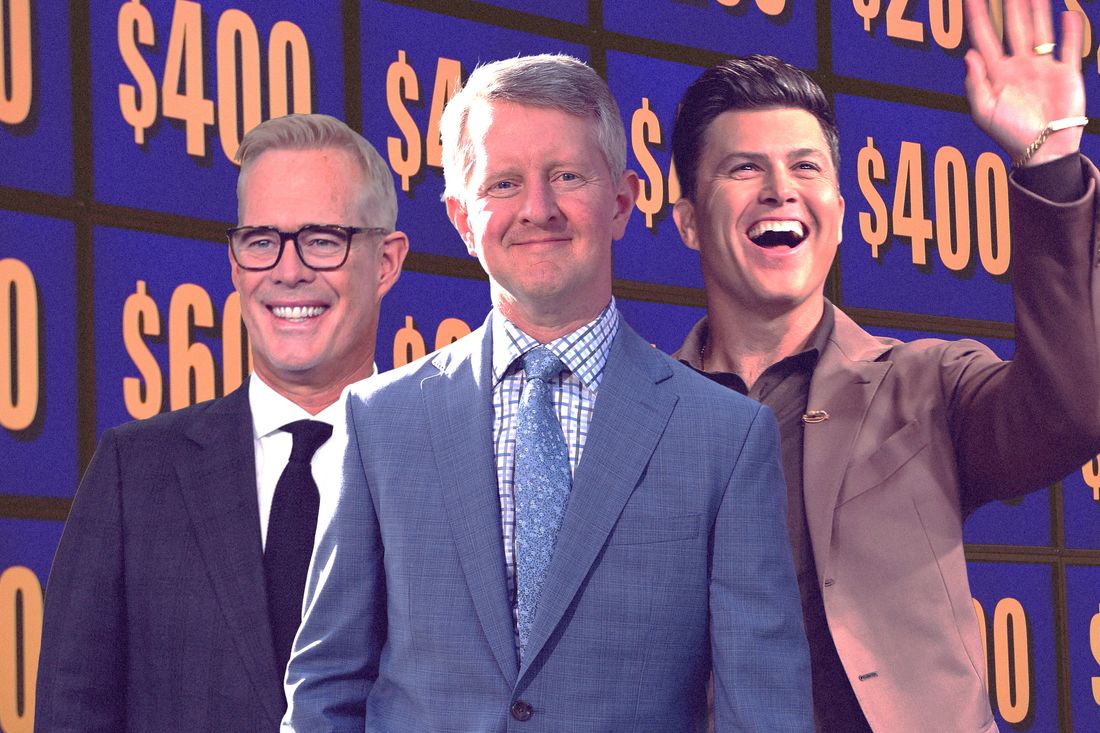
➽ With this week’s debut of ESPN Jeopardy!, hosted by Joe Buck and streaming on Disney+, Hulu, and the ESPN app, Sony and Davies will have launched their fourth spinoff series in as many years. The parade of offshoots began in September 2022 with the premiere of Celebrity Jeopardy! on ABC, followed in 2023 by Jeopardy! Masters on the same network. Next came the Colin Jost–hosted Pop Culture Jeopardy!, which debuted on Amazon’s Prime Video at the end of 2024 (and switched to Netflix this past May for season two).
➽ Last fall, in-season episodes of weeknight syndicated Jeopardy! (along with the companion Sony game show Wheel of Fortune) began streaming for the first time, with new installments premiering on both Hulu and Peacock the day after airing on local TV stations.
➽ March saw the arrival of Jeopardy! YouTube Edition, a special for the Google streamer hosted by Jennings and featuring creators such as Monét X Change. While not a full-fledged spinoff, the episode signaled the studio’s desire to bulk up its presence on the world’s biggest video platform. (Another YouTube special is planned for the fall.) ➽ And in late 2024, Sony launched the Jeopardy! Bar League, teaming up with bar-trivia giant Geeks Who Drink to bring the show’s gameplay to pub quizzes across the country. As of this month, the program is operating in 350 bars, giving the show a regular IRL presence.
To longtime fans and outside observers, this furious pace of expansion may seem like another example of the entertainment industry’s longtime addiction to sequels and brand extensions. Davies doesn’t deny there’s a profit motive; Sony is not the BBC, after all. But he makes a passionate, and persuasive, case for why the changes had to happen. “While rumors of its demise are highly exaggerated, broadcast television is hardly in the ascendancy,” he says. “To protect Jeopardy!, we have to make it thrive in a new media environment, which includes making it work in streaming and experientially. The previous version of the show didn’t need to expand. Now, with the threat to broadcast, you’ve got to be in all these different areas. Yes, it’s commercial, but it’s modernize or die.”
This effort to futureproof Jeopardy! by turning it into a 21st-century content universe was not the first thing Suzanne Prete, president of game shows at Sony Pictures Television, had in mind when she recruited Davies for the executive-producer role .... |
| |
|
At the outset of Sony’s Spider-Man: Brand New Day, anyone who ever met, knew, or loved Peter Parker has had every vestige of him magically wiped from their memories (this being a bid to prevent multiversal collapse that also wreaks havoc on the Queens-dwelling enhanced human’s personal life; it’s complicated). Over the movie’s opening weekend in theaters, however, audiences showed no such amnesia. The ninth live-action Spider-Man installment grossed a superheroic $360 million in North America and web-slung to a breathtaking $932 million worldwide. Not only did it eclipse prerelease “tracking” estimates that had it doing about $195 million domestically, SM:BND beat 2019’s monolithic Avengers: Endgame to become the biggest debut in box-office history.
With Brand New Day also comes the dawn of a slew of new records for Sony’s 24-year-old franchise. Brand New Day more than toppled Spider-Man: No Way Home’s $260 million opening haul in 2021 — the franchise’s previous biggest start — and also surpassed the $168 million record set by Avengers: Endgame for |
|
|
|
|