





 |
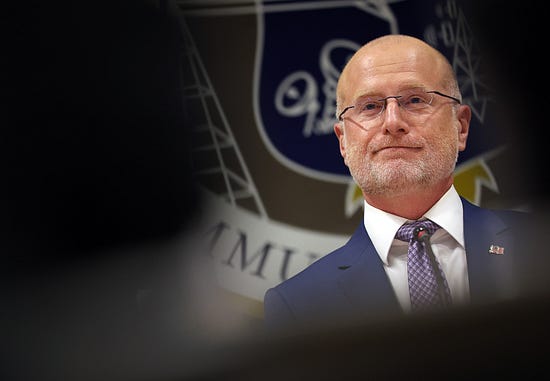
WHEN NEWS BROKE YESTERDAY that the Federal Communications Commission voted to allow further consolidation of local broadcast networks, few were surprised. After all, putting the brakes on ownership of the media by conservative-leaning companies like Sinclair was never in the cards for the Trump-aligned FCC or his lapdog its chair, Brendan Carr.
But I do think the focus of the coverage has been ever so slightly misplaced. Much has been made of the topline number: 39 percent. For two decades, that has been the percentage of U.S. households that owners of broadcast networks were limited to. The idea was that, by keeping some control out of the hands of major conglomerates—by at least limiting their reach—local owners would keep some control of local TV networks. That was the hope, anyway. With its vote yesterday, the FCC has scrapped the limit.
Opponents of the move have repeatedly argued that the FCC simply does not have the legal authority to do this. Congress passed a law creating the 39 percent cap, and according to interest groups like the Free Press,¹ the FCC cannot unilaterally lift it. “Changing this limit requires congressional action, but Carr doesn’t care. He’ll do whatever it takes to clear the way for Trump-aligned billionaires to swallow up stations wherever and whenever they please. The result would be just one or two dominant broadcasters in every market, deep job cuts for journalists, and an influx of bargain-basement content disguised as local news,” Free Press general counsel Matt Wood said in a statement.
I, frankly, don’t have terribly strong opinions on this, at least on the consolidation front: There’s a decent business case to be made that local news is in real trouble in an age of near-infinite viewing options, and consolidation will help cut costs even if it means reducing the usefulness of the news in some locales. In an ideal world, every town would have three healthy and competitive broadcast channels offering up a diverse array of morning and afternoon news, but we don’t live in an ideal world. We live in a world of broadcast and cable and streaming and YouTube and TikTok and the infinite scroll. (Speaking of which: If you want some viewpoint diversity, make sure to sign up for The Bulwark’s YouTube feed!)
What I do find concerning, though, and what I think everyone should find concerning, is the FCC’s explanation of how it will regulate media deals now that the 39 percent cap is gone: “Under a case-by-case approach, the Commission’s interests in localism, viewpoint diversity, and competition (to the extent they are implicated in a case) can be fully analyzed and vindicated in the context of a specific transaction. There may be transactions that would have exceeded the limits of the 39% national cap that do not promote the public interest and those will be denied.” (Emphasis added.)
So, basically: Brendan Carr wants to decide who gets a pass and who doesn’t. And if I know anything about Brendan Carr—the guy who took a victory lap when Jimmy Kimmel got suspended by ABC and the guy who demanded ABC’s broadcast renewals come up early for displeasing the president—it’s that he’s absolutely 100 percent not to be trusted with this power.
But really, no government entity should have this power. And I think on some level, most Americans agree with that. It is noxious to American beliefs about freedom of speech and the First Amendment that the government should determine who should or shouldn’t get to own an outlet dedicated to the promulgation of news and opinions and entertainment due to the viewpoints of the owners. It’s why it rankled that Donald Trump attempted to use the power of the government to hold up the AT&T/Warner Bros. deal during his first term because he wanted to try and hurt CNN.
Support our growing coverage of movies, books, arts, ideas, and culture—become a Bulwark+ member today:
THAT’S ALSO WHY, frankly, David Ellison is smart to try and shift the argument over the Paramount/Warner Bros. merger away from a question of market share and toward the much more fraught issue of CNN’s ownership.
In an opinion piece for the New York Times about the lawsuits filed by Democratic attorneys general aimed at stopping the merger, Ellison—the chairman and CEO of his family’s Paramount Skydance Corp. and the would-be buyer of Warner Bros.—framed the question thus: “I believe a plainer worry sits beneath the briefs and the news releases: the news. The issue is whether I can be trusted as a steward of Warner’s CNN. There has been speculation about my politics, my loyalties, my intentions.”
Now, as I wrote a couple of weeks back, a Paramount-WB merger would likely be terrible for theaters. And it would likely be terrible for the writers and actors and directors who would lose jobs if the merging of streamers and studios led to less product being created, as it almost certainly would, eventually. I think the AGs are smart to frame their argument this way and to sidestep entirely the question of CNN’s ownership. I hope they stick to this. Because I also believe that Ellison intuitively understands that there’s something . . . unsettling about the power of the government being used to keep a news organization out of the hands of an owner whom those in power in the government dislike.
And this goes both ways. I personally found it abhorrent that the Ellisons used their proximity to and friendliness with Trump as a cudgel in their effort to strong-arm Warner Bros. away from Netflix. The looming threat of a long, drawn-out regulatory process—a process that would, wink wink, be shortened if the Ellisons were the guys writing the check—was despicable, full stop. So maybe there’s some element of turnabout being fair play here. That said, it’s one thing to dislike the idea of an Ellison-owned CNN or to worry about what it means for the folks who work there and the journalism being done there. But it’s another entirely to use the power of the government to block someone whose views we dislike from owning that outlet. Whether the person wielding that power is Brendan Carr or a Trump-led Department of Justice antitrust division . . . or a friendly attorney general.
Assigned Viewing: Miami Vice (Prime Video)
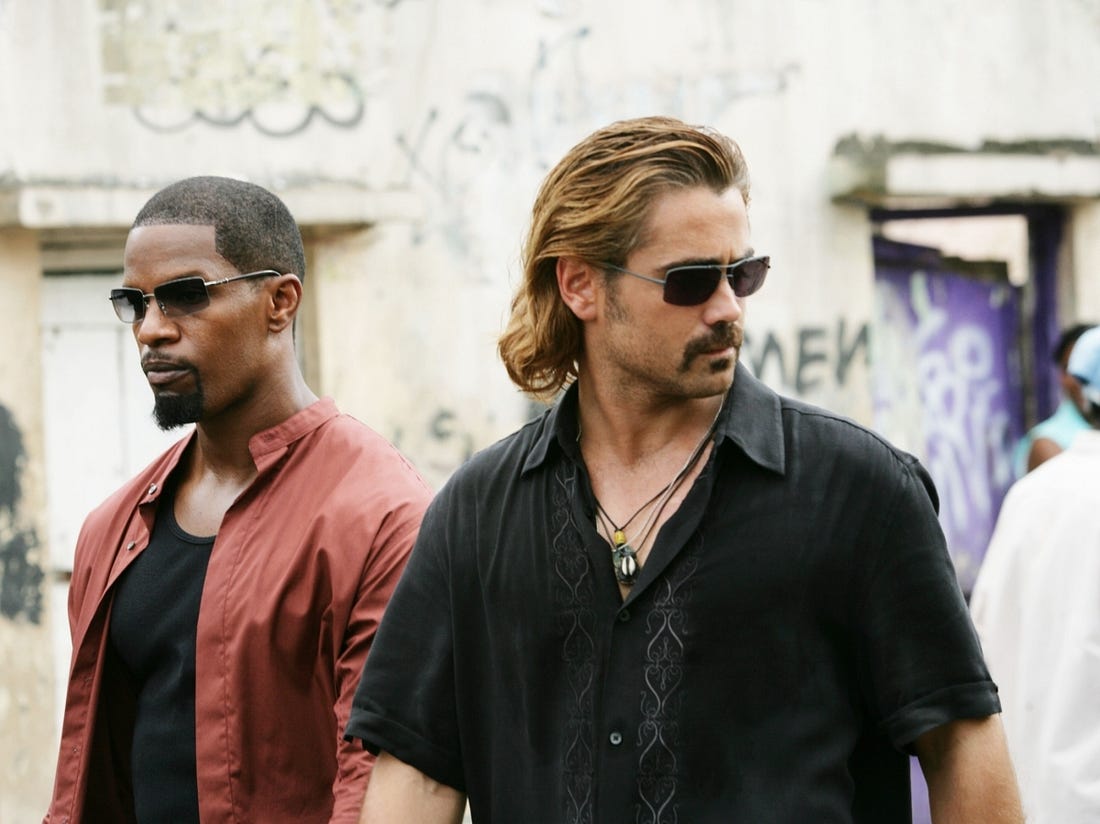 |
Okay, I’m not assigning Miami Vice because it was recently the twentieth anniversary of the film’s release and, as Bilge Ebiri has persuasively argued over the years, its reputation deserves to have evolved from misfire to masterpiece. I’m not even assigning it because I myself recently rewatched it, needing to feel a little something after a rough day. (What does it say about me that my feel-good flick starts with a Linkin Park/Jay-Z remix needle drop? Something awesome, I presume.)
No, I’m assigning it because this is the moment everyone should have realized that Colin Farrell was the real deal. Yes, he’d been good in stuff before this—Minority Report, Tigerland, etc.—and he’d soon hit another level of critical acclaim by partnering with Martin McDonagh in In Bruges, Seven Psychopaths, and The Banshees of Inisherin over the next decade-plus. But Farrell does such exquisitely subtle desperate longing in this film that it went over most everyone’s head the first time around. The whole core of the film is Sonny’s desire for the life his partner, Rico (Jamie Foxx), already has, and you almost miss i