| | In this edition: East Africa energy hub planned, dealmakers prepare for IPO wave, and AI drives cybe͏ ͏ ͏ ͏ ͏ ͏ |
| |  Dar es Salaam Dar es Salaam | Accra |  Libreville Libreville |
 | Africa |  |
| |
|
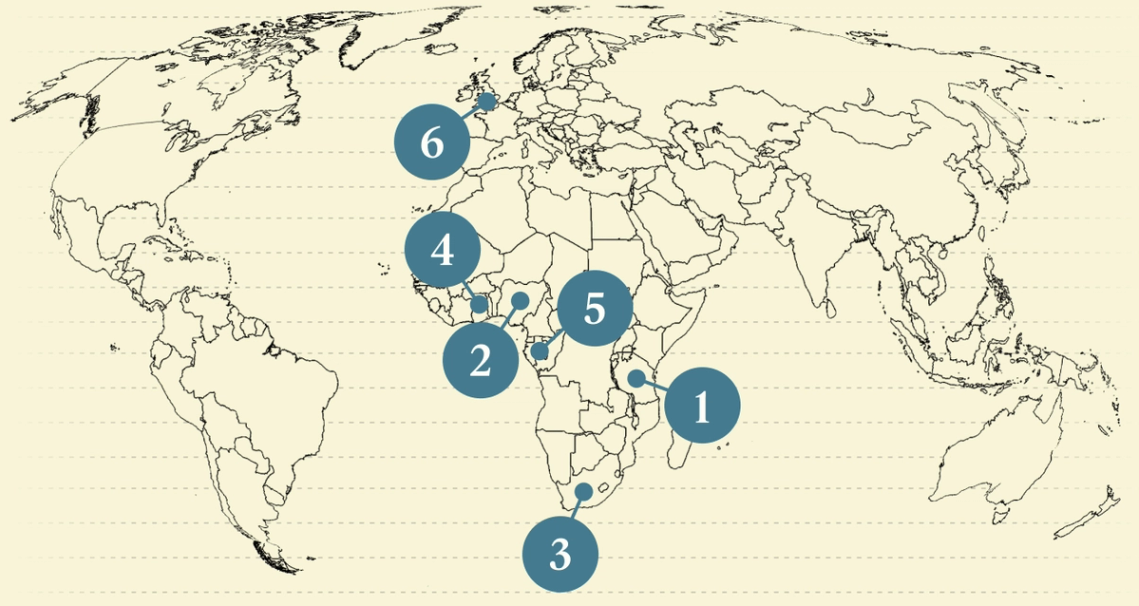 - E. Africa energy hub planned
- Bracing for an IPO wave
- DA launches manifesto
- A new customs deal
- AI accelerates cybercrimes
- ‘Fridge-free’ vaccines trialed
 A looted ‘talking’ drum returns to Côte d’Ivoire. |
|
Plans for new East Africa energy hub |
 Tanzania’s President Samia Suluhu Hassan. Anastasia Barashkova/Reuters. Tanzania’s President Samia Suluhu Hassan. Anastasia Barashkova/Reuters.Tanzania and Uganda signed an agreement with Vitol, the world’s largest independent oil trader, to develop Tanga Port into a regional energy hub as the continent works to capture more value from its natural resources. The partnership comes as Africa’s energy ecosystem is on the cusp of major change: Uganda is preparing to begin commercial oil production, with supplies due to flow through the still-under-construction East African Crude Oil Pipeline to Tanzania’s Tanga Port, ready for shipment to global markets. Uganda currently imports most of its petroleum products through Kenya, via the Port of Mombasa. It’s unclear what the planned energy hub will entail, but Tanzania’s government said potential investments in new infrastructure, such as storage facilities, could exceed $20 billion, Reuters reported. The Iran war has exposed how much many East African countries depend on fuel imports. The proposed Tanga Port development could radically alter regional dynamics by creating a refining and trading platform that connects upstream Ugandan crude, downstream refining, and new fuel logistics. |
|
Africa’s dealmakers bet on IPO wave |
| |  | Yinka Adegoke |
| |
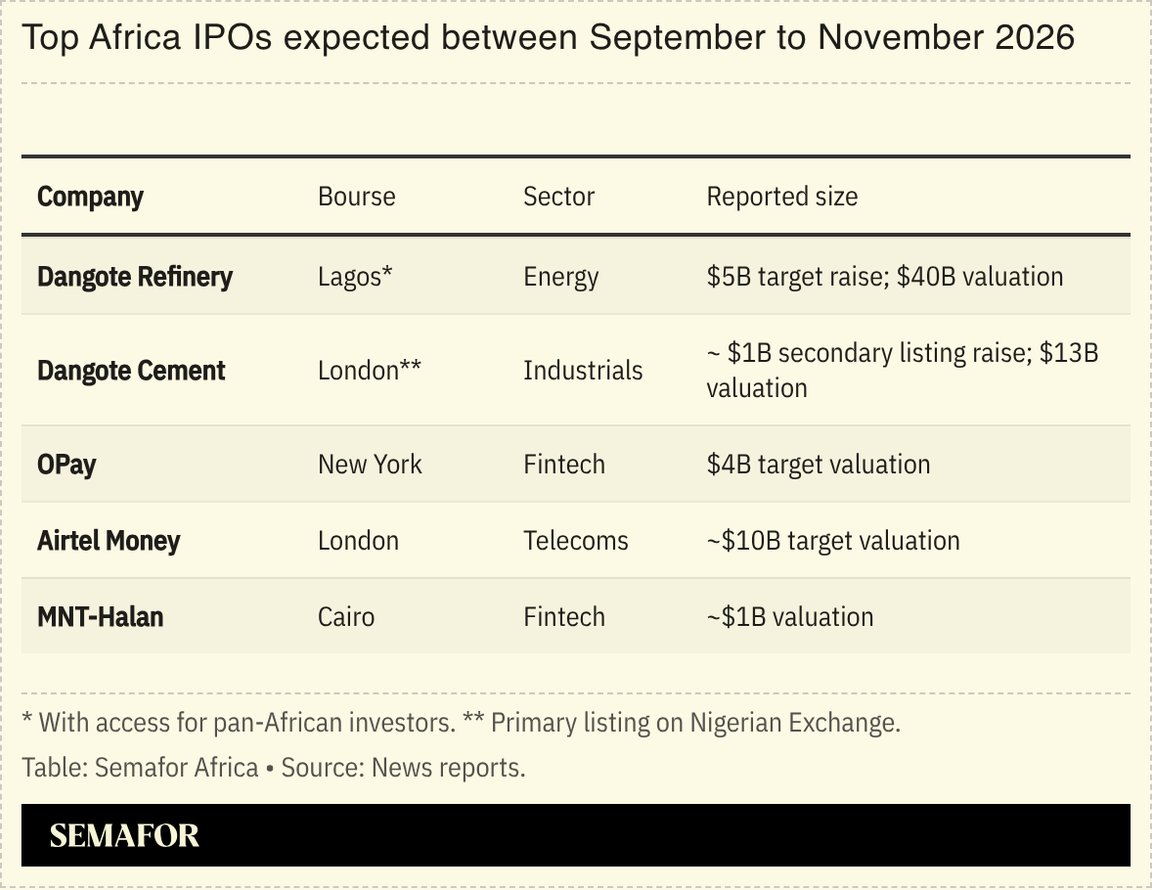 Africa’s dealmakers are betting that the continent’s capital markets are entering a new phase, with the anticipated $5 billion listing of Aliko Dangote’s oil refinery on the Nigerian Exchange kicking off a burst of IPO and M&A activity. “The Dangote IPO has got everyone very excited,” Yemisi Deji-Bejide, head of M&A for Africa at Standard Chartered, told Semafor. She said the deal reflected the continent’s growing ability to build and finance large industrial businesses after years of sluggish activity. The Dangote Petroleum Refinery IPO, which still needs regulatory approval, is expected to be Africa’s largest-ever listing. It is being marketed to investors across the continent even though its primary listing will be in Lagos. Strong demand from retail and institutional investors could eventually broaden the pool of capital for other African companies, said Miguel Azevedo, head of investment banking for the Middle East and Africa at Citigroup. “One transaction won’t create a market, but this transaction by its size will change things.” Other potential IPOs are emerging across the continent’s tech and telecom industries. The M&A market has also picked up, including Diageo’s $2.3 billion sale of its East African beer business to Japan’s Asahi, and South African lender Nedbank’s $855 million offer for a controlling stake in Kenya’s NCBA Group. |
|
S. Africa’s DA launches manifesto |
| |  | Tiisetso Motsoeneng |
| |
 Leader of the Democratic Alliance and former Cape Town mayor Geordin Hill-Lewis. Siphiwe Sibeko/Reuters. Leader of the Democratic Alliance and former Cape Town mayor Geordin Hill-Lewis. Siphiwe Sibeko/Reuters.South Africa’s Democratic Alliance promised an end to political appointments in public administration as the second-largest party in the ruling coalition aims to capture the country’s economic heartland in upcoming local government elections. The polls represent the first major electoral test for Cape Town Mayor Geordin Hill-Lewis, who became DA leader in April, as he seeks to translate his local success into nationwide momentum. South Africa’s 247 municipal councils, which control more than $33 billion in annual local budgets, are up for grabs in the Nov. 4 polls. Survey data from the Social Research Foundation, a policy think tank, finds the DA leading in Johannesburg with 42% of the vote, while the rival African National Congress party had 18% support among likely voters, down from 30% earlier in the year. Separate research by Ipsos indicates that only 38% of South Africans consider their local municipal performance adequate. The elections threaten to entrench multiparty coalition rule after the ANC lost its outright majority across key metropolitan councils in 2021 — a showing that foreshadowed its historic loss of a parliamentary majority in 2024. The ANC is expected to release its manifesto next week. |
|
New customs system for AfCFTA |
 The African Continental Free Trade Area signed a $3.1 billion deal with Nigerian company Bergmans Security Consultants to deploy a customs system aimed at improving trade in Africa. Trading under the AfCFTA — the world’s largest free-trade area — started in 2021. Intra-Africa trade has grown since then, rising by 12.5% from 2023 to $220 billion in 2024. But African trade analysts say the pact’s impact remains constrained by several structural and operational challenges. AfCFTA is tasking the Abuja-based Bergmans with creating a system that will make the customs units of member countries interoperable, the trade area’s Secretary-General Wamkele Mene said at the deal’s signing last week. |
|
AI boosts cybercrime, warns Interpol |
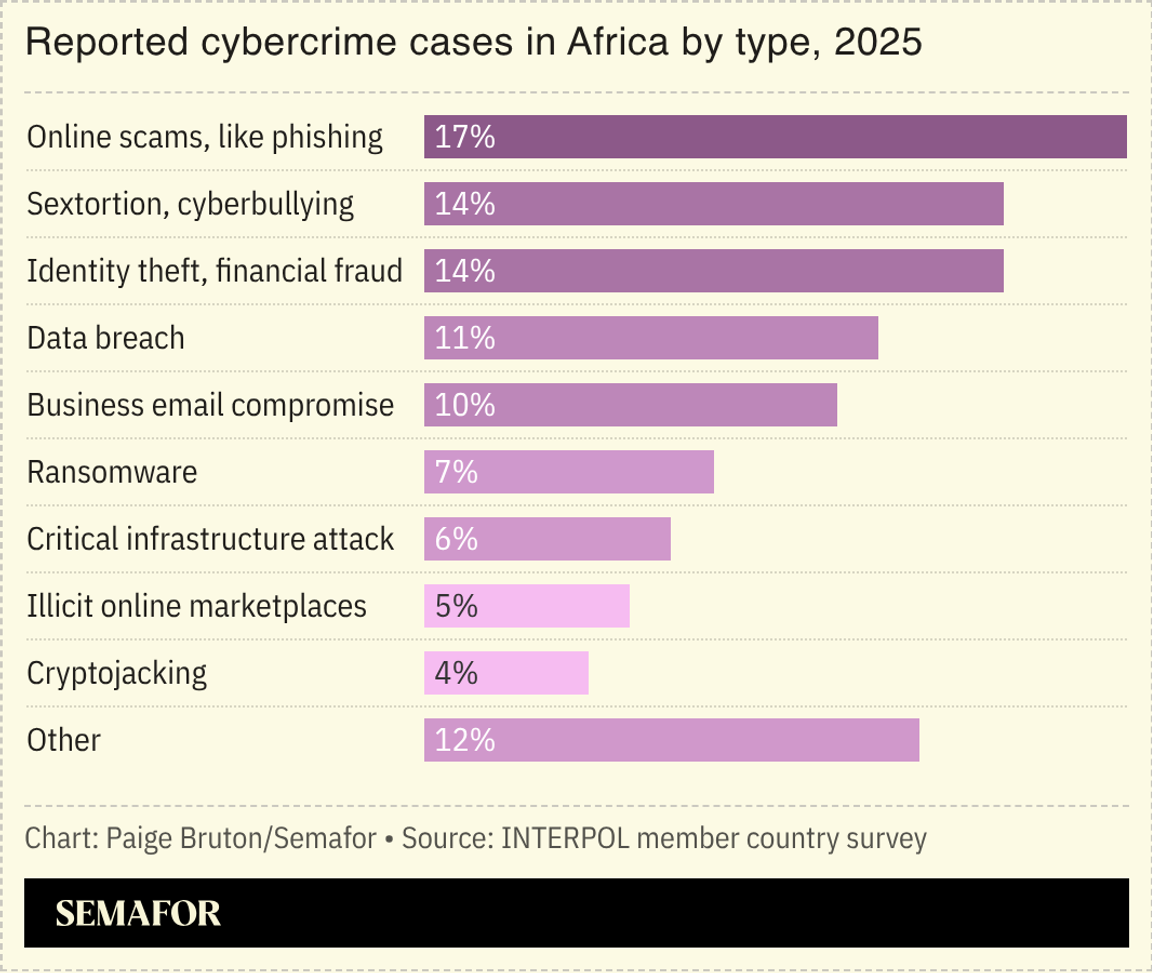 Artificial intelligence is making cybercrime easier in Africa, Interpol warned in a new report. AI enabled 55% of reported cybercrimes across the continent in 2025, highlighting the scale of a threat that will require greater cooperation on regulation and technological investment to combat. Identity theft, phishing, and online blackmail were the most reported cybercrime activities in the 36 countries covered by the study last year. Business email compromise scams caused the most financial damage. AI is giving criminals more capacity to conduct “scalable, automated, and highly targeted attacks” with huge costs, the report warned: Africa’s losses to cybercrime amounted to a third of the $15.3 billion spent on cybersecurity, Interpol estimated. Many African governments are fighting cybercrime with inadequate staffing and equipment. The African Union’s Malabo Convention on Cyber Security and Personal Data Protection, adopted in 2014, remains the continent’s main framework for combating cybercrime, but implementation has been uneven. — Alexander Onukwue |
|
Fridge-free vaccines trialed |
 Francis Kokoroko/Reuters Francis Kokoroko/ReutersVaccines that can be stored without refrigeration have been successfully trialed in patients for the first time, marking a potential breakthrough for immunization in Africa. Around half of all vaccines are wasted each year, partly due to breaks in the “cold chain,” meaning that between production, transport, and the eventual injection, they become too hot or too cold and are therefore unusable. Most vaccines, including the tetanus-diphtheria jab used in the trial, must be refrigerated or frozen. The new technology, which was developed by British pharmaceutical company Stablepharma, uses a sugar called trehalose to turn vaccines into a powder that can be stored at room temperature, and later mixed with water before injection. A larger trial is due to begin in the coming months, marking the final research hurdle before potential rollout. One in five children in Africa remains unvaccinated, according to the World Health Organization. |
|
 Business & Macro |
|
|