
|
 |
How an IT Team Learned What A CCMS Was For — By Discovering They Couldn't Remember Their Own Instructions
IT departments and tech writing teams have been talking past each other for decades — AI adoption is just the latest place it's showing up
|

| |||||||||||||||


My first big consulting engagement was in 1999, with a global pharmaceutical maker trying to shave days off the time it took to create, manage, and deliver a New Drug Application to the U.S. Food and Drug Administration (FDA) and regulators worldwide.
The math was simple and enormous. The company estimated the new drug would earn roughly four million US dollars a day once approved. But the bigger driver was the patent clock 🕰️. Every day the writers spent wrestling with intricacies in the content before submission was a day the drug sat unapproved and unable to be sold. It was also a day closer to the patent’s expiration date. After that, generic makers could copy the formula without doing the research or repeating the safety and efficacy testing the original maker (my client) had already paid for.
 |
That price tag wasn’t small. The company was chasing blockbuster status — ka-ching 💰 ka-ching — industry shorthand for a drug that clears a billion US dollars a year in global sales.
Getting there wasn’t cheap, either. A Tufts Center for the Study of Drug Development estimate put the cost of bringing a new drug to market in that era at roughly $800 million USD. About one-half of that money was direct research and clinical trial spending. The remainder was the capitalized cost of years of tied-up resources and the compounds that failed to become approved products along the way. Falling short of blockbuster sales numbers meant not recouping what the drug cost to make.
Example: Celebrex — Pfizer’s arthritis and pain medication — is the textbook case. Launched in 1999, it was pulling in roughly $2.9 billion USD in sales a year before its patent protection ended in 2014 — resulting in the company losing the bulk of that revenue within about a year once generics arrived in the market.
My client’s IT department was fixated on solving problems with whatever Microsoft software they already had, or whatever they could code themselves with the skills they’d built up over their careers — exactly the same way a man with a good hammer treats every problem like a nail, whether or not it is one.
When the writers asked the IT to help them develop the capability known as systematic content reuse — Ann Rockley‘s term for content tagged once and auto-populated everywhere it belonged, so nobody had to remember where it lived or go looking for it — IT heard us asking for something copy-paste already handled.
The writers asked IT to help them develop a capability known as systematic content reuse. The “mother of content strategy,” Ann Rockley, coined the term to describe content that is tagged once and automatically published everywhere it belongs. Nobody has to remember where the content lives or go looking for it.
IT heard something different. They thought we were asking for a better way to copy and paste content.
What they knew was the other half of Rockley’s distinction: opportunistic reuse, where someone remembers a paragraph exists, tracks it down, copies it, and then, pastes it in. It’s the most common form of content reuse there is. It doesn’t require any special technology. That’s exactly why the IT team couldn’t see what our tech comm staff was asking for.
What changed their minds was an exercise a trainer named Sally Chase (now retired) ran with the whole group — writers and IT together — training us on the newly-released Arbortext Epic XML editor (one of the first tools built specifically for authoring XML), and on how to build structured XML content designed for systematic reuse following a single-source publishing model. She put everyone in a computer lab, handed out instructions, and had them work through a set of tasks alone, about an hour’s worth. Then she sent everyone to lunch, which in hindsight was the whole point.
When the group came back, she announced she’d handed out the wrong instructions by mistake, and that she’d already removed them from every workstation over lunch. The new instructions, she said aloud, were simple: undo everything the first set had asked them to do.
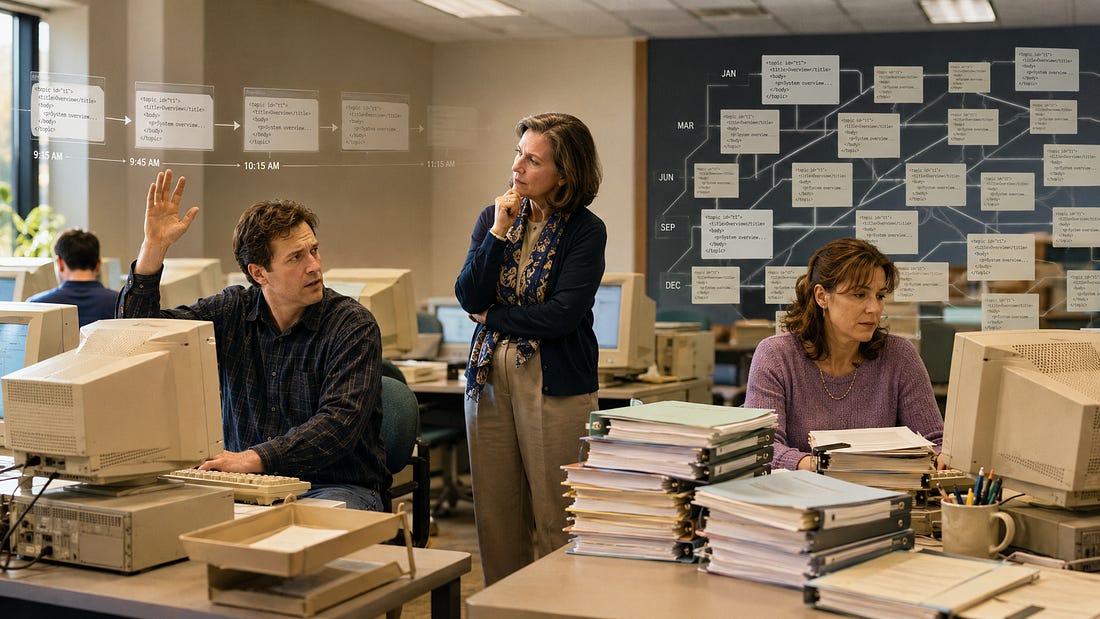
One IT crew member raised his hand, audibly frustrated. “How are we supposed to remember what you had us do previously,” he said, “when you took the instructions away?”
“A-ha,” Sally said. “So you can’t remember what we did an hour ago. But you expect writers to remember where content was copied and pasted last year.”
 |
That was the moment IT understood