| | In today’s edition: Saudi Arabia investigates IPO advisors, activity craters at Dubai’s Jebel Ali po͏ ͏ ͏ ͏ ͏ ͏ |
| |  | Gulf |  |
| |
|
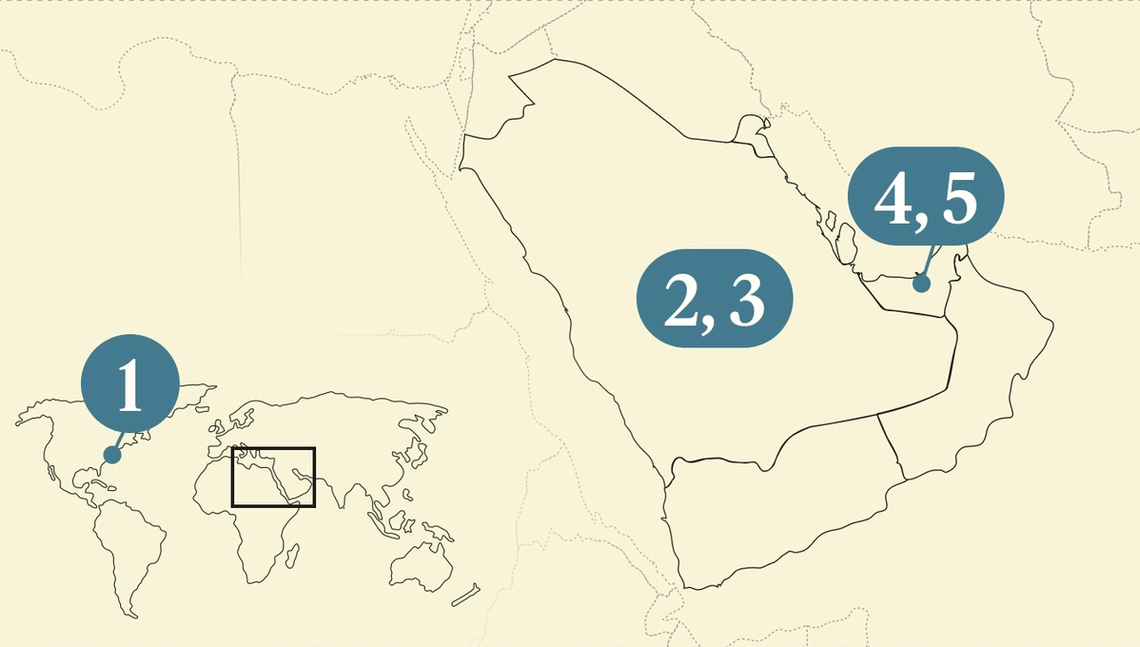 - Hormuz talks falter
- Mecca pact unpacked
- Saudi looks for IPO fix
- VC exit activity fades
- DP World weathers war
 A falcon frenzy descends on Malham. |
|
Mediators struggle for Hormuz headway |
 Ambrey/Handout via Reuters Ambrey/Handout via ReutersMediators are struggling to make progress in resolving the US-Iran conflict, with each step forward seemingly followed by another pace back. Pakistani sources told Anadolu news agency that Washington and Tehran had agreed to extend their moribund June ceasefire. However, Reuters cited an Iranian source saying there had been “absolutely no progress” in reviving the deal. Each side accuses the other of failing to honor past commitments and ignoring the current reality. Trump said the US had “total control” over the Strait of Hormuz, adding: “All they have is fake news… Iran is all talk and no action.” Iran insists the strait remains closed, with its foreign minister saying: “Worse than fake news is fake intelligence.” Traffic through the strait is at a trickle, but the cost of previous strikes on ships is becoming more apparent, with an oil spill menacing Iranian and Omani coasts. |
|
Saudi pact to test collective defense |
 Saudi Press Agency/Handout via Reuters Saudi Press Agency/Handout via ReutersThere’s little clarity about how Saudi Arabia, Türkiye, and Pakistan will fulfill their NATO-like pledge to mutual defense in the pact they signed last week. The kingdom has come under fire this week — if less intensely than in previous ones — but there has been no public sign of collective action. That has led analysts to conclude the agreement is unlikely to create a cohesive regional bloc to confront Tehran. Pakistan already has forces in Saudi Arabia and a bilateral pact with Riyadh, but Islamabad “offered Riyadh statements of solidarity and no soldiers,” columnist Bobby Ghosh noted. Türkiye’s clarification that the agreement is defensive, open to new parties, and not directed at anyone was also unusual, he added: “Deterrence does not usually come festooned with this many asterisks.” The countries appear to be focusing more on deeper intelligence sharing and joint exercises. This approach aligns with Washington’s shift from regional security guarantor to military “integrator,” Atlantic Council’s Allison Minor wrote. |
|
Saudi probes stock market weakness |
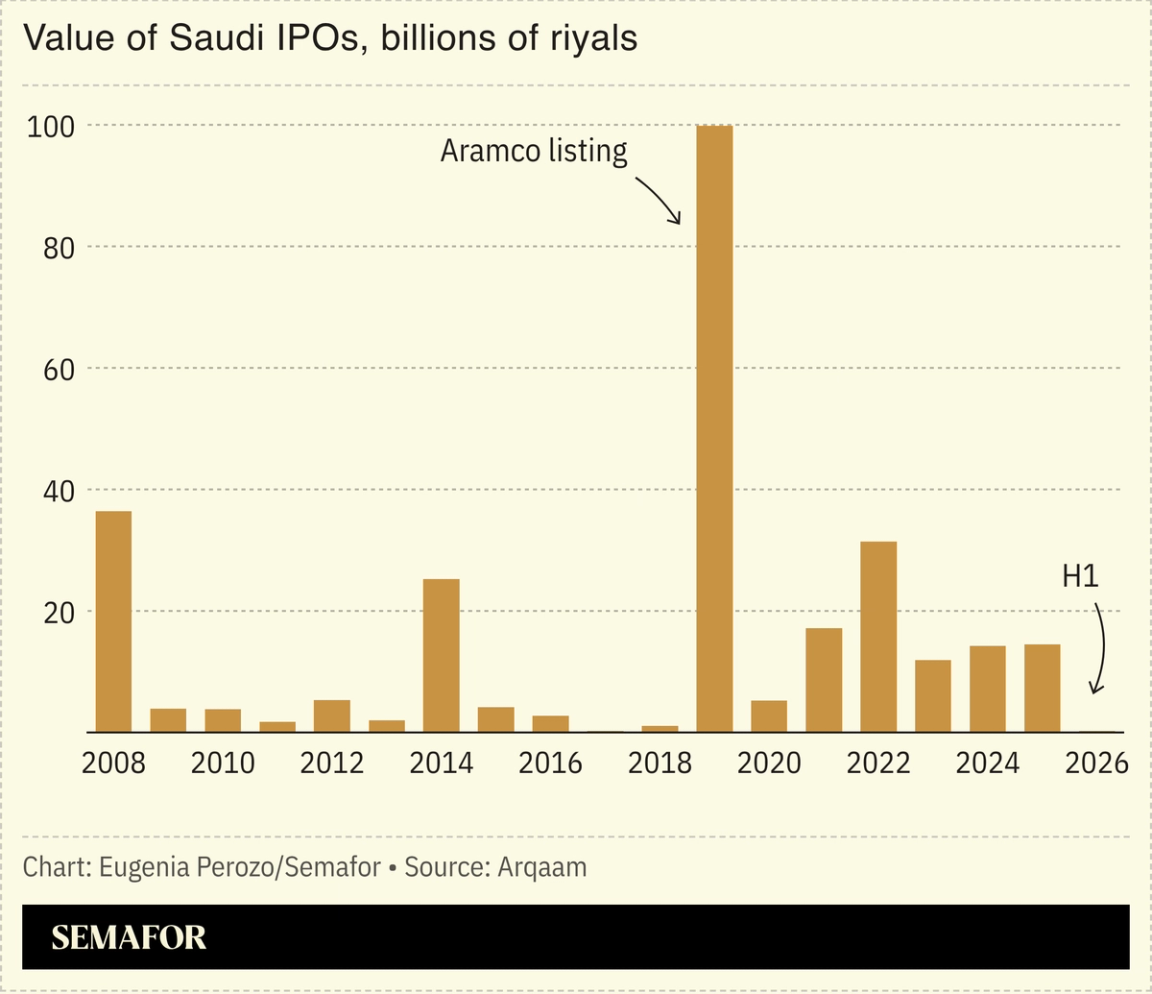 Saudi Arabia’s stock market regulator is investigating the poor performance of recent initial public offerings, according to people familiar with the matter, including looking into the advice given by investment banks as it tries to kickstart new listings. The investigation has been underway for several months and covers IPOs going back to at least early 2025, the people said. The Capital Market Authority has requested information from global and local banks on their discussions with clients and investors, and on how shares were priced, the people said. Liberalizing investor rules and attracting more listings has been a success of Saudi Arabia’s economic diversification push, with the government raising billions of dollars selling stakes in public firms to fund new investments. But many companies’ shares have fallen in value after listing. The CMA is expected to report its findings later this year. — Matthew Martin |
|
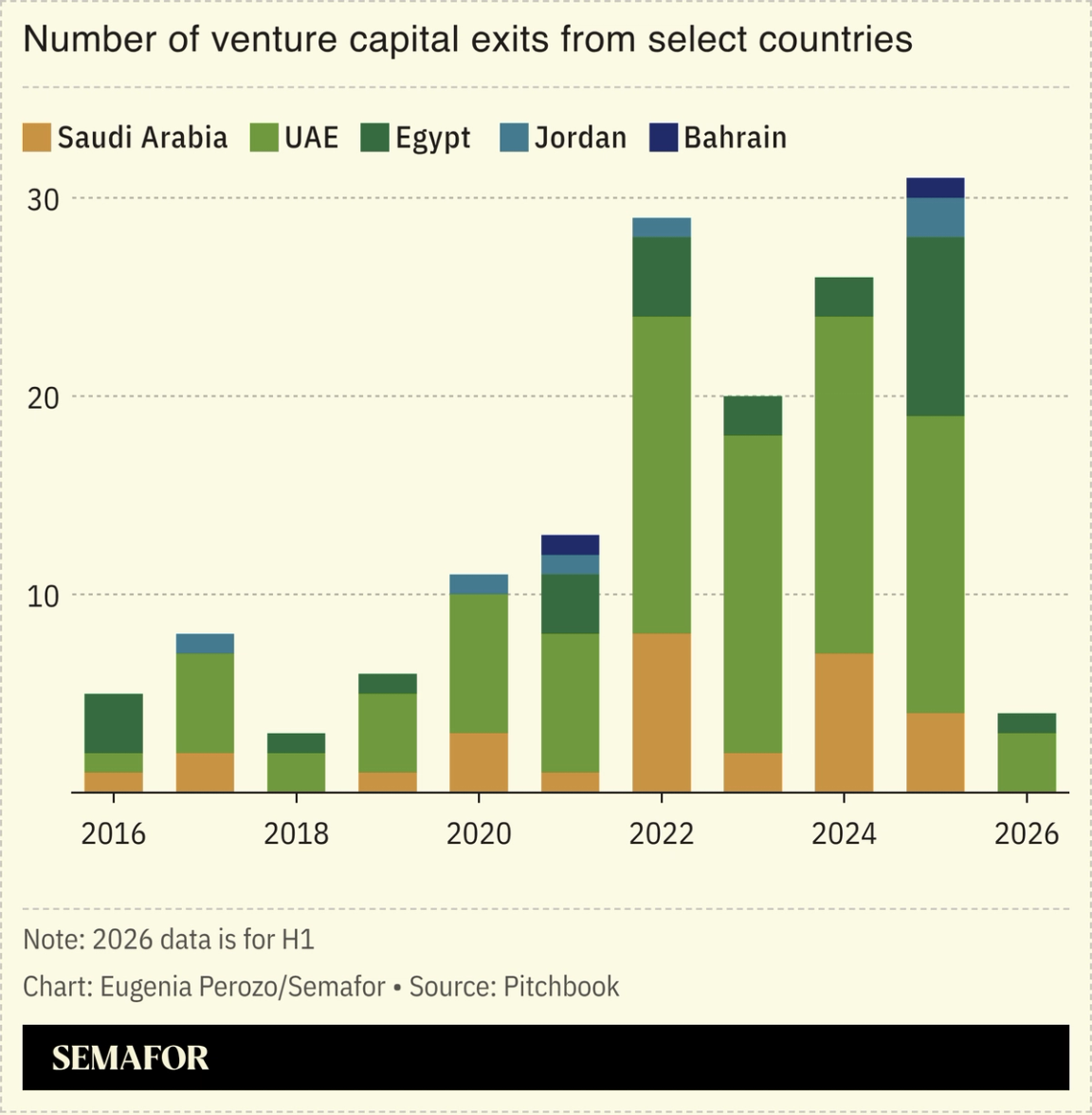 Gulf startups are staying private for longer, according to private capital tracker Pitchbook, part of a global trend of weaker exit and IPO activity amid public market volatility. The UAE is the only Gulf country to rank among the top 20 venture capital markets on some measures, but the value of VC exits is low at just $402 per capita, compared to more than $8,000 for Singapore and $12,600 for the US. “Everything is AI,” Nalin Patel, director of research for EMEA private capital at Pitchbook, told Semafor, adding that the US’ dominance in that arena with marquee names like OpenAI and Anthropic is drawing capital from other local markets. The subdued exit environment in the Gulf is directly linked to geopolitical uncertainty, Patel said. Exits can create a virtuous cycle that could help the region’s push to build technologies and services that will power a move away from oil and gas. When Dubai-based Careem was acquired by Uber in 2019 for $3.1 billion, for example, the buyout turned 75 of its employees into millionaires, creating a large cohort of potential founders and backers. — Kelsey Warner |
|
Hormuz closure dents DP World earnings |
 Hamad I Mohammed/Reuters Hamad I Mohammed/ReutersDP World weathered a sharp fall in traffic at its flagship Jebel Ali port in the first half of the year, as the closure of the Strait of Hormuz forced it to reroute cargo overland to other ports. Container throughput at Jebel Ali fell 86% in the second quarter, but the rest of the business helped offset the damage: Global volumes increased across its network of more than 60 ports, and first-half revenue rose 13% year-on-year to $12.7 billion, though net profit fell 39%. Alternative routes through UAE terminals such as Fujairah and Khor Fakkan can cost four to five times more once inland transport is included, a company official told Semafor, a cost gap that gives DP World confidence displaced cargo will return in time. The company is nonetheless developing two terminals in Fujairah. — Manal Albarakati |
|
 As AI and emerging technologies reshape the global economy, three billion people remain offline, disconnected from the digital opportunities transforming our world. On Tuesday, September 22 in New York City, The Next 3 Billion will bring together leaders including Nigeria Federal Minister of Industry, Trade and Investment Jumoke Oduwole, Shell Foundation CEO Jonathan Berman, Amazon Chief Sustainability Officer Kara Hurst, GSMA Director-General Vivek Badrinath, Nvidia Head of Sustainability Josh Parker, and more to explore how AI, energy, and global development can expand access, unlock opportunity, and drive inclusive growth across the world’s fastest-growing regions. September 22 | New York City | Delegate Application |
|
 DealsEnergy- A supertanker was seen moored at Saudi Arabia’s Ju’aymah terminal inside the Gulf, the first such sighting in almost a month as the kingdom works to keep crude flowing after Houthi threats extended the risk to its Red Sea ports. — Bloomberg
Industry- Industries Qatar reported an 89% drop in net profit to 216 million riyals ($59 million) for the first half of the year, as the impact of the Iran war forced it to reduce production of petrochemicals and fertilizer. One bright spot was steel, where output, prices, and profits all rose.
- Emirates Global Aluminium said its Al Taweelah smelter in Abu Dhabi, running at 18% of capacity after Iranian missile and drone strikes forced an emergency shutdown in March, should return to pre-war output by the first quarter of 2027. — AGBI
|
|
 Courtesy of Saudi Press Agency Courtesy of Saudi Press AgencyFrom the comfort of well-upholstered armchairs in a vast room in Malham, north of Riyadh, hundreds of prized hunting birds will be exchanged for millions of riyals over the next few weeks. Falconry is an important part of Saudi sporting heritage — along with camel racing and horse racing — but its economic importance is increasing too. Sales at the annual International Falcon Breeders Auction have soared by more than 60% since 2023, reaching 13 million riyals ($3.5 million) last year, when some 1,100 birds of prey were bought and sold. On the first night of this year’s auction, one gyrfalcon — the largest of the family — sold for 380,000 riyals. Other deals took the total over the first four days to more than 1 million riyals, with more than two weeks still to go. The buyers tend to be Saudi, but the sellers (and their birds) often fly in from Europe, North America, and elsewhere. The money should keep flowing in the months ahead: Falcons bought at the auction can compete in races offering prize money totaling 50 million riyals. — Dominic Dudley |
|
|


