
|
 |
Today’s piece was originally published in Oligarch Watch, Popular Information’s sister publication. We are living in an age of unprecedented wealth concentration. Oligarch Watch produces accountability journalism on the world’s wealthiest people.
To receive more reporting like this every week, please subscribe.


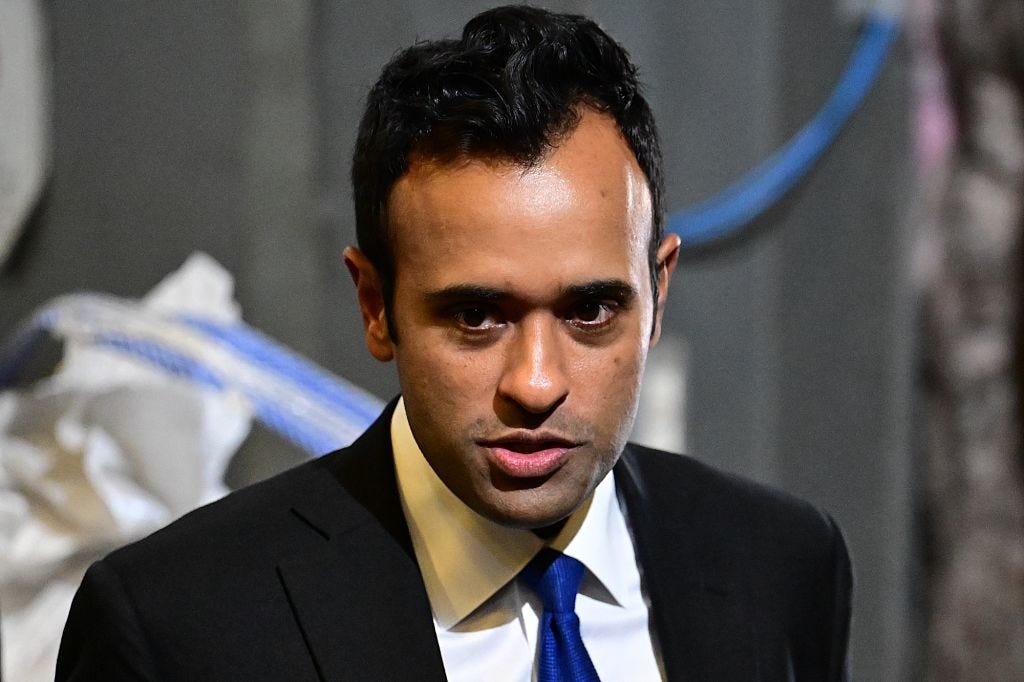 |
Vivek Ramaswamy, a billionaire and the Republican nominee in Ohio’s gubernatorial race, served as the frontman for a dubious pharmaceutical company and then cashed out weeks before its dramatic crash.
In 2014, Ramaswamy founded Axovant, a company he used to buy the rights to an inauspicious Alzheimer’s drug that had repeatedly failed in clinical trials. Axovant then hired Ramaswamy’s mother, who, despite lacking relevant research experience, helped massage data from old clinical trials to make the drug appear more promising. The extent of the elder Ramaswamy’s role has not been previously reported.
In 2015, touting his mother’s reinterpretation of the data to potential investors and regulators, Ramaswamy led Axovant to a $1.4 billion initial public offering, the largest in biotech history at the time. He spent the ensuing two years promoting the drug intepirdine as a possible breakthrough for the millions of Americans who have Alzheimer’s disease.
Then, after structuring the company to insulate himself and other insiders from potential losses, he cashed out through a private back door weeks before another clinical failure cratered the stock price. One state retirement fund for teachers lost more than $1 million.
Ramaswamy, whose gubernatorial candidacy has received tens of millions in combined financial backing from fellow right-wing billionaires Elon Musk, Jeff Yass, and Bill Ackman, reaped an estimated $260 million from Axovant’s parent company.
Ramaswamy has maintained that he is “proud” of his work on intepirdine. “There is probably nothing in a meaningful way we could’ve done differently in the decision of advancing that drug,” he said at a 2018 conference held as the Axovant share price hovered around the $1 mark. “Given those same set of facts… with a different drug today, I think we would make the same decision.”
The Ramaswamy campaign did not immediately respond to a request for comment.
Daniel Skinner, a professor of health policy at Ohio University, noted that while Ramaswamy was never charged with a crime, he profited substantially off of his intepirdine marketing right before the failure of its last clinical trial. “That’s where people have a lot of questions, whenever you kind of pump and dump something,” he said in an interview with Oligarch Watch. “You look back at his words, and he was extremely effusive — really right up to the very end — about the prospects of this working.”
How Ramaswamy’s mother massaged data from failed drug trials
After completing his undergrad at Harvard in 2007, Ramaswamy cut his teeth by co-managing the biotech portfolio of a New York hedge fund. He used the experience to start his own company in 2014: Roivant Sciences, which launched a web of subsidiaries to buy up floundering pharmaceutical drugs from major developers with the goal of bringing them to market.
One of Ramaswamy’s early reclamation projects was SB-742457, a drug to improve cognitive functions in patients with Alzheimer’s disease. Axovant, a Roivant subsidiary, acquired the drug in December 2014 and rebranded it to RVT-101. It later settled on the international nonproprietary name intepirdine.
Axovant purchased the in-license for intepirdine from GlaxoSmithKline for a $5 million upfront payment — a sum that was tantamount to “lunch money,” as one industry publication observed at the time. (A 2026 analysis by Ambrosia Ventures found the median going rate for similar pharmaceutical licensing deals was $50 million.)
The bargain-bin selloff reflected the drug’s troubled developmental run, which concluded with Glaxo discontinuing it, according to AlzForum. At Glaxo, it had failed multiple Phase 2 clinical trials, including the two most recent trials — involving 576 and 684 patients — before its acquisition by Axovant.
But once in the hands of Axovant, Glaxo’s failed clinical trials were reevaluated to make intepirdine appear full of promise as an Alzheimer’s treatment.
In 2015, Ramaswamy, who was 29 years old at the time, hired his own mother, Geetha Ramaswamy, as Axovant’s vice president of medical and scientific strategy. By July of that year, within weeks of Axovant raising $315 million in its record-setting IPO, the elder Ramaswamy had co-published two analyses on intepirdine despite having no experience conducting clinical trials, an investigation by Oligarch Watch found.
While Geetha Ramaswamy had previously worked in the neuroscience divisions of Abbott Laboratories and Merck, her roles were primarily focused on management, relationship building, and recruiting and training, according to her LinkedIn. “Played a key role in Speaker training .[sic] Valued as a scientific peer by national experts,” reads one of her LinkedIn career bullet points. But Geetha Ramaswamy appears to have never conducted a clinical trial before or during her time at Axovant, nor did she produce significant original research during her career.
At Axovant, her co-analyses pulled from Glaxo’s 48-week, Phase 2b clinical trial of 684 Alzheimer’s patients that found the drug had “failed to achieve formal statistical significance” and had not “met the overall criteria for success.”
However, by omitting huge segments of the original trial data, a “responder analysis” co-authored by Geetha Ramaswamy concluded there was enough evidence to “support the initiation of a Phase 3 confirmatory study evaluating the efficacy of RVT-101 [intepirdine] in mild-to-moderate Alzheimer’s disease in the second half of 2015.”
Instead of measuring patients’ exact cognitive performance while on intepirdine, her analysis merely divided them into two classifications: “responder” and “non-responder.” Put another way, if it were an academic test, a responder analysis would use pass-or-fail grading instead of a numeric system.
An article published last year in the leading peer-reviewed journal Alzheimer’s & Dementia objected to responder analyses for increasing the risk of “causal fraud” when used to evaluate the clinical benefits of Alzheimer’s treatments. “Statistical approaches that rely on a dichotomized binary outcome, including responder analyses… result in a loss of information and reduced statistical power, increasing the risk of false positives and negatives,” wrote University College London’s Kathy Liu and colleagues.
In smoothing over clinical findings that were a liability for her son’s ascending company, Geetha Ramaswamy also stood to profit financially. Along with her annual salary of $250,000, an Axovant regulatory filing from 2015 reported that she was “granted a stock option for 262,500 common shares… with an exercise price of $0.90 per share.”
The other analysis she co-published shortly after Axovant’s IPO was a “completer analysis” that again sugarcoated Glaxo’s failed 684-patient trial — this time, by excluding the more than 30% of patients who had dropped out during the