
|



Matic: The World’s First Intuitive Home Robot has arrived. (Sponsored)
 |
Designed and assembled in America, Matic is the world’s first robot built to understand you. Its new feature, Matic Cues, lets you interact with it like you would anyone else.
Point and speak. Say “Hey Matic, clean this” while pointing at a mess, and Matic knows exactly what to clean.
Understands 70+ languages. Ask Matic to clean the kitchen, follow you, or go to the sink, in whatever language you speak.
Skip the app. Anyone at home can use Matic, not just app-savvy adults, but kids and grandparents too.
Every home robot before this needed an interface. Matic just needs you to talk.
Try Matic, backed by their 6 month money back guarantee.
A vehicle travelling at 40 miles per hour covers about 60 feet every second. Within that second, software has to determine what is physically nearby, classify each object, estimate where those objects will move, select a path, and issue steering and braking commands.
Doing all of this quickly is something that has been largely solved. However, doing this correctly in unpredictable and distinct traffic situations is still an open problem. This is because real-world traffic produces more distinct scenarios than any team can pre-determine. For example, Waymo describes one such case, where a vehicle is on fire on the road ahead while the drivable lanes remain physically clear [3]. The geometry of such a scenario might permit driving straight through it. However, the real meaning of it calls for turning around or taking preventive action.
Waymo and Tesla, two companies investing in self-driving cars, have tried to come up with different types of answers to these questions.
For reference, Waymo reports 220.6 million rider-only miles through March 2026. These are miles covered with no human in the driver’s seat, across five metro areas [5]. On the other hand, Tesla reports more than three million vehicles in the United States covering over 30 billion miles a year, with 1.28 million active Full Self-Driving subscriptions in the first quarter of 2026 [10]. Almost all of those Tesla miles involve a driver who remains responsible for the vehicle. Tesla’s driverless service is separate and much smaller, running without safety monitors in Austin, Dallas, and Houston, while the Bay Area service uses a safety driver [10].
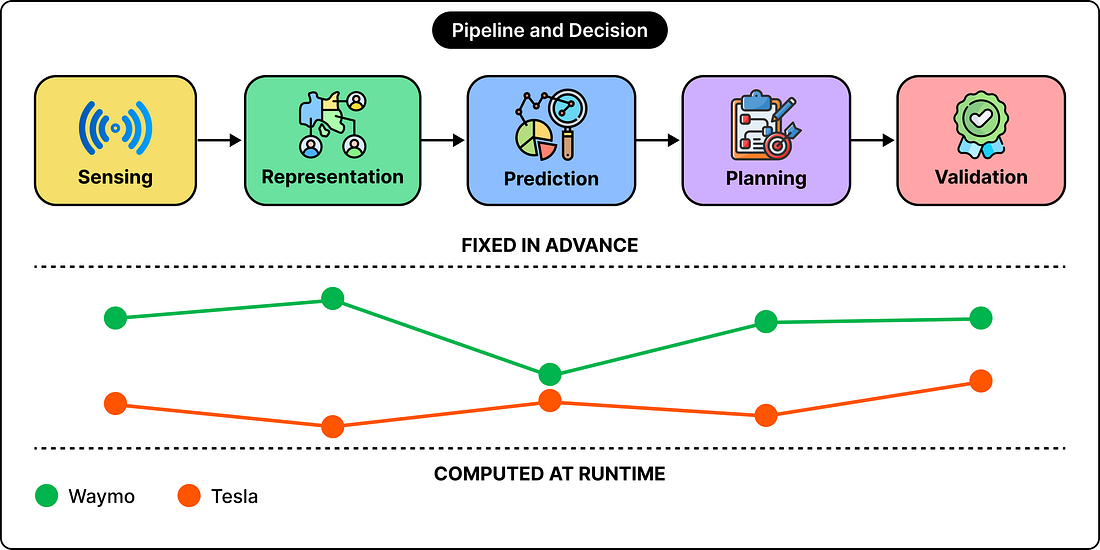
Both approaches depend heavily on machine learning. But they differ in how much gets fixed in advance. In this article, we will take a look at both approaches while trying to answer the following questions:
How does each system detect what is physically nearby?
What each builds from that data, and why one keeps the result readable?
How each estimates what other road users will do?
How a path gets selected, and what verifies it before the vehicle acts?
What safety evidence each publishes, and why the figures measure different things?
Where does the knowledge inside each system come from?
 |
Disclaimer: This post is based on publicly shared details from various sources. References at the end. Please comment if you notice any inaccuracies.
Sensing
A camera records light intensity across a grid of pixels. Distance appears nowhere in that grid, so depth has to be computed from the arrangement of pixels, but that computation can be wrong. A large object far away and a small object nearby can occupy the same region of an image.
Lidar arrives at the same answer by a different route. The unit emits laser pulses, measures how long each pulse takes to return after reflecting off a surface, and converts that interval into a distance. We can think of the output of this as a point cloud, which is a three-dimensional set of measured points describing the surfaces around the vehicle [1]. The distance is no longer an estimate but a measurement.
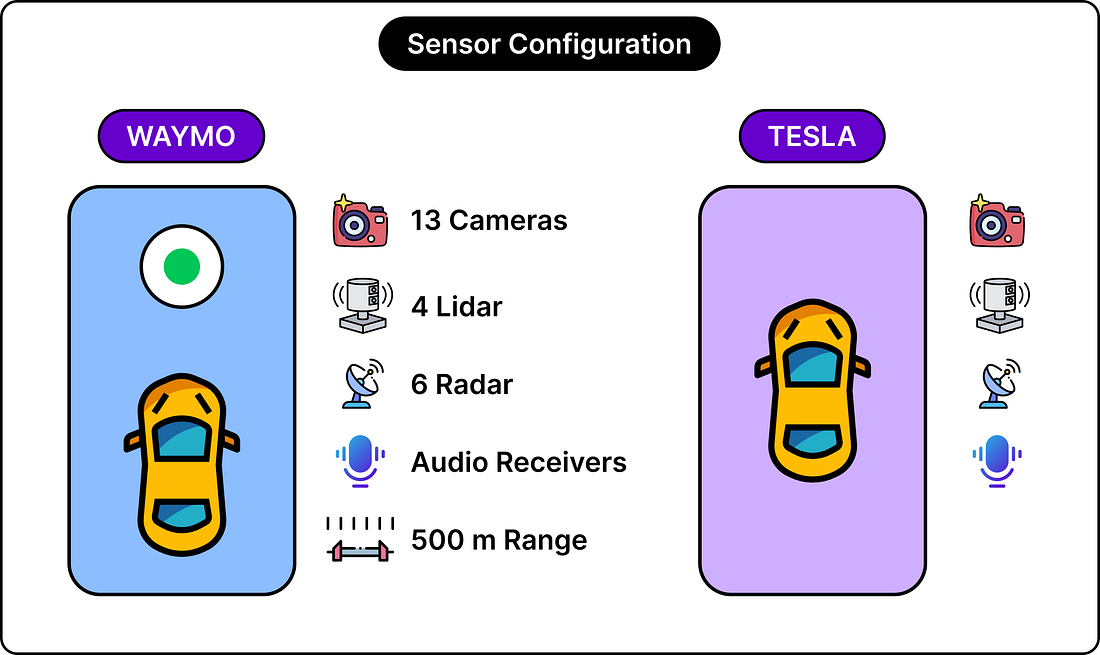
Waymo’s sixth-generation system, which began fully autonomous operations in February 2026, carries 13 cameras, four lidar units, six radar units, and a set of external audio receivers used to detect sirens and railroad crossings [2]. Coverage overlaps in every direction and extends to 500 metres. This overlap is for help situations when rain, road grime, or ice limits what a camera captures. Lidar and radar sustain the perception capabilities in such scenarios. [2].
Tesla’s vehicles mainly rely on cameras. Instead, Tesla relies entirely on a “pure vision” approach that uses exterior cameras and artificial intelligence to navigate. For example, Tesla’s documentation describes Model 3 and Model Y as running camera-based Tesla Vision, without radar, using cameras and neural network processing [9].
See the diagram below:
 |
There is another point here that requires our attention. Waymo’s fifth-generation Jaguar I-PACE vehicles carry 29 cameras [1]. The sixth-generation system carries 13, which Waymo attributes to a 17-megapixel imager covering the same area with fewer than half the cameras [2]. In other words, Waymo is also reducing overall sensor count while continuing to describe redundancy as essential.