
|
 |
Why Metadata Is Everyone's Problem Now
From record store bins to online shopping malls, and from library shelves to AI training data, the same mistake keeps showing up
|

| |||||||||||||||


[TL;DR] A taxonomy might look like a neutral list of categories. It’s not. Building one always means someone decides what content earns its own category, what gets lumped together, and what gets left out altogether — and those decisions aren’t neutral.
My friend Rahel Anne Bailie once told me about a taxonomy project she worked on for a European mobile carrier. If I recall correctly, (most days, that’s questionable 🤨), the job was to make an online music library work for listeners in different countries by organizing it so the people in each market could find the music they wanted.
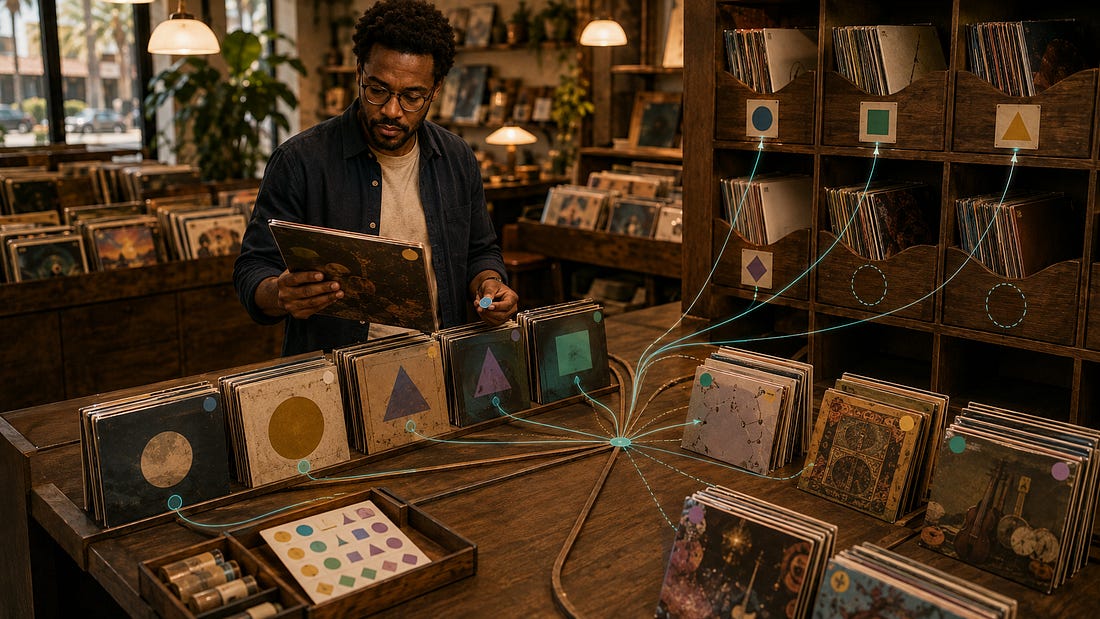
Bailie, founder of Content Seriously and creator of the Content Integrity Model, was helping a client solve the information and data challenges behind a service intended to compete with Apple iTunes. Her team’s work included categorizing the music library, which seems simple, until you try doing it for music lovers in multiple countries.
 |
How Metadata Enters The Equation
Assigning a song to a genre category creates metadata; information that tells a system what something is and where it belongs. Bailie’s team started with a taxonomy shaped by a classification scheme commonly used in the commercial music industry. That taxonomy wasn’t localized for describing music in the new markets Bailie’s client planned to offer the streaming music service to.
👉🏾 Localization is the process of adapting content to be meaningful for a particular culture, locale, or market.
Source: The Language of Localization (XML Press)
To be clear, the categories the music industry used were well-suited for the audiences for which they were built. The problem materialized as Bailie’s team recognized the incongruities in the way music is categorized in various target markets. The solution to the classification problem they faced involved squaring the pre-existing music taxonomy with how each new target market already organized its music. A big challenge given that the original categories hadn’t been designed with this kind of flexibility in mind.
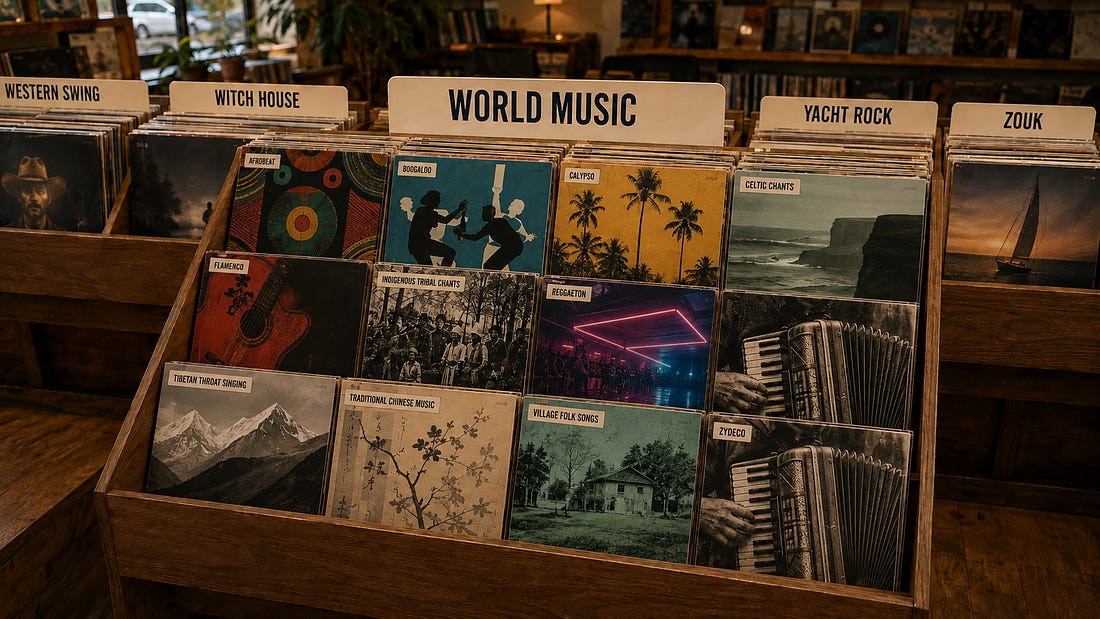 |
Somewhere in their work, Rahel’s team noticed that world music wasn’t really a genre at all. It was a container: a catch-all category for anything that didn’t fit into existing ones.
That begs the question: Is sorting music by genre and geography the only way to organize it — or just the way a US- and UK-dominated music industry happened to do it?
Some Countries Organize Music By The Emotion It Evokes
India’s classical music tradition doesn’t organize primarily by genre or geography. It sorts by rasa — the specific emotion a piece of music is built to produce — a system old enough to appear in the Natya Shastra, a text roughly two thousand years old.