
|
 |



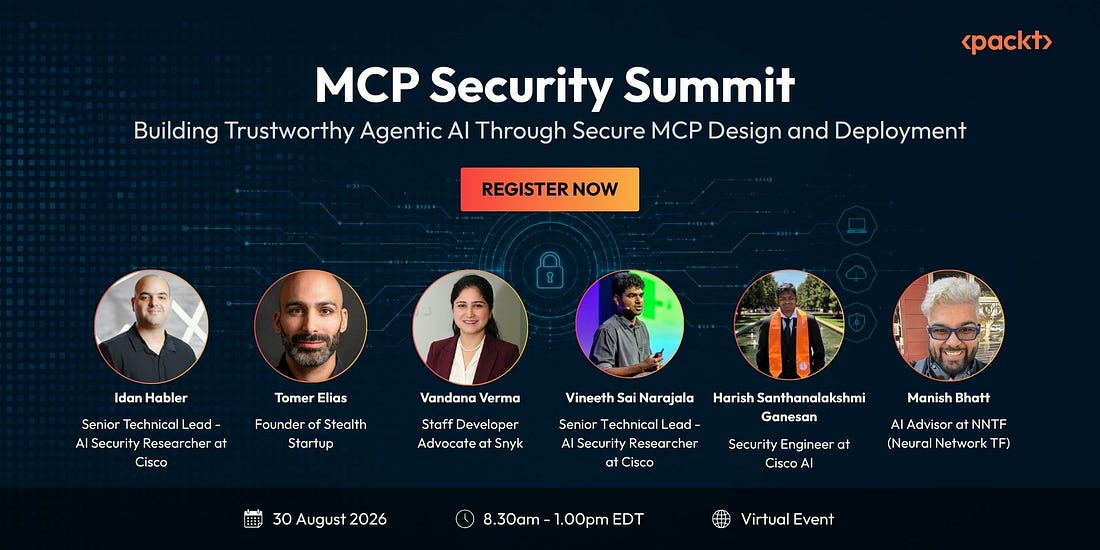 |
Organizations are rapidly deploying AI agents that can access enterprise data, invoke tools, and execute actions across business systems. Many of these deployments rely on the Model Context Protocol (MCP). While MCP accelerates agent capabilities, it also introduces new attack surfaces that security teams must evaluate before large-scale adoption.
The Securing the Model Context Protocol Summit is designed for security professionals responsible for assessing, approving, and defending AI agent deployments. Attendees will gain practical guidance from OWASP contributors, security researchers, and practitioners actively working to define secure MCP adoption patterns.
For Cyber_AI and _secpro subscribers, there is currently a 30% discount too. Make sure you don’t miss out—and see you there!
Key takeaways
AI cannot compensate for poor telemetry, fragmented systems or weak security processes.
High-quality, normalised security data is one of the most important foundations of an AI-ready SOC.
Identity and least privilege become particularly important as AI systems gain access to security infrastructure.
RAG can turn organisational security documentation, threat intelligence and previous investigations into a searchable knowledge layer.
The best starting point is usually a narrow, high-volume workflow where AI can demonstrate measurable value.
AI should reduce repetitive work and extend analyst capabilities rather than replace security expertise.
Artificial intelligence is increasingly being presented as the answer to many of the problems facing Security Operations Centres. AI can analyse enormous quantities of telemetry, identify unusual behaviour, summarise incidents and help analysts write detection queries. Newer systems can go further, using AI agents to investigate alerts, retrieve information from multiple security platforms and recommend or even execute response actions.
There is a temptation to see this as primarily a technology purchasing exercise. Deploy an AI security platform, connect it to the SIEM and start looking for results. Of course, in practice, it is rarely that simple.
AI does not eliminate the need for good security data, reliable processes or experienced analysts. In fact, the introduction of AI often exposes weaknesses in all three. An organisation with incomplete telemetry, poorly managed identities and inconsistent incident-response procedures will struggle to get reliable results from even the most capable AI system.
Building an AI-ready SOC therefore begins somewhere less exciting than selecting a large language model. It begins by making sure the security operation itself has the foundations required for AI to work effectively.
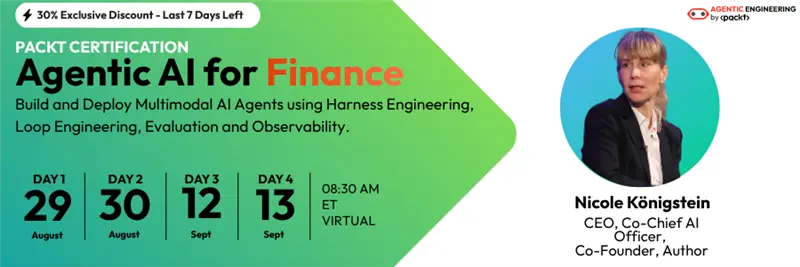 |
AI is reshaping quant trading, investment research, risk analytics, fintech infrastructure, and corporate decision systems. This 4-day intensive certification is designed for practitioners who want to build production-grade financial AI agents, not toy prototypes. Design and deploy a portfolio-grade Financial AI Agent architecture for trading, research, and enterprise finance workflows. Work directly with market data, SEC filings, earnings transcripts, etc.; master agentic system design; build applied systems for portfolio analytics, investment research automation, and corporate financial intelligence; and, earn a Packt-endorsed Agentic AI for Finance Certification to validate your applied AI skillset.
If you’re aiming to transition into AI-driven finance roles, quant-adjacent engineering, or applied LLM systems in enterprise environments, this is a high-signal, hands-on program.
AI needs something useful to analyse
The most important ingredient in an AI-powered SOC is not the AI, but, rather, the data. Modern security operations already generate enormous amounts of telemetry. Endpoints produce process and network events. Identity platforms record authentication and privilege changes. Cloud environments generate API activity and configuration events. Network infrastructure produces DNS, firewall and proxy data. Applications create their own authentication and operational logs.
AI can potentially correlate all of this information, but only if the information is available, sufficiently complete and presented in a form that the system can understand. Consider an investigation into a suspicious account. An AI system might be able to identify an unusual login from a new location. That becomes considerably more useful if it can also access the user’s normal authentication patterns, device information, VPN activity, endpoint telemetry and recent privilege changes.
If half of that information is missing, the AI has to reason with an incomplete picture. This creates an important distinction between more data and better data. S