
|


 |
It’s hardly news that Americans are not happy with the state of their nation. Confidence in the country’s direction crashed hard during the Bush years and never recovered. But what’s notable about more recent years is Americans’ increasing dissatisfaction with their personal lives:¹
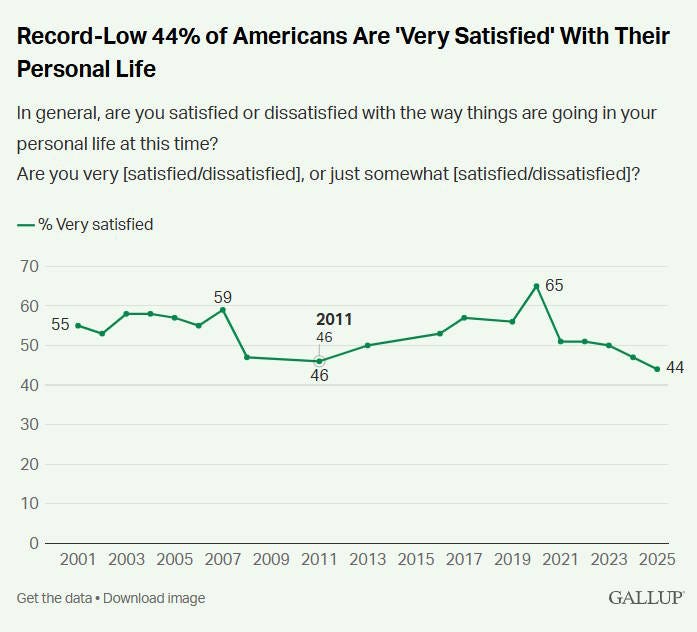 |
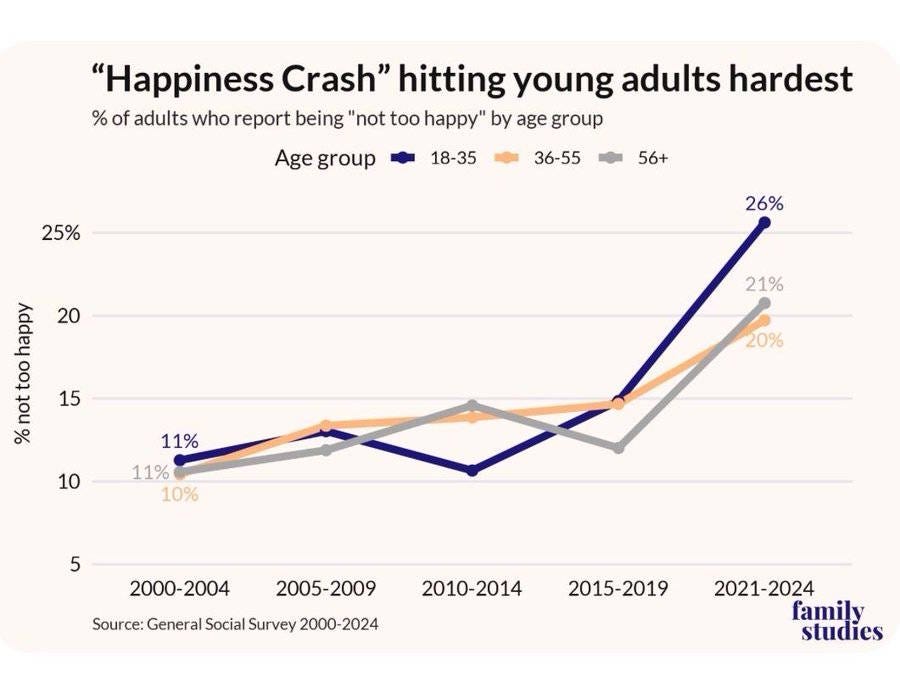
This decline looks pretty mild, but other numbers tell an even starker story. For example, happiness surveys show an increasingly despondent populace:
 |
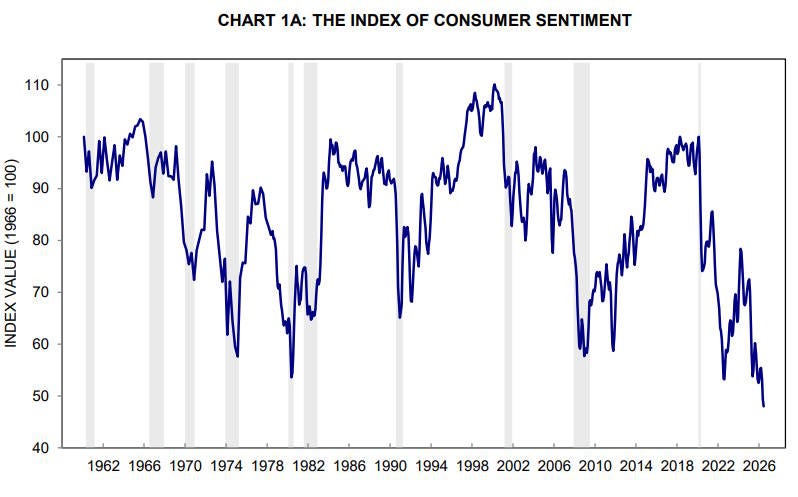
Suicide has been slowly rising as well. And then there’s consumer sentiment:
 |
For intellectuals and commentators such as myself, for many policy wonks and academics, and even for many politicians, the question is how to make the American people happier. And the answers we come up with are usually economic ones — ideas for policies that will improve the material well-being of either the whole populace, or some segment of it.
This is common on both sides of the aisle. On the left, centrists have embraced the Abundance movement, whose main idea is to give Americans more stuff — more housing, electricity, health care, and so on. For progressives and leftists, meanwhile, Medicare for All is probably the centerpiece idea. On the right, Trump’s trade agenda has usually been justified with claims that it will return good manufacturing jobs to the American working class. Even immigration restriction is usually couched in economic terms — the MAGA people claim that mass deportations will open up jobs for Americans, lower the price of housing, and so on.
The roots of the country’s malaise, too, are often described in economic terms. Many people claim that the First China Shock — and the loss of good blue-collar jobs to offshoring more generally — left a disappointed, angry working class in its wake. Progressives decry corporate landlords that they claim raise the cost of housing, and blame grocery stores’ greed for the rising cost of food. Practically everyone agrees that inflation was the biggest reason Trump won the 2024 election.
I’ve spent a lot of time arguing against a lot of these ideas (and in favor of a few of them). But I almost always accept the basic frame that A) many of America’s problems are due to economic malaise, and B) we ought to focus on finding ways to make Americans richer. Partly, this is because I was trained as an economist; I recognize that things like culture wars are also important to Americans, but I don’t have much special expertise in that area. But partly, I think I just subscribe to the general tendency of American intellectuals to focus on the material.
I was thinking of this as I read Jay Caspian Kang’s essay, “Subaru Socialists and the Great Disappointed.” Kang argues that the young, educated, angry voters who currently form the Democrats’ base can be separated into two basic groups: Millennials who are mad about the raw economic deal they received during and after the Great Recession, and Zoomers who are mad about Covid and Palestine. Here he describes the first of these groups:
This new voting bloc has two similar but distinct components. There are what I call the Subaru Socialists: college-educated millennials in their thirties and early forties who earn a somewhat steady income but not what they expected. These voters arrived at their politics via the Great Recession, Occupy Wall Street, and the continual escalation of housing prices in urban areas—all of which heightened the contrast between what they were promised when they took on student debt and their current circumstances.
For a long time, I basically bought the narrative that at least some of the unrest of the 2010s was due to angry Millennials who had gotten screwed by the Great Recession. It makes intuitive sense that a generation who were on the losing end of such a vivid demonstration of economic risk would turn toward policies that decrease economic risk — like government health insurance and rent control. It also makes sense that they’d want student debt forgiveness.