
|
 |
The Mark That Says a Human Made This
Can a mark tell readers how much of an AI-assisted article belongs to its writer?
|
| |||||||||||||||


I recently spoke with a writer I mentor who wanted something they assumed didn’t exist. They’d noticed social media platforms placing AI labels on some posts and didn’t find those labels useful.
“What I really want is a standard, recognizable symbol,” they told me.
Something like the Compact Disc Digital Audio logo or ENERGY STAR, the US government-backed mark identifying products and buildings that meet defined energy-efficiency standards. A writer could place it on printed or web content to tell readers that a person created what they were about to read.
I understood the appeal. Readers increasingly have trouble determining how an article was produced. Writers who create their own material have little more than a byline with which to describe their process. So I went looking for the mark and found something interesting.
A Standard Built On A Human Declaration
Micah Voraritskul founded VerifiedHuman in April 2023. The organization now includes certified creators across more than 25 countries and six continents. Its eight categories cover writers, visual artists, musicians, voice actors, content creators, educators, organizations, and advocates.
Membership is pay-what-you-can, with no required minimum. Members agree to a published standard and may place the VerifiedHuman mark on individual works that meet it. The mark doesn’t cover everything a creator produces.
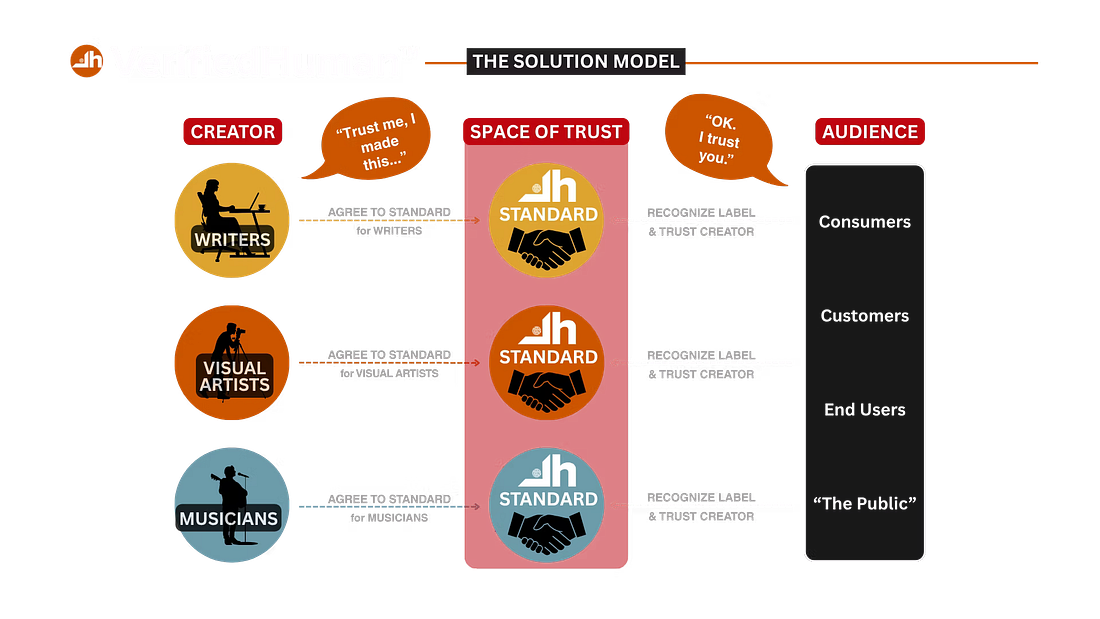 |
I expected the process to examine the work before issuing the mark. Instead, creators receive immediate access to the certification marks after joining and agreeing to the standard. No work is independently reviewed as part of that initial process.
A creator completes a short questionnaire (I signed up to see what it asked) and represents that qualifying work meets the requirements. The mark initially communicates that declaration.
VerifiedHuman describes its system as “trust-based, process-driven approach rather than automated detection or probabilistic analysis.” That disclosure matters because some of the language surrounding the mark suggests something stronger.
How Does VerifiedHuman Classify Human And AI Involvement?
VerifiedHuman bases its framework on a five-level classification system.
The organization argues that asking whether someone “used AI” no longer tells us enough. A writer may use AI to brainstorm, organize research, create an outline, draft passages, or produce an entire article. Treating every use as equivalent conceals what the writer contributed.
The Human-AI Collaborative Spectrum defines five levels:
👉🏾 VH5 covers work created entirely by a person without generative AI contributing to the ideas, drafting, or production.
👉🏾 VH4 allows generative AI to assist with research, outlining, brainstorming, and similar supporting tasks, while the creator produces the work.
👉🏾 VH3 allows AI to generate raw material, including drafts and passages, provided the creator substantially transforms it through their own voice, structure, perspective, and editorial decisions.
👉🏾 VH2 describes work largely generated by AI and then directed, selected, or lightly edited by a person.
👉🏾 VH1 covers work generated by AI with little human involvement beyond prompting and accepting the result.
Work classified as VH3, VH4, or VH5 may carry the VerifiedHuman mark. Work at VH2 or VH1 may not.
The boundary falls between transformation and editing. It asks who controlled the resulting work and what that person contributed.
What Work Qualifies For The VerifiedHuman Mark?
The site illustrates the difference between VH3 and VH2 with two writing scenarios.
In its VH3 scenario (which is above the threshold and qualifies the creator to use the mark), a writer begins with an AI-generated draft but rebuilds the argument, replaces generic material with original examples and analysis, and rewrites the piece in their own voice. Little of the original generated composition remains.
In its VH2 scenario (which is below the threshold and does not qualify the creator to use the mark), someone generates a complete post, makes minor changes for accuracy and tone, and publishes it. The system supplied the structure, voice, and other creative choices that define the finished piece.
Each person directed an AI tool and reviewed the result. The standard classifies the work according to how much of the generated composition survived and whether the writer imposed their own creative decisions on it.