Scientists warn that a warming Himalayas could mean more deadly hazards
͏ ‌      ͏ ‌      ͏ ‌      ͏ ‌      ͏ ‌      ͏ ‌      ͏ ‌      ͏ ‌      ͏ ‌      ͏ ‌      ͏ ‌      ͏ ‌      ͏ ‌      ͏ ‌      ͏ ‌      ͏ ‌      ͏ ‌      ͏ ‌      ͏ ‌      ͏ ‌      ͏ ‌      ͏ ‌      ͏ ‌      ͏ ‌      ͏ ‌      ͏ ‌      ͏ ‌      ͏ ‌      ͏ ‌      ͏ ‌      ͏ ‌      ͏ ‌      ͏ ‌      ͏ ‌      ͏ ‌      ͏ ‌      ͏ ‌      ͏ ‌      ͏ ‌      ͏ ‌      ͏ ‌      ͏ ‌      ͏ ‌      ͏ ‌      ͏ ‌      ͏ ‌      ͏ ‌      ͏ ‌      ͏ ‌      ͏ ‌      ͏ ‌      ͏ ‌      ͏ ‌      ͏ ‌      ͏ ‌      ͏ ‌      ͏ ‌      ͏ ‌      ͏ ‌      ͏ ‌      ͏ ‌      ͏ ‌      ͏ ‌      ͏ ‌      ͏ ‌      ͏ ‌      ͏ ‌      ͏ ‌      ͏ ‌      ͏ ‌      ͏ ‌      ͏ ‌      ͏ ‌      ͏ ‌      ͏ ‌      ͏ ‌      ͏ ‌      ͏ ‌      ͏ ‌      ͏ ‌      ͏ ‌      ͏ ‌      ͏ ‌      ͏ ‌      ͏ ‌      ͏ ‌      ͏ ‌      ͏ ‌      ͏ ‌      ͏ ‌      ͏ ‌      ͏ ‌      ͏ ‌      ͏ ‌      ͏ ‌      ͏ ‌      ͏ ‌      ͏ ‌      ͏ ‌      ͏ ‌     

What we know about the link between Nepal’s flash floods and our climate crisis | The Guardian

Support the Guardian

Fund independent journalism

Down to Earth - The Guardian
Aerial view of buildings submerged in mud after deadly flash floods
03/09/2026

What we know about the link between Nepal’s flash floods and our climate crisis

Donna Lu Donna Lu
 

At 8.37am local time last Wednesday, a huge mass of rock and ice sheared free from a mountain, sliding 1,200 metres to the valley floor in Nepal’s Langtang national park, about 60km north of the country’s capital, Kathmandu.

Horrifying images and videos soon emerged of a torrent of mud, water and debris that swept down the Lhende Khola valley at speeds approaching 150km/h. Flowing down the Lhende Khola, Bhotekoshi and Trishuli rivers that run between Tibet and Nepal, the flood water swept away homes, roads, bridges and power plants. Along the Trishuli, water levels rose by as much as nine metres in half an hour. As of the time of writing, the death toll of the disaster approached 1,000 people, with more than 4,400 on both sides of the border missing.

As the rescue effort continued – hampered by bad weather, poor access and the threat of further flooding due to two lakes that have formed after the landslide – Nepali prime minister Balendra Shah said the catastrophe was “not an ordinary” event.

Shah said on social media that “the risks we face in the Himalayan region are increasing alongside climate change … It is now time for us to strongly raise with the international community the issue of the disasters we are experiencing as a result of climate change.”

More on the scale of this disaster and what it tells us about our climate crisis, after this week’s headlines.

Essential reads

Global heating will hit at least 1.8C, UN warns, and there are ‘no good outcomes’ Global heating will hit at least 1.8C, UN warns, and there are ‘no good outcomes’
‘Supersizing before our eyes’: UN warns of record El Niño approaching ‘Supersizing before our eyes’: UN warns of record El Niño approaching
Trump’s plan to sell off a part of Yosemite is what oligarchy looks like | Rebecca Solnit Trump’s plan to sell off a part of Yosemite is what oligarchy looks like | Rebecca Solnit

In focus

People gather their belongings from their homes on to a truck in a flood-affected area.
camera The floods, triggered by a glacial collapse, devastated communities in Nepal and Tibet. Photograph: Skanda Gautam/Zuma Press Wire/Shutterstock

What caused last week’s catastrophe was not immediately clear: initial reports suggested the floods could have been caused by an earthquake in the ⁠area that triggered a landslide, while early satellite imagery suggested that a glacial collapse was to blame. Subsequent satellite analysis showed that bedrock underneath a glacier collapsed, with the landslide registering as a magnitude 5.2 seismic event.

“It seems that a massive rock face with the glacier on top of it has essentially gone,” says Adrian McCallum, a senior lecturer in geotechnical engineering at the University of the Sunshine Coast in Australia. One seismologist called the landslide “one of the largest in the last decade or two in the world”.

As Nepal’s Shah said in his statement, our environmental crisis cannot be separated from this disaster. The Himalayas – spanning Nepal, India, China, Bhutan and Pakistan – are warming twice as fast as the global average, putting the region at increased risk of avalanches, landslides and floods. The UN said in 2023 that Nepal’s mountains had lost close to one-third of their ice in just over 30 years due to global heating.

While scientists haven’t definitively linked the Lhende Khola landslide to the climate crisis, they have pointed out that rising temperatures mean permanently frozen mountain slopes are at risk of melting and destabilising.

“Increased temperatures result in increased melt, which results in increased water,” McCallum says. “Movement of water into voids within either soil or rock … destabilises what once may have been a more solid rock mass or soil environment.”

With global heating, mountainous areas are also at risk of permafrost degradation, “glacial lake outburst floods” (GLOFs), and increasingly erratic rainfall, raising flood and landslide risk.

Glacial lakes form behind natural dams as a result of glacier melt, and can cause catastrophic outburst floods if their natural dam walls are breached. More than 12,000 deaths have been attributed to such floods globally.

Given the risks to downstream communities in the Himalayas, scientists have pointed to the need for early warning systems, which would require coordinated international monitoring efforts.

“Wherever the glaciers are receding … you have the potential for a GLOF to occur,” McCallum says, such as in the European Alps and the South American Andes. In North America, an outburst flood causes periodic problems in Juneau, the capital of Alaska.

To be clear, there was no GLOF involved in last week’s landslide. But Nepal has more than 2,000 glacial lakes, and 21 of those, according to the UN, are considered potentially dangerous.

As climate academic Bill McGuire wrote for the Guardian this week, global heating will “leave no part of the planet untouched. As the world processes the horror of the events in Nepal and Tibet, it is a lesson that we ignore at our peril.”

Read more:
What the floods tell us about the future of India’s Himalayas | This Is India

Nepal’s glacial collapse foreshadowed a future of climate disaster | Michael Mann

The Nepal floods seem a world away – but climate breakdown will affect us all | Nesrine Malik

Composted reads

The good news

How a South African town cleaned up its polluted river using stones, wood and sand How a South African town cleaned up its polluted river using stones, wood and sand
‘Breakthrough’ as Turkmenistan starts fixing ‘mindboggling’ methane mega-leaks ‘Breakthrough’ as Turkmenistan starts fixing ‘mindboggling’ methane mega-leaks
The chefs turning down the heat by switching from gas to electric The chefs turning down the heat by switching from gas to electric

The bad news

Almost half of world’s farmers poisoned by pesticides every year, experts find Almost half of world’s farmers poisoned by pesticides every year, experts find
‘Sad moments ahead’: Kew Gardens to fell rare trees in race to save Victorian greenhouse ‘Sad moments ahead’: Kew Gardens to fell rare trees in race to save Victorian greenhouse
‘They take the water, the springs dry up’: fear as Guatemalan goldmine plan is revived ‘They take the water, the springs dry up’: fear as Guatemalan goldmine plan is revived
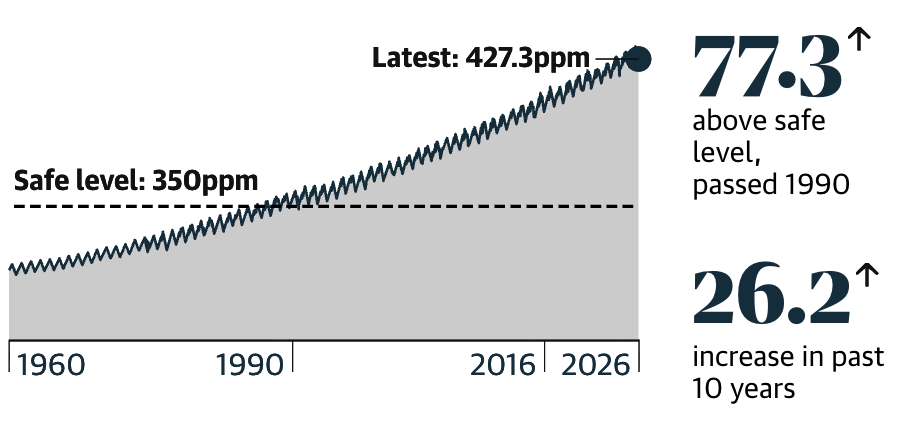
The most important number of the climate crisis:
427.3
Atmospheric CO2 in parts per million, 31 August 2026
Source: NOAA

The Guardian’s climate forum 2026

On Tuesday 20 October, join Damian Carrington, and our panel of experts – including Prof Andy Haines, Katie White MP, Asad Rehman, Shruti Suresh Gareth Thomas and Amy Fairman – for a hopeful and solutions-focused evening.
Book tickets here or at guardian.live

The change I made – Switch to eco-friendly detergent

Laundry detergents.
camera Good for clothes and planet. Composite: The Guardian

Usually it’s readers suggesting these small life hacks – but sometimes we have a few of our own.

For the Filter, Jane Hoskyn “spent weeks putting capsules, sheets and liquid detergent through their paces to find the best for your clothes and the planet”. You can find all the details here, including on her very thorough methodology (there’s also a picture of her pet cat, if you still need convincing).

Let us know the positive change you’ve made in your life by replying to this newsletter, or emailing us on downtoearth@theguardian.com

Creature feature – Kākāpō

Kākāpō population tops 300 for first time in 75 years, after record breeding season.