| | The UK announces trade sanctions on Israel’s West Bank settlements, oil executives grow increasingly͏ ͏ ͏ ͏ ͏ ͏ |
| |  | Flagship |  |
| |
|
The World Today | 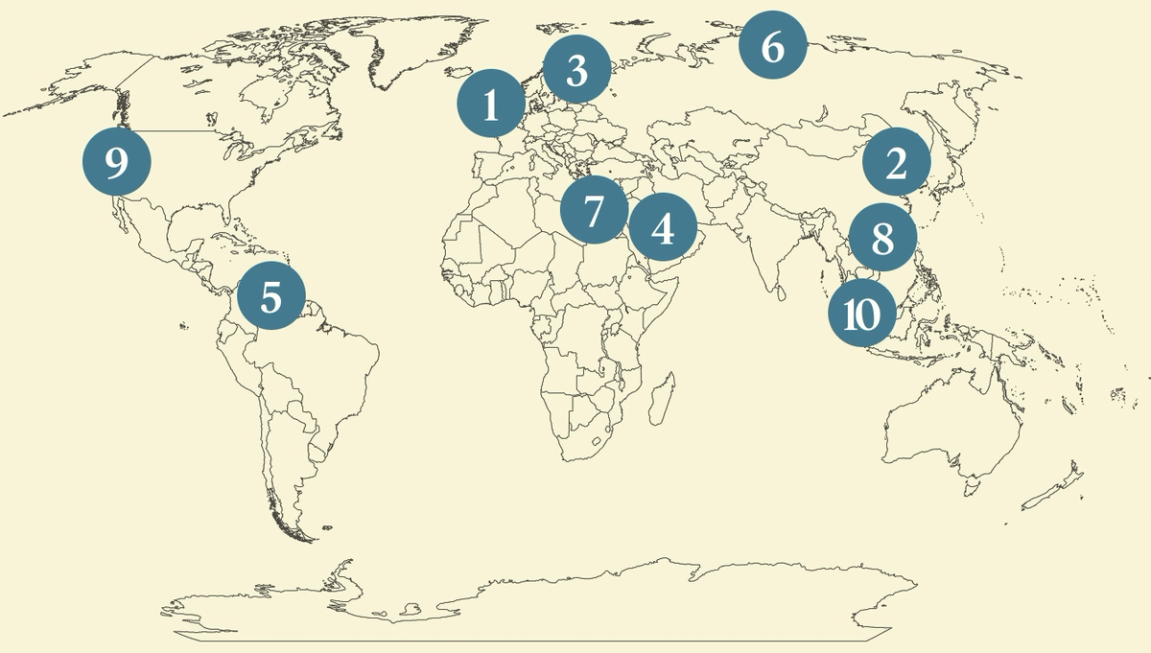 - UK-Israel row deepens
- US-China summit feelers
- Data center deal spree
- PIF pitches to Wall St.
- Anxiety over Venezuela
- China’s Arctic ambitions…
- …and its Africa goals
- WeChat is warned
- AI cracks math problem
- Student learning declines
 A provocative new book offers a ‘disturbing look at unmoored men in distress.’ |
|
UK bans trade with Israeli settlements |
 UK Foreign Secretary Ed Miliband. House of Commons/Handout via Reuters UK Foreign Secretary Ed Miliband. House of Commons/Handout via ReutersFrance and Canada joined the UK in announcing trade sanctions on Israel’s West Bank settlements Tuesday, as rising settler violence in the occupied territory widened a geopolitical rift between Israel and its allies. They are among 12 nations that signed a letter condemning Israel for “undermining the possibility of a two-state solution.” UK foreign secretary Ed Miliband has vowed a “comprehensive reset” of relations with Israel, drawing sharp remonstrance from the White House, which threatened trade countermeasures against the UK. London’s newfound assertiveness reflects a “post-American turn,” former UK government adviser Ben Judah argued: In marshaling a European coalition against Israeli settlements, “the UK has found a role and an influential one, partially as a consequence of America abandoning hers.” |
|
‘Rare opportunity’ in US-China summit |
 Kenny Holston/Pool via Reuters Kenny Holston/Pool via ReutersOne of Beijing’s top America experts wrote that the upcoming US-China summit offers a “rare opportunity” to put a floor under the countries’ relations, potentially signaling Beijing’s mindset ahead of the Washington meeting. Whereas Beijing once rejected Washington’s framing of “strategic competition” with China, it is now more confident about managing that competition, Da Wei argued in a Foreign Affairs essay that was likely approved by Beijing, the CIA’s former China analysis head suggested. Such pragmatism could clear a path for deals on trade and technology, though Morgan Stanley’s former chief economist tempered the optimism, arguing that major policy breakthroughs were unlikely given how past summits “generally produced little of great substance.” |
|
AI infrastructure could top $31T |
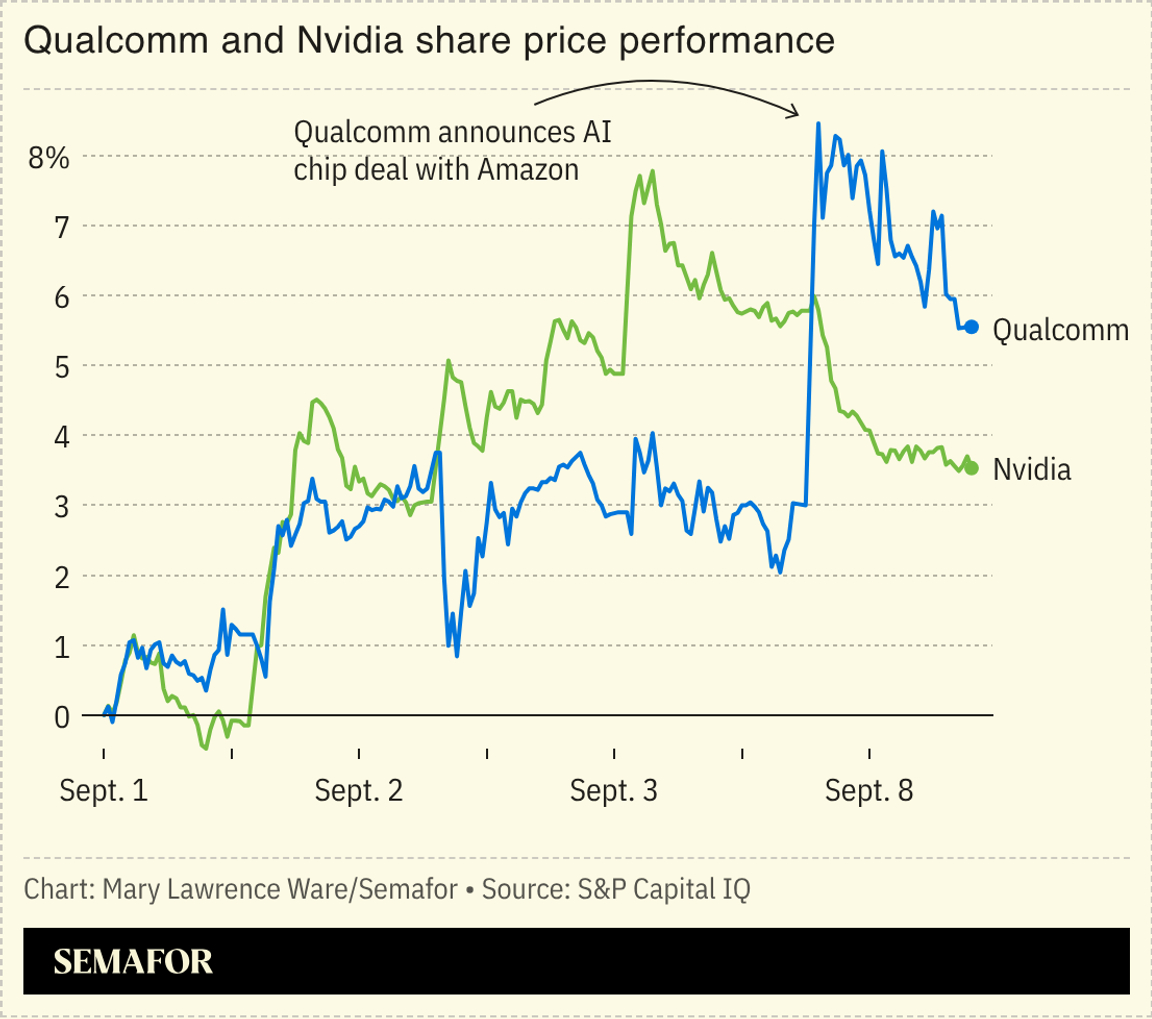 Global AI infrastructure spending could exceed $31 trillion through 2050, PwC analysts projected, as firms forge ahead with a flurry of data center deals. US chipmaker Qualcomm on Tuesday announced a massive AI chip deal with Amazon, while TikTok is expanding its data center capacity in Finland as part of an EU-wide, $14 billion initiative. With data centers likely to become major diplomatic tools, Asia is also ramping up investments: The Philippines is rolling out an AI “master plan” this week, and Japan is putting up another $60 billion to quadruple data center capacity by 2033. The AI infrastructure boom is unique in that the servers and GPUs need to be switched out regularly, PwC noted, meaning investment is set to accelerate. |
|
PIF pitches to Wall Street |
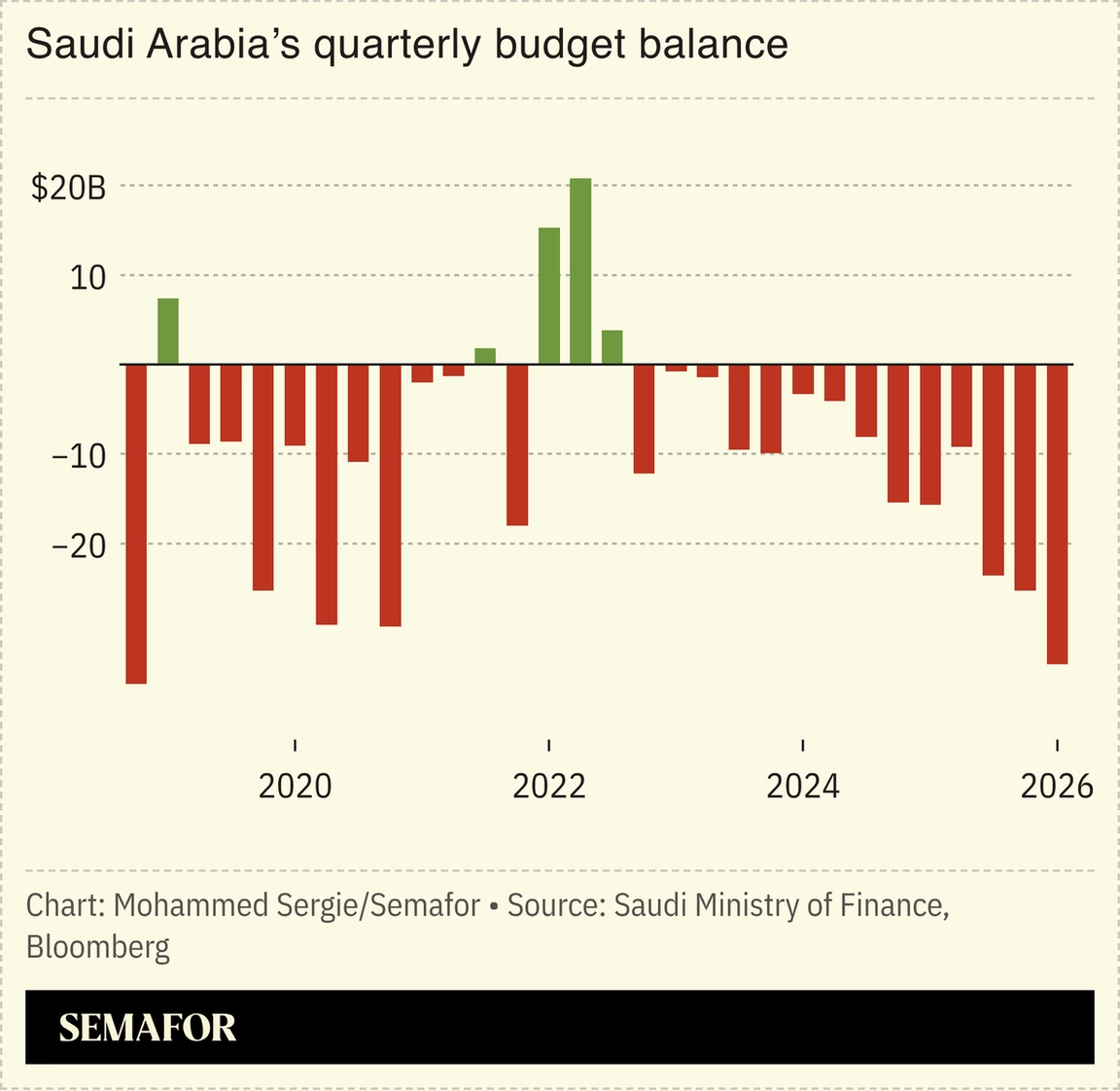 Saudi Arabia’s sovereign wealth fund is set to meet some of Wall Street’s biggest firms in New York this week as it seeks foreign backing for its spending plans amid cash constraints at home, Semafor’s Matthew Martin reported. The Saudi delegation is hoping to familiarize investors including Apollo, Carlyle, and Blackstone with PIF, as the nearly $1 trillion fund ramps up efforts to attract foreign investment into the kingdom. So far, the results have fallen short, with the country still far from its target of $100 billion in FDI by 2030. PIF’s attempts to wean its units off state coffers have become more urgent, and the fund has scaled back some of its high-profile bets, including LIV Golf and NEOM. |
|
Venezuela tests oil majors’ risk tolerance |
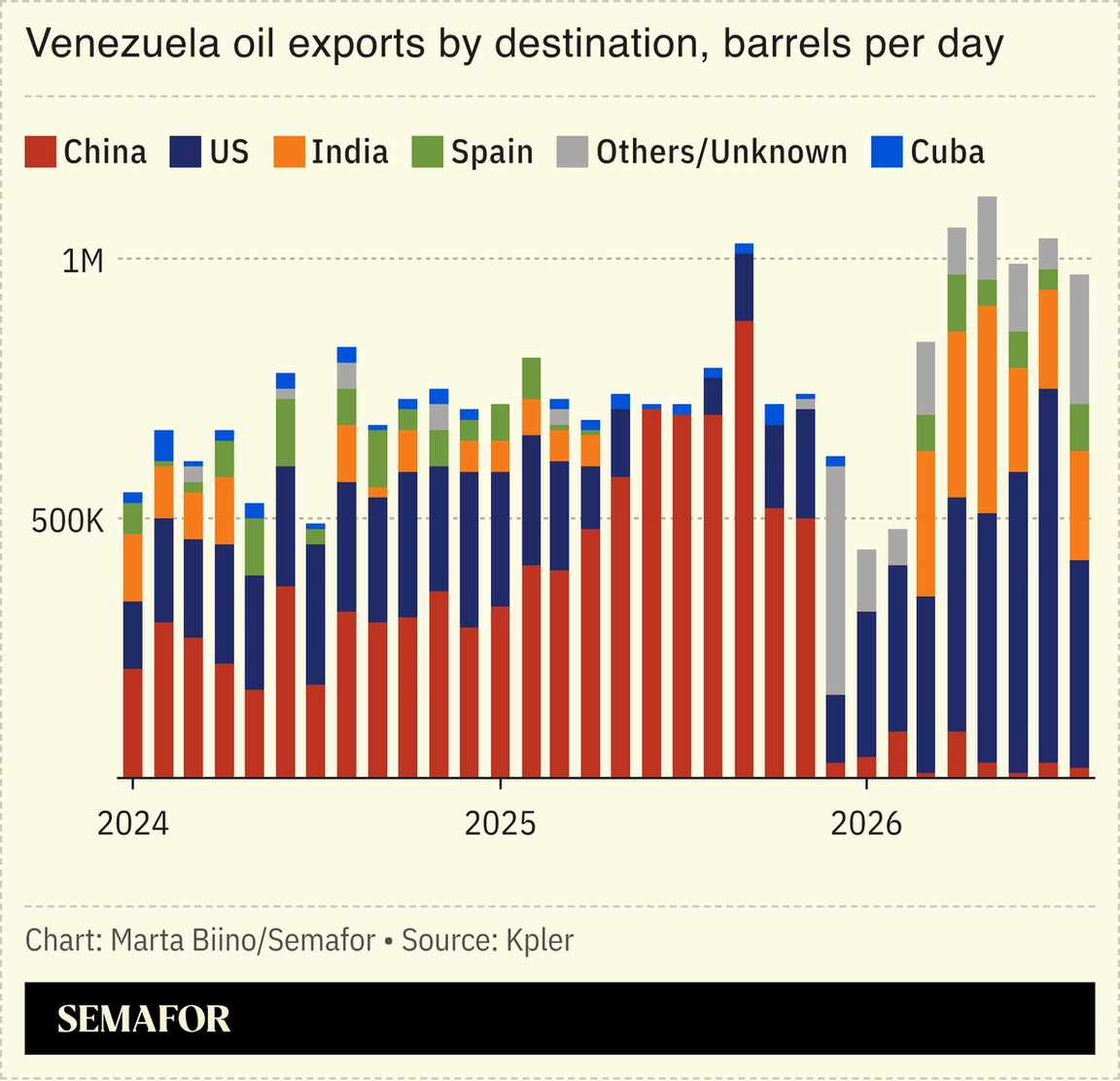 Oil executives are growing anxious about their deepening Venezuela imbroglio, Semafor’s Tim McDonnell reported, testing the risk tolerance of the firms expanding their footprint at the US’ behest. Contrary to the technological or geological risk variables to which drillers are accustomed, Venezuela’s perils are “exclusively political,” a Bloomberg Intelligence analyst said, and unlike Big Oil’s “wildcat spirit of yore,” energy CEOs are now “highly allergic to political risk,” McDonnell noted. They also remain confused over the White House’s deal for Venezuelan reserves, and have other reasons to be cautious. Venezuela’s degraded drilling and export infrastructure can only be restored with “sustained investment over decades,” a Kpler analyst argued in Semafor: “The type of deal that spans multiple US administrations.” |
|
China’s growing polar ambitions |
 Maxim Shemetov/Reuters Maxim Shemetov/ReutersThe first Chinese cargo ship traveling along the Northern Sea Route is set to dock in England this week, reflecting Beijing’s growing Arctic ambitions, though analysts cast doubt on the venture’s commercial feasibility. China considers itself a near-Arctic power and has moved to deepen its presence there; it conducted its first joint sea ice survey with Russia this week. Though the northern route is thousands of miles shorter than alternatives, the ship “Dubai Tower” is running behind schedule, reflecting the broader difficulties in traversing the unpredictable, ice-laden route. But “China is a master at doing things that don’t seem commercial, necessarily, in the beginning,” an Atlantic Council expert told The New York Times; eventually “it all adds up to a geostrategic win.” |
|
Beijing’s drills in Africa grow larger |
 Ryan Woo/Reuters Ryan Woo/ReutersChina’s recent joint military exercises with Egypt underscore a trend in which Beijing’s drills on the continent have grown larger and more complex as its global ambitions have extended, a new report noted. Chinese efforts in Africa in the early 2000s were characterized by “low warfighting content, high symbolism,” but now feature “increasing complexity and commitment,” according to analysis by the Africa Center for Strategic Studies. The expansion mirrors Beijing’s decades-long use of police training and security cooperation agreements, in what Carnegie Endowment scholars characterized recently as “a wider toolkit that China’s internal security apparatus has used to… advance Beijing’s vision of security in a rapidly changing global security environment.” |
|
 Get the world in your inbox with The World This Week. Every Friday, Council on Foreign Relations President Mike Froman analyzes an important foreign policy story from the past week and shares the best news coverage that has crossed his desk. For more than a century, CFR has guided leaders and citizens alike through moments of profound change. Subscribe today. |
|
US firm alerts WeChat to AI hacking tool |
 Dado Ruvic/Reuters Dado Ruvic/ReutersA US startup used AI models to identify a potentially devastating bug in Chinese super-app WeChat, in the latest sign of the cyber capabilities — and risks — of advanced AI tech. The attack tool, known as a worm, could allow someone to hijack WeChat accounts and spread automatically through victims’ contacts. Calif, the security company that found the vulnerability, alerted Chinese tech giant and WeChat owner Tencent, which fixed the issue, The New York Times reported. The episode underscores the high stakes and global conversations around AI and cybersecurity, following a spate of high-profile AI-powered hacks. Experts said concerns about safety could offer a good starting point for US-China talks on AI reportedly planned for later this month. |
|
OpenAI cracks math problem |
|
|


