| | In today’s edition: Israeli PM Netanyahu causes another Abu Dhabi kerfuffle, Qatar’s deficit deepens͏ ͏ ͏ ͏ ͏ ͏ |
| |  | Gulf |  |
| |
|
 - Another escalation
- PIF takes pitch to Wall Street
- Qatar’s budget deficit widens
- Abu Dhabi lures AI investors
- Saudi nuclear oversight details
 Riders up for camel-racing season. |
|
Netanyahu’s Abu Dhabi rift |
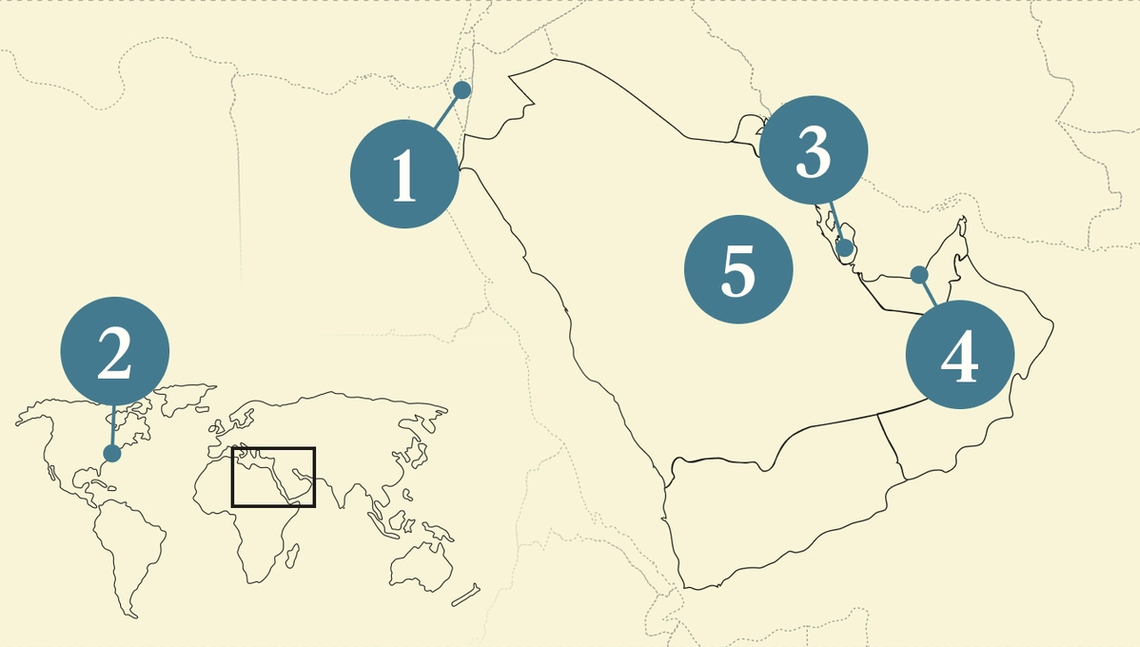
 Ammar Awad/Reuters Ammar Awad/ReutersIn May, discord between Abu Dhabi and Israeli Prime Minister Benjamin Netanyahu surfaced when he said he had secretly visited the UAE during the war and secured a “historic breakthrough” with President Sheikh Mohamed bin Zayed. The UAE denied the “alleged visit.” This week’s bombshell report by Israeli journalists that Sheikh Mohamed personally warned Netanyahu about the Oct. 7 attack in advance of the Hamas offensive, and that the Israeli leader did nothing, didn’t get a clear response from Abu Dhabi. The UAE foreign ministry declined to “comment on reports or speculations” and said “all relevant intelligence information continues to be exchanged between the concerned parties.” The rift with Israel’s most prominent Arab security partner comes amid a heated Israeli election, where Netanyahu rival Yair Lapid has been greeted more warmly by Abu Dhabi. Still, electoral politics haven’t weakened the Abraham Accords: The UAE has consistently criticized Netanyahu’s far-right government while deepening defense coordination with the US and Israel during the Iran war. Meanwhile, the region’s wars are intensifying. Iran fired ballistic missiles at US forces in Jordan and attacked ships in the Strait of Hormuz after the US destroyed five Iranian oil tankers; Tehran also threatened tankers near Bahrain and Kuwait. Saudi Arabia’s conflict with Yemen’s Houthis is heating up, too: Saudi warplanes conducted strikes in Houthi-controlled areas after the Iran-linked group attacked the kingdom on Tuesday. — Mohammed Sergie |
|
 Andrew Kelly/Reuters; Courtesy of PIF; Elizabeth Frantz/Reuters Andrew Kelly/Reuters; Courtesy of PIF; Elizabeth Frantz/ReutersSaudi Arabia’s Public Investment Fund is set to meet some of Wall Street’s biggest firms in New York this week, seeking foreign backing as it navigates cash constraints at home. PIF’s senior management, along with representatives of some of its biggest portfolio companies, will hold talks with Apollo, Blackstone, Brookfield, Carlyle, KKR, and Stonepeak, as well as the US Export-Import Bank. Investment bankers from Lazard are brokering the meetings, which aren’t fundraising for a specific project but rather laying the groundwork for the future, people familiar with the matter said. Weaning PIF units off state coffers has become more urgent given the slow uptick of foreign direct investment into Saudi Arabia and runaway spending at several PIF companies. Some high-profile bets such as NEOM have been drastically scaled back as a result. Other investments have made more progress. HUMAIN has signed partnerships with several US tech firms and says it is already attracting external financing for its data centers, though its CEO acknowledged to Semafor he was seeking to reduce reliance on PIF financing. — Matthew Martin |
|
War blows hole in Qatar budget |
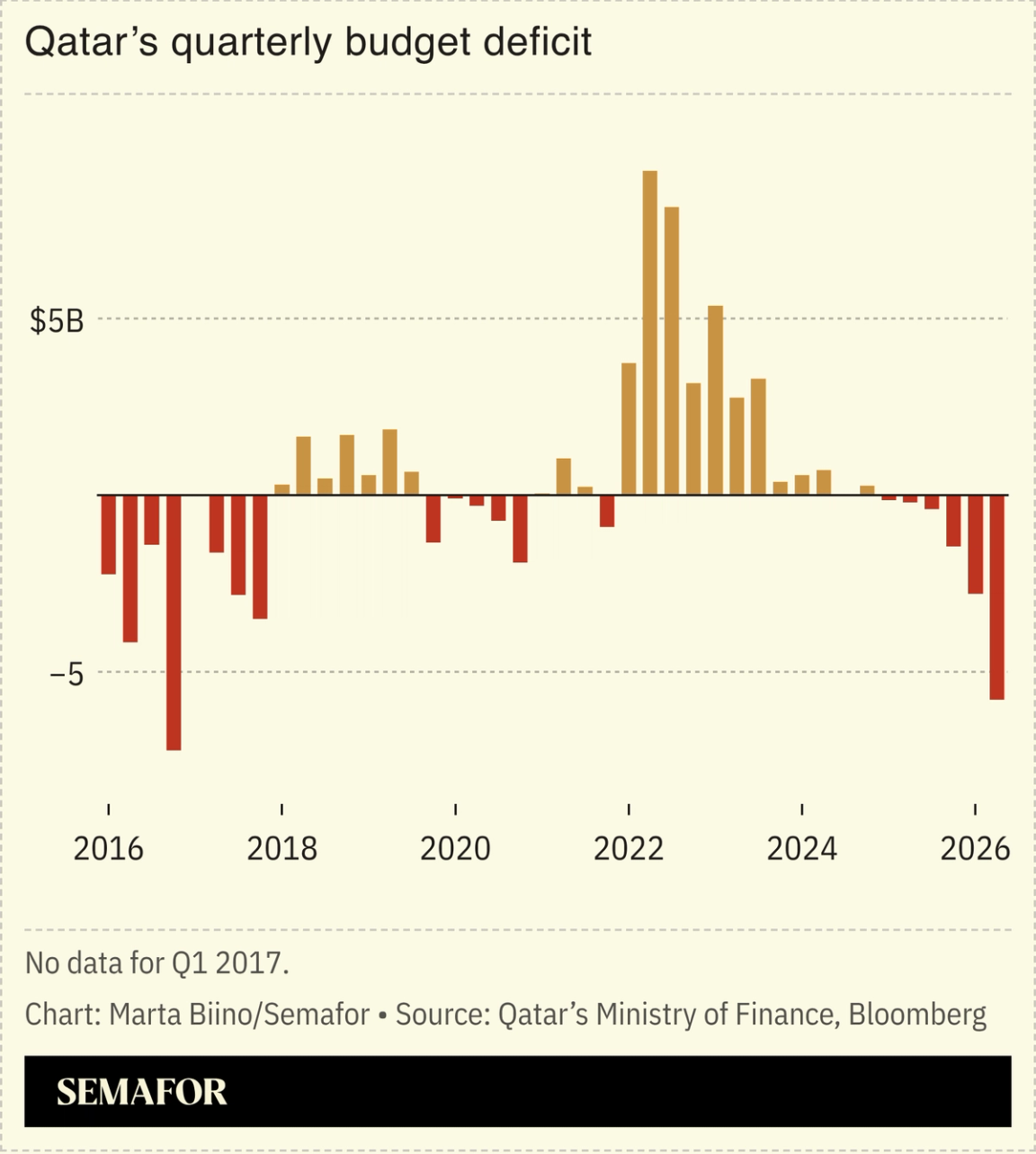 Qatar posted its widest quarterly budget deficit since 2016 as the Iran war choked off most of its liquefied natural gas exports through the Strait of Hormuz. The 21.2 billion-riyal ($5.8 billion) second-quarter shortfall was almost double the previous quarter’s, and there are few signs that passage through the strait is easing. Still, several Qatari LNG tankers are heading toward the Gulf, which suggests there are expectations that shipments could resume soon, Bloomberg reported. The country, one of the world’s wealthiest on a per-capita basis, has accumulated sovereign assets that are more than double its GDP. This buffer, along with relatively low government debt, led Fitch Ratings to affirm Qatar’s AA sovereign rating last week, while keeping its outlook “negative” because of the prolonged disruption to exports through Hormuz. — Mohammed Sergie |
|
Abu Dhabi counts AI money |
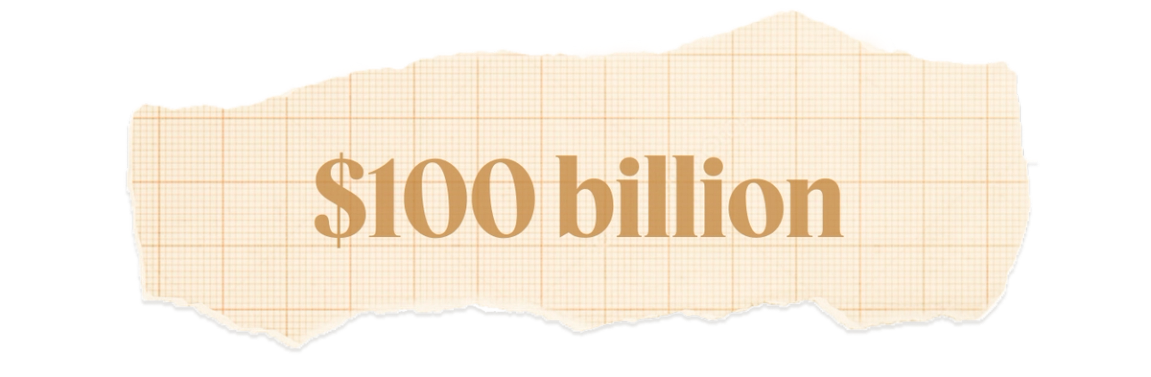 Abu Dhabi’s financial hub ADGM says entities licensed there now hold more than $100 billion in AI-focused investment, as it looks to draw more fund managers by dangling proximity to the UAE capital’s prodigious coffers and appetite for cutting-edge technology. Abu Dhabi tech vehicle MGX — which closed its first fund in July at $49 billion — is the largest, according to ADGM. The white-collar worker hub grew 34% to around a headcount of 50,000, as assets under management rose 54% year-on-year. Bain Capital, Blue Owl Capital, and Man Group are among the firms to expand in the financial center so far this year. To meet rising demand for offices, a massive expansion of ADGM is underway, on the scale of the Hudson Yards development in New York City, spearheaded by Aldar and Mubadala and costing 60 billion dirhams ($16.3 billion). |
|
Probing Saudi nuclear ambitions |
 Jessica Koscielniak/Reuters Jessica Koscielniak/ReutersSaudi Arabia may give the UN nuclear watchdog greater inspection powers as part of its attempts to get a nuclear deal with the US approved and head off criticism that the agreement does not sufficiently limit proliferation risks. The Saudi-US nuclear deal is expected to allow the kingdom to enrich uranium to nearly 20%, according to documents sent to US lawmakers, The Wall Street Journal reported, raising concerns that nuclear material could be diverted for military uses. Saudi officials are negotiating a bilateral deal with the International Atomic Energy Agency that would include additional obligations for monitoring and verification. The Saudi-US deal would favor American firms over Chinese and Russian competitors, but is less restrictive in other areas. Saudi Arabia has not signed up to the “Additional Protocol” that grants IAEA inspectors sweeping access. Iran had implemented that protocol under its 2015 nuclear deal. — Matthew Martin |
|
 Checking In- Dubai is chipping away at immigration queues by bringing the counter to the passenger. Its airports launched “Click and Travel,” a handheld device that lets officers verify passports by scanning faces and irises in seconds. More than 31,000 travelers used it in trials, and it joins smart gates and other technology that clears passengers in as little as six seconds.
- The wizarding world is coming to Abu Dhabi: Warner Bros World is adding three Harry Potter lands recreating Hogwarts, Diagon Alley, and the Forbidden Forest by 2029. Yas Island is stacking up entertainment giants, with a Disney park and a Sphere venue also on the way. — The National
Real Estate- Dubai Sotheby’s International Realty is facing a 439 million dirham ($119.5 million) lawsuit from Luxhabitat, its former ally-turned-rival, which claims the brokerage hid revenue through another entity to dodge a profit-sharing deal. The Sotheby franchise denies the claims; staff at its UK arm accused the owner of misconduct earlier this year. — Bloomberg
Space- International Holding Company, the Abu Dhabi conglomerate controlled by the emirate’s Deputy Ruler Sheikh Tahnoon bin Zayed, is buying an 80% stake in UAE-based space and technology investor Marlan Holding. Marlan’s portfolio spans space systems, autonomous devices, and AI, and the company is also building commercial satellites.
|
|
 Johannes Sadek/Reuters Johannes Sadek/ReutersCamel-racing season is underway in Saudi Arabia, where the ancient Bedouin sport is evolving: first came robot jockeys … and then women. The eighth Crown Prince Camel Festival is running through Sept. 13 at Taif, with 248 races and more than 50 million riyals ($13.3 million) in prize money on the table. Robot jockeys, introduced in 2005, are controlled by trainers who race alongside in trucks with remotes that work the whips, and shouting through speakers for the camels to hear their trainers’ voices. Women waited longer, left out of the men-only terrain until 2021. To the shock (and horror) of their ancestors, they are now in the hunt, going from tending the herds to winning trophies last year. — Manal Albarakati |
|
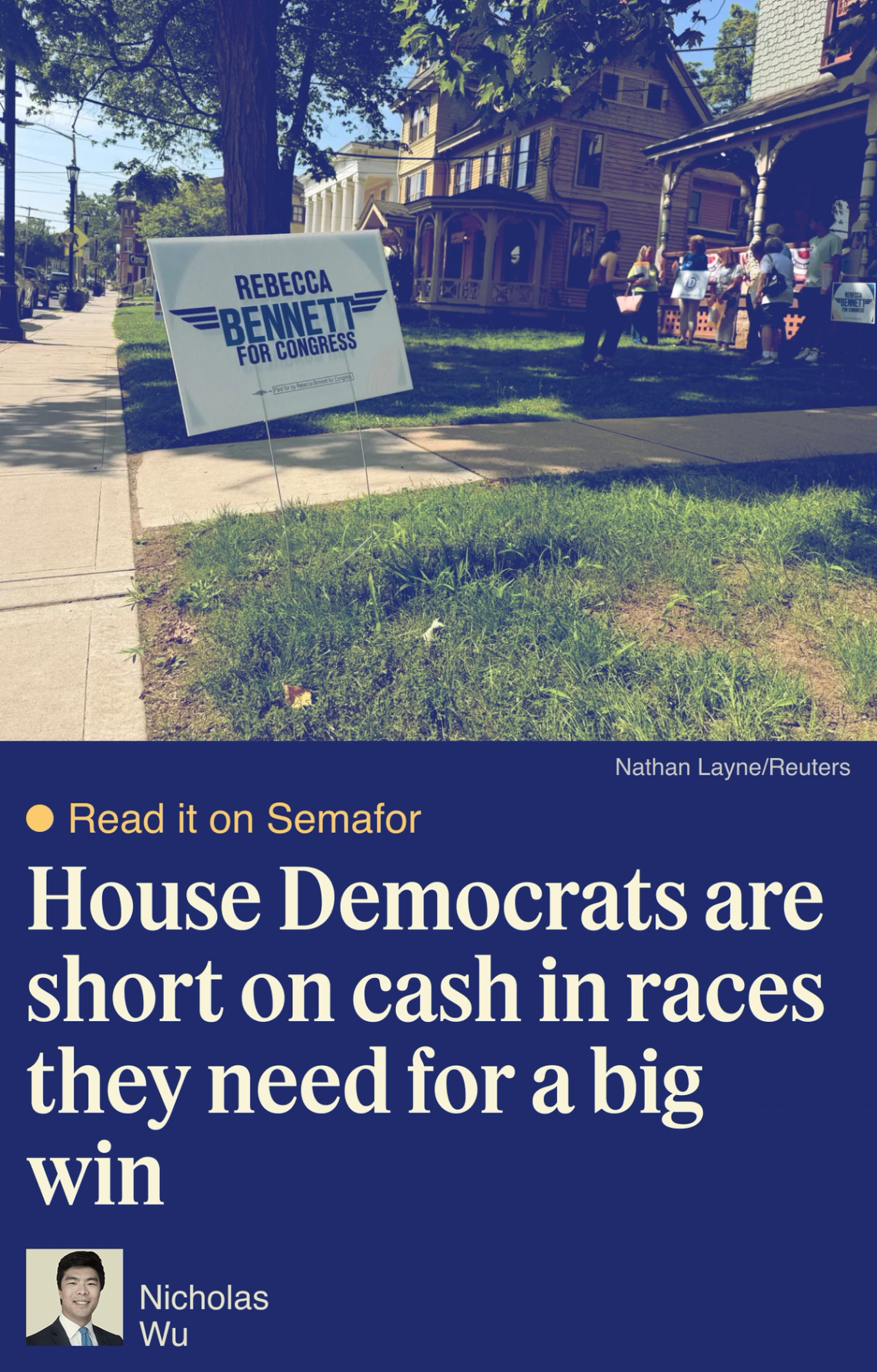 The News: The Democrats’ battle for the US House is exposing a divide between flush battleground hopefuls and lesser-known challengers whose fundraising is struggling to keep up with Republicans. → |
|
|
| |  | | | You’re receiving this email because you signed up for briefings from Semafor. |
|


