| | In this edition: South Africa’s GDP shrinks, Nigeria’s trade surplus doubles, and Kenya’s foreign tr͏ ͏ ͏ ͏ ͏ ͏ |
| |  | Africa |  |
| |
|
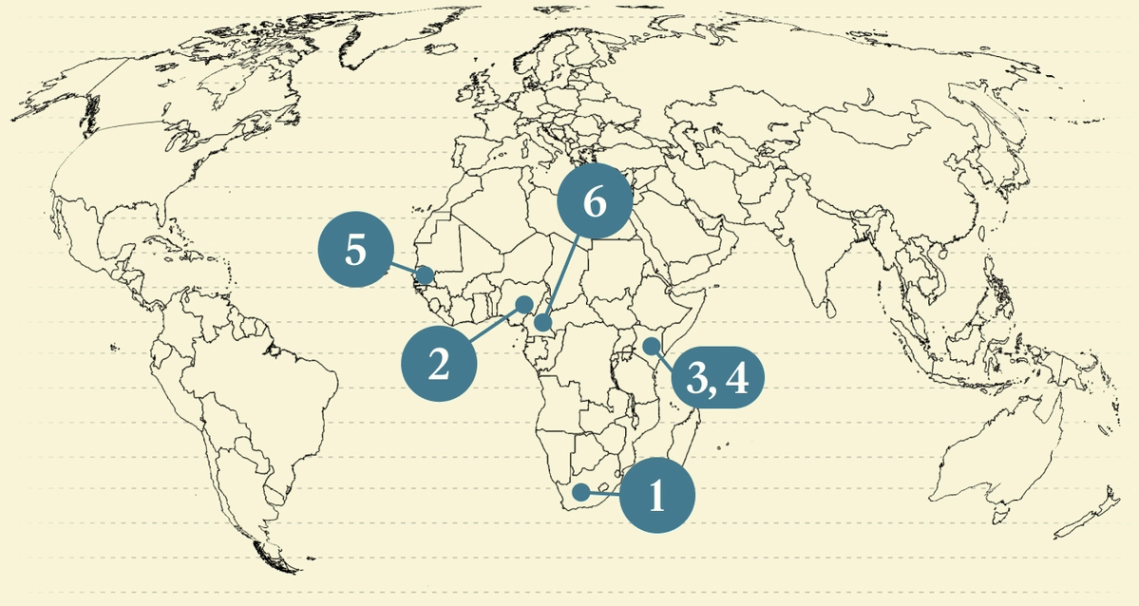 - S. Africa’s GDP shrinks
- Nigeria’s trade surplus grows
- Refinery faces crude challenge
- Foreign traders fear crackdown
- Senegal plans to reprofile debt
- Fund eyes ambitious goal
 The first African company to locally produce a sickle cell treatment. |
|
South Africa’s GDP shrinks in Q2 |
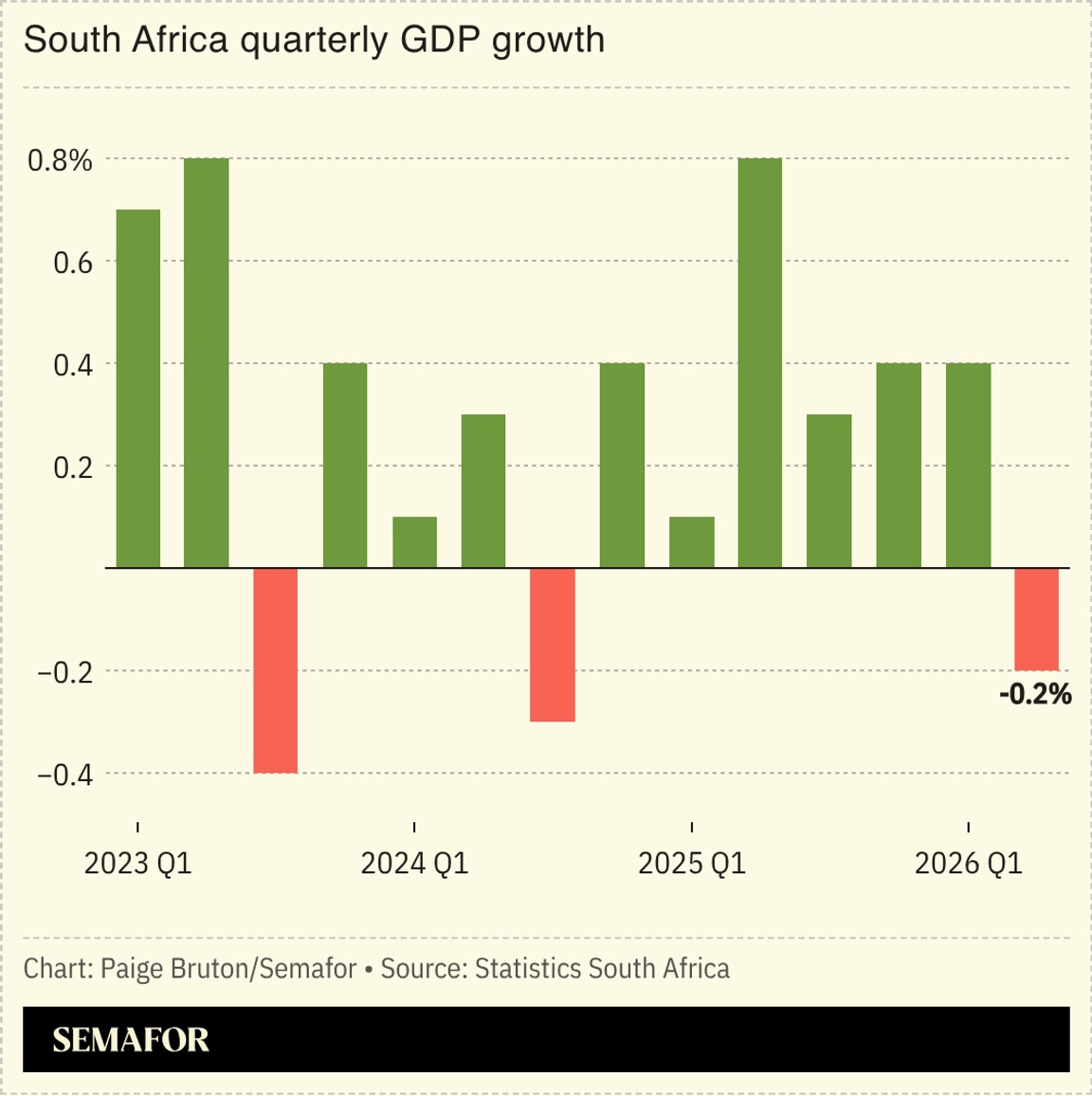 South Africa’s GDP shrank in the second quarter of this year, as the impact of the Iran war ended an 18-month period of growth in Africa’s biggest economy. Weakened demand and higher fuel prices, caused by the blockade in the Strait of Hormuz, weighed on the mining, trade, and manufacturing sectors. The 0.2% contraction marks the end of the steady economic recovery that followed the formation of the coalition government two years ago, prompting Goldman Sachs to revise down its 2026 growth forecast to 1.2% from 1.6%. South Africa’s central bank, which raised its main interest rate in May to forestall the war’s inflationary impact, is due to hold its latest rate-setting meeting this month. Capital Economics said the bank’s tightening cycle is “most definitely over.” The economic slowdown, combined with unemployment hitting a four-year high, has in recent months sparked a resurgence of anti-migrant rhetoric and vigilante violence targeting Africans who were accused of taking jobs and overloading public services. The discontent comes ahead of municipal elections in November. — Alexis Akwagyiram |
|
Nigeria’s trade surplus doubles in Q2 |
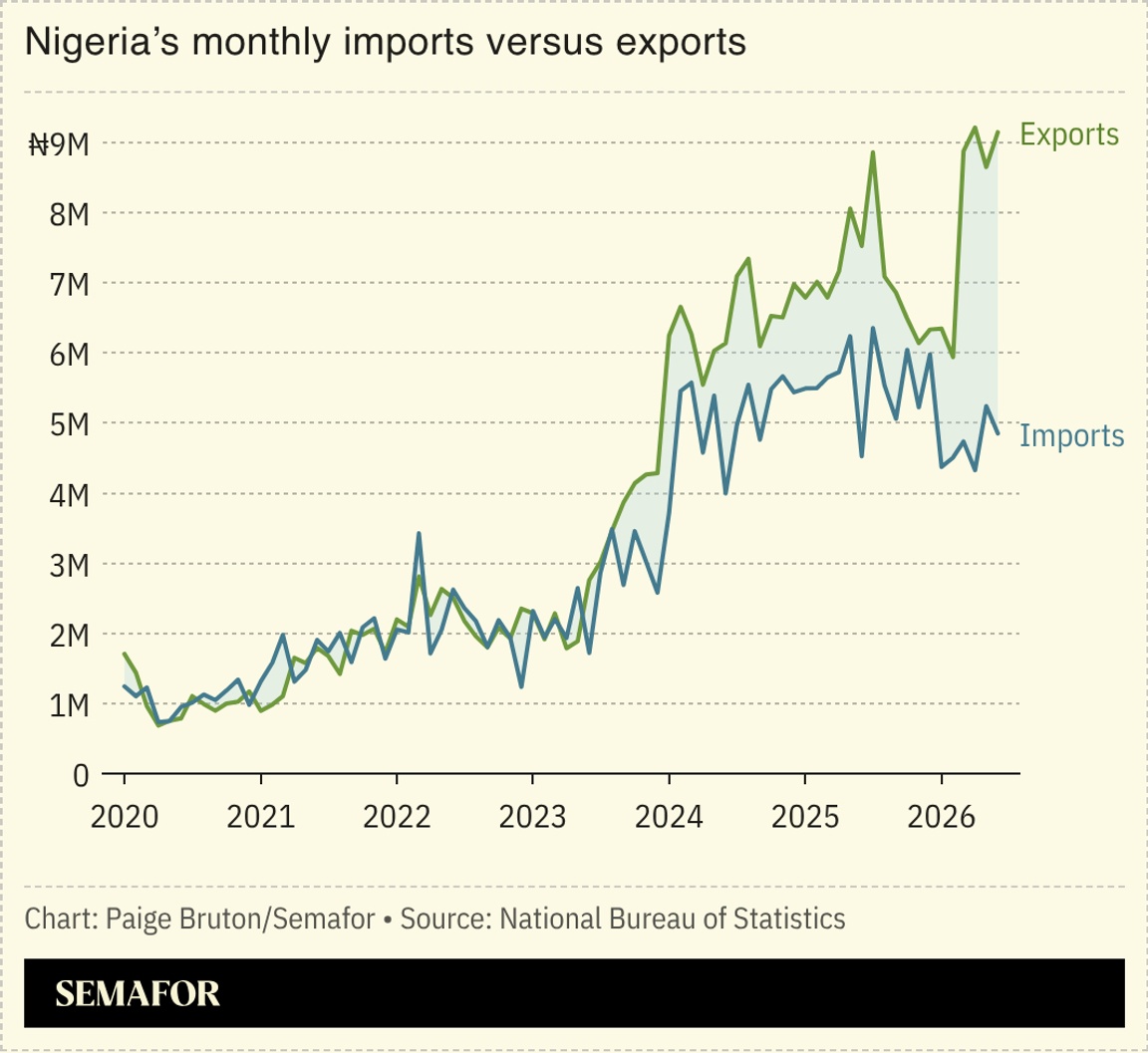 Nigeria’s trade surplus grew to $9.5 billion in the second quarter, doubling in size compared with the same period last year, the government’s statistics agency said. The shift was driven by a fall in fuel imports and a rise in the exports of crude oil and raw materials. Higher oil prices as a result of the Iran war and increased exports have also helped drive broad economic growth, with Nigerian GDP expanding 4.43% year-on-year in the second quarter, the fastest pace in five years. The trade data points to the impact of the Dangote Refinery, which began operating at full capacity this year, after initially coming online in September 2024. Enhanced domestic refining capacity has reduced Africa’s biggest crude oil producer’s longstanding dependence on fuel imports, and that capacity is set to increase further with Dangote’s plans to double output to 1.4 million barrels per day. Nigeria still maintains a sizable fuel import bill, however, as the downstream oil sector’s regulator insists that imports are necessary for local competition. — Alexander Onukwue |
|
Dangote’s faces Kenya refinery hurdles |
 Sodiq Adelakun/Reuters Sodiq Adelakun/ReutersAs the Dangote Group nears the opening bell for its Nigerian refinery’s IPO, plans to build a similar plant in Kenya are under the spotlight because of an array of potential challenges. The massive refinery in Lagos state has sourced crude oil from within Nigeria as well as international markets. But it remains unclear where the planned refinery in Lamu, which Dangote aims to complete by 2030, will secure its feedstock from: Kenya imports nearly all of its oil from the Middle East. A Dangote Industries executive told Reuters that the company does not foresee challenges with securing crude for the project. Meanwhile, fundraising for the $16 billion Kenya project “could become a formidable challenge,” an analyst said, given Dangote’s concurrent plans to double the Lagos refinery’s capacity. But Aliko Dangote, the billionaire tycoon behind the refineries, has benefited from the global diesel refining crunch since the US-Iran war started, telling Bloomberg he felt “extremely bullish” about margins over the medium term. |
|
Kenya’s foreign trader crackdown |
 Monicah Mwangi/Reuters Monicah Mwangi/ReutersKenya’s crackdown on foreign hawkers and small-scale traders has exposed a tension in President William Ruto’s economic agenda in trying to protect jobs for Kenyans while keeping the country open to foreign capital and regional trade. Hundreds of Burundians have sought help leaving Kenya after Ruto ordered authorities to shut down businesses operated by foreigners, prompting fears of harassment and xenophobia. “We will go home but this is very unfair to us,” one Burundian street trader told Semafor. “These jobs we do, no Kenyan wants to do them.” The government has offered undocumented East Africans 90 days to regularize their status. But the move comes days after Ruto ordered India’s Tata Chemicals to leave Kenya, suggesting a broader “local benefit” agenda. Critics see echoes of the anti-migrant populism seen elsewhere, with Ruto facing a tough re-election campaign in August 2027. — Vivianne Wandera |
|
Senegal seeks more time to pay debt |
 Misper Apawu/Reuters Misper Apawu/ReutersSenegal will try to buy more time to pay off its debt by extending the maturity of its borrowing, its prime minister said, as the country works to qualify for an International Monetary Fund program. The plan also involves renegotiating interest rates, but would not cut the overall debt load. He said the country must clear $3.5 billion in arrears to avoid stalling economic activity and triggering job losses. The IMF and Senegal reached an agreement last week for a $2.2 billion loan package, pending final approval. The country’s finances have been under strain since the previous government failed to disclose billions in loans, pushing debt above 130% of GDP and prompting the nation to request the IMF suspend an earlier program. The crisis has fueled political turmoil: President Bassirou Diomaye Faye split with his longtime ally Ousmane Sonko this year, in part due to disagreements over how to handle the debt. |
|
Africa50 targets $20B portfolio |
 Philimon Bulawayo/Reuters Philimon Bulawayo/ReutersAfrican infrastructure investor Africa50 plans to raise the value of its portfolio to $20 billion over the next five years, an executive told Reuters. The Casablanca-based fund has backed more than 30 projects in 32 countries spread across multiple sectors, with a current combined value of about $9 billion. Africa receives only about 5% of global infrastructure investment, and the share of the continent’s annual GDP invested in infrastructure is at only half of the UN’s 7% benchmark for sustainable development, according to the continent’s private capital association. The continent’s annual infrastructure investment gap is at about $170 billion, the African Development Bank said last year. Africa50’s flagship investments include power plants in Cameroon, Kenya, and Madagascar, as well as in data center projects in Ghana and Kenya. |
|
 Business & Macro |
|
|


